




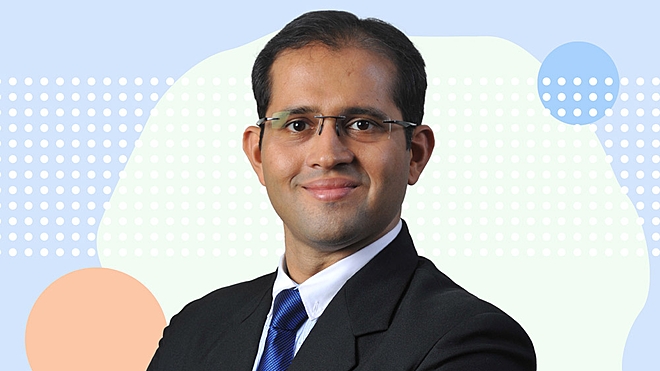

In a market where valuations seem to defy gravity, Ashish Naik, Fund Manager at Axis Mutual Fund, is steering through the noise with a steady hand. Managing assets worth over Rs 40,000 crore across four schemes, Naik is balancing caution with agility as stretched valuations and global uncertainties test even seasoned investors.
In this conversation, he shares how Axis’s funds, including the Axis ELSS (tax-saving) fund, is recalibrating their strategies by diversifying the portfolios, embracing new sectors and staying true to its growth-and-quality philosophy. Read on as Naik unpacks market dynamics, valuation risks and the fund house’s roadmap to winning back investor trust.
We're in a market where valuations across large-, mid- and small-cap segments are stretched. How are you approaching equity allocation in such an environment?
Yes, valuations remained stretched. In fact, we've seen valuations across the board expand over the last few years, primarily because we are emerging from the Covid-era. Over the last two to three years, we've seen earnings expand across the market. There have been consistent domestic inflows, something we hadn't seen much in the previous decade. These two factors, combined, have led to a situation where large caps today are closer to their five-year averages after the corrections in the last 12 months. However, mid- and small-cap stocks still trade at a significant premium, even compared to the last five years.
Overall, the market seems to be at a premium over a longer-term period. So yes, one has to be cautious about high valuations. To that extent, we have reduced equity allocations across various asset classes—in hybrid funds by around 10 per cent on average, and in other funds, there is a slightly higher cash level. Wherever possible, we've also increased exposure to large caps, reducing our weight in mid- and small-cap stocks.
The global macroeconomic backdrop is shifting rapidly, whether it be Fed policy or supply chain disruptions. What are the biggest external risks you are watching right now?
Yes, the global macro backdrop has been volatile, not just in recent months but over the past two to three years. We've seen rising geopolitical tensions, including regional wars across parts of the world, which have continued. These issues have impacted markets and contributed to volatility, particularly since we're a commodity-importing nation. Still, our domestic macro remains relatively stable. Inflation is within the RBI's target range. But what's new – and more concerning – is the rise in tariff wars, which have intensified in recent months. Every country is negotiating tariffs, and if this trend doesn't normalise, it could harm global growth. That would, in turn, impact some of our export-driven sectors and our currency.
Regarding central bank policies, although inflation was expected to taper, rate cuts by the Fed and other major central banks are now on hold, primarily due to concerns related to geopolitics and trade. If growth slows significantly, however, central banks will likely pivot again, and we are closely monitoring this development.
Do you expect earnings growth across the Nifty or broader market to justify current valuations, or is the market running ahead of fundamentals?
Valuations, as discussed earlier, have remained high and expanded in most segments. To some extent, this is justified, and in specific sectors, valuations remain reasonable. However, it's now crucial to evaluate absolute valuations in relation to what companies are worth based on their growth.
For instance, if a company that was growing at 15 per cent starts growing at 30-35 per cent, valuations may expand. But if growth moderates to 20-25 per cent, those valuations can come under pressure. Also, while inflows have continued, we're seeing rising outflows due to IPOs and other issuances. Therefore, net market flows are becoming more balanced, making it crucial to be valuation-aware and take corrective action in portfolios if there is excess.
Could you share your investment philosophy? How do you select stocks for your portfolios?
Since its inception, Axis Mutual Fund has been known as a growth- and quality-focused fund house. These remain our core investment pillars. We seek companies and management teams that can grow sustainably over the long term, with consistent cash flows and ROCEs, which enable them to navigate economic cycles effectively.
While market dynamics have changed over the last decade, we are now seeing many new sectors, particularly those linked to investments, begin to show signs of growth. Sectors that earlier didn't qualify under traditional growth and quality definitions are now being included. So yes, we continue with a growth-and-quality tilt, but our universe now includes newer sectors and companies, and we've accordingly made portfolio adjustments.
The Axis ELSS Tax Saver Fund has moved from the fourth to the second quartile in the last year. What are the key drivers of this turnaround?
The changes in this fund have been ongoing for the past two years. Earlier, the fund was more concentrated in a few large sectors. We've reduced that concentration, creating room to add new sectors and sub-sectors that contribute both to economic activity and returns. The portfolio is now more diversified, making the fund more agile and responsive to rapid market cycles. Sectors perform well for a few quarters and then correct, so agility is crucial. The growth-and-quality tilt remains, but it's now applied across a broader, more diversified portfolio.
The rebound in quality and growth-oriented stocks seems to have helped several Axis Mutual Fund's schemes. How significant was this for your fund?
The rebound in quality and growth stocks did help since that's where we already had exposure. But equally important was being nimble, diversified and selective. It's not just about style; it's about actively tracking company fundamentals and management quality. Stock selection has also played a big role. So, while macro factors helped, our proactive approach also contributed significantly.
What was the rationale for diversifying the portfolio and adding these sectors, given the earlier concentration?
Earlier, the economy – and our portfolios – were primarily driven by services and consumption. That resulted in some concentration. Post-Covid, the economic landscape has broadened. We have traditional cyclical sectors, such as capital goods, railways and defence, as well as CDMO (contract development and manufacturing organisation) within the pharmaceutical and new-age economy sectors, like quick commerce. These sectors weren't large or investable a few years ago. Now, they offer high growth potential, which is why they've found a place in our portfolios.
Axis Mutual Fund has faced a rough patch over the last few years, particularly with its growth and quality strategies underperforming. What internal reflections or strategic recalibrations took place during that period?
Growth and quality as a strategy outperformed for a very long period, especially since the inception of many of our funds. For most of the last decade, growth and quality did well. However, these strategies also go through cyclical phases, where more cyclical or higher beta names tend to outperform, often following a market downturn. That's precisely what we saw playing out.
We were comfortable with some underperformance during these phases, knowing that cyclical names were in favour. But at the same time, we reflected on changing economic realities. If newer sectors and companies with improving medium-term outlooks were emerging, they needed to be represented in the portfolio. We've made those changes, often faster in our smaller funds, due to fewer liquidity constraints. In larger funds, these adjustments have taken place more gradually.
Do you believe Axis Mutual Fund has turned a corner in terms of investor perception and performance credibility?
I've been with Axis since its inception, and one thing we've consistently maintained is that Axis stuck to its growth-and-quality philosophy. We've always aimed to identify unique, investable ideas without chasing momentum. While we may have delivered strong outperformance in certain periods, some underperformance was to be expected. That said, we've reassured our partners that we're proactively making the necessary changes.
We've brought in new fund managers, expanded our research team and broadened our stock coverage in response to a more diversified market environment. When we engaged with investors time and again, we have shown how we've adapted to renew their confidence in our approach.
Ask Value Research 
 New episodes every Friday

 New Process Alert
  Seems like you've uploaded a wrong QR code. Please upload the QR code downloaded from MF Central platform.


