 Widely read:


 AI-generated image
Rohan stared at his phone. The screen was mocking him.
Rs 2.56 lakh. That’s what his BSE Sensex-based index fund was worth after investing Rs 5,000 a month for the last three and a half years. Forty-two months of consistency. No skipped SIPs. No panic selling. Just pure, disciplined investing.
And what did he get in return? A gain of Rs 46,000.
He slumped back in his chair. “Is this what all the hype is about?”
It wasn’t a loss. On paper, he was 22 per cent (5.84 per cent CAGR) in the green. But it didn’t feel like success. Not when social media was filled with stories of people turning small SIPs into crores. Not when his friend casually mentioned getting better returns in a fixed deposit. Not when finance influencers screamed about compounding like it was a cheat code.
This wasn’t a cheat code. This felt like a cheat.
He scrolled through his investment app one more time. His thumb hovered over “Pause SIP.” That’s when he remembered the man who had convinced him to start it in the first place.
His uncle.
They hadn’t spoken in months, but in that moment, Rohan needed to hear from someone who didn’t just talk finance but had lived it.
He called.
“Still doing your SIP?” came the amused voice from the other end.
“Thinking of quitting, actually,” Rohan replied.
“Oh? Why?”
“I’ve been investing for three and a half years. Rs 5,000 every month. I’ve made a return, sure. But it’s nothing special. Just 20 per cent. I thought SIPs were supposed to create wealth.”
There was a pause. Then came a calm reply. “Let me tell you how mine started.”
His uncle’s voice took on a measured tone. “I started my SIP back in January 1995. Same amount as you — Rs 5,000 a month.”
Rohan expected to hear a fairytale of early riches. What he heard instead shook him.
“By June 1998, after three and a half years of SIPs, I had invested Rs 2.10 lakh.”
Rohan leaned in.

The graph above represents the value of a Rs 5000 SIP in the BSE Sensex index fund for the above-mentioned time periods.
“My portfolio value was just Rs 1.96 lakh. I was in the red. Down 6.5 per cent.”
“You were losing money?”
“Absolutely. And I wasn’t the only one. The market was crawling. SIPs didn’t feel magical. They felt like a monthly tax on optimism.”
Rohan was stunned. He was frustrated over a profit. His uncle had once stuck through an actual loss.
“So, what did you do?”
“I kept going.”
And then came the real punch.
“Fast forward to today,” his uncle continued. “I’ve now invested Rs 18.3 lakh through that SIP.”
Rohan could hear the faint clack of a keyboard.
“And the current value of that investment?”
A pause. Then: “Rs 1.79 crore.”
Rohan froze. Rs 1.6 crore in gains. A return of 878 per cent.
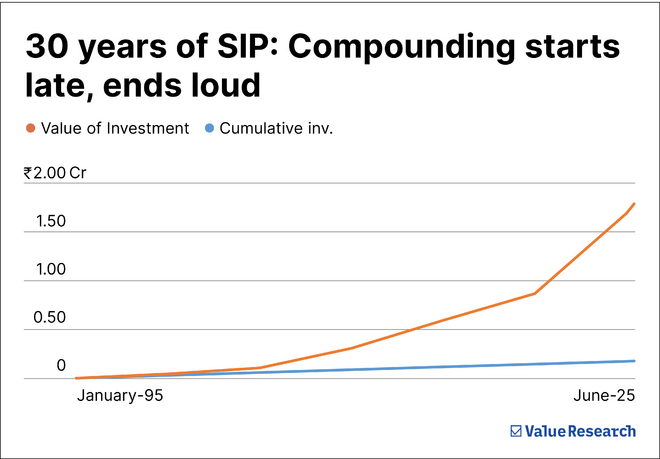
The graph shows the value of a Rs 5000 SIP wrt the BSE Sensex index fund starting from January 1995.
All from a simple SIP. No hot stocks. No timing the market. No switching funds every quarter.
Just one habit. Done quietly. Done consistently. Done long enough for compounding to stop crawling and start sprinting.
“That’s the thing most people miss,” his uncle said. “Compounding doesn’t start like a rocket. It starts like a rusted bicycle. You pedal and pedal and wonder if it’s moving at all.”
“But if you just keep pedalling, one day you look down and realise you’re flying.”
Rohan sat in silence. His 22 per cent return suddenly looked different. It wasn’t a failure. It wasn’t even average.
It was a better start than his uncle’s.
And yet, he had almost thrown it away.
That night, Rohan didn’t pause his SIP. He increased it.
Rs 7,000 a month. A small upgrade. But one made with clarity, not confusion.
He now understood that compounding wasn’t meant to impress you in the beginning. It was meant to reward you in the end.
Rohan almost walked away from a journey that had barely begun. A journey that was already ahead of where his uncle had once stood but looked too ordinary to matter.
His uncle had stayed the course through loss, through boredom, through silence. And in return, compounding had given him something extraordinary. Not just crores, but clarity. The kind of clarity that comes only to those who wait without applause.
That night, Rohan didn’t just continue his SIP. He recommitted to it. Not for the numbers, but for what they meant.
Because the real reward of compounding isn’t found in statements or screenshots.
It’s found in the quiet decision to stay in the game long after others have left.
And that’s what makes a crorepati.
Not brilliance.
Not timing.
Just time.
And the courage to let it work.
Also read: Got your bonus? Here are 8 ways you can use it like a pro
This article was originally published on June 23, 2025.
Disclaimer: This content is for information only and should not be considered investment advice or a recommendation.
For grievances: [email protected]
Ask Value Research 
 New episodes every Friday






 New Process Alert
 Seems like you've uploaded a wrong QR code. Please upload the QR code downloaded from MF Central platform.


