 Widely read:


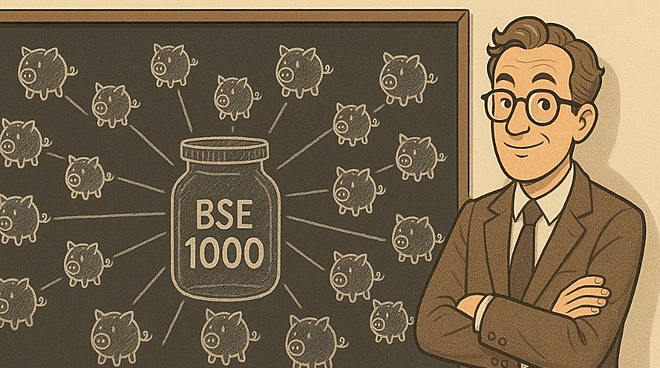 AI-generated image
Motilal Oswal has launched India’s first index fund tracking the BSE 1000 Total Return Index (TRI). This new offering aims to give investors one-stop access to the entire listed equity market, spanning everything from blue-chip large caps to tiny micro caps. The New Fund Offer (NFO) opened for subscription on June 5, 2025, and will close on June 19, 2025.
Motilal Oswal BSE 1000 Index Fund NFO snapshot
| Parameter | Details |
|---|---|
| Fund name | Motilal Oswal BSE 1000 Index Fund |
| Fund type | Open-ended index fund |
| Benchmark | BSE 1000 Total Return Index (TRI) |
| Fund managers | Swapnil Mayekar, Dishant Mehta (Equity) andRakesh Shetty (Debt) |
| Exit load | 1% if redeemed within 15 days; nil thereafter |
| Taxation | Gains taxed at 20 per cent if sold within a year. If sold after a year, gains beyond Rs 1.25 lakh are taxed at 12.5% |
What makes BSE 1000 TRI different?
The BSE 1000 TRI is designed to capture the performance of the top 1,000 listed companies in India, covering about 94 per cent of the country’s total listed market capitalisation. That makes it the most expansive passive index currently available.
Unlike narrow benchmarks such as the Nifty 50 or even the Nifty 500, the BSE 1000 reaches deeper into the market—investing in micro-cap companies as well. Micro caps refer to the smallest listed companies by market cap, often under-researched and less liquid, but with high growth potential and volatility. In this index, they occupy the 501st to 1000th rank.
The index is rebalanced semi-annually and uses free-float market cap weighting to ensure investability and liquidity.
However, while the index will invest in more companies, the actual weightings reveal a familiar story. The index seems to be large-cap heavy.
| Market segment | Weight in BSE 1000 (in %) |
|---|---|
| Large caps | 70.9% |
| Mid caps | 16.0% |
| Small caps | 8.9% |
| Micro caps | 4.2% |
| As of May 30, 2025 Source- BSE |
|
So, while the index does extend into micro caps, their influence on overall returns is limited. In fact, the bottom 100 of the index constituents depict only 0.25 per cent of its weightage. In other words, the fund continues to be dominated by large-cap names that drive most broad-based indices.
Sector and stock exposure: Little deviation
Although this new fund will invest in 1,000 stocks, the sectoral composition looks strikingly similar to the Nifty 500 and Nifty Total Market indices.
| Sector | Nifty 500 TRI (%) | Nifty Total Market TRI (%) | BSE 1000 TRI (%) |
|---|---|---|---|
| Financial Services | 31.3 | 30.5 | 29.8 |
| Information Technology | 8.6 | 8.4 | 8.4 |
| Oil, Gas & Consumables | 7.8 | 7.6 | 7.6 |
| Automobile & Auto Parts | 6.7 | 6.7 | 6.8 |
| FMCG | 6.6 | 6.5 | 6.6 |
| Total | 61.0 | 59.6 | 59.2 |
| As of May 30, 2025 | |||
And when it comes to top holdings, there’s hardly any surprise.
| Company | Nifty 500 TRI (%) | Nifty Total Market TRI (%) | BSE 1000 TRI (%) |
|---|---|---|---|
| HDFC Bank Ltd. | 7.8 | 7.5 | 7.5 |
| ICICI Bank Ltd. | 5.4 | 5.2 | 5.2 |
| Reliance Industries | 5.1 | 4.9 | 4.9 |
| Infosys Ltd. | 3.0 | 2.9 | 2.8 |
| Bharti Airtel Ltd. | 2.6 | 2.5 | 2.5 |
| Total | 23.9 | 23.0 | 22.9 |
| As of May 30, 2025 | |||
The top 10 stocks together make up around 32 per cent of the portfolio, reiterating the dominance of large caps.
Liquidity
Despite the micro-cap inclusion, liquidity doesn’t seem to be a major concern. According to the fund presentation, the average daily trading volume for the micro-cap segment alone is Rs 5,900 crore, which is sufficient to support a fund size of Rs 5,000 crore.
However, due to the large number of stocks and execution complexity, tracking error may be higher than typical large-cap index funds.
Performance
While long-term numbers are healthy, they don’t show significant outperformance over existing total-market indices.
| Index | 5-year CAGR | 10-year CAGR | 15-year CAGR |
|---|---|---|---|
| Nifty 500 Total Return Index | 25.1 | 13.9 | 13.1 |
| Nifty Total Market Total Return Index | 25.6 | 14.1 | 13.4 |
| BSE 1000 TRI | 25.8 | 14.2 | 13.6 |
| As of May 30, 2025 | |||
Returns are neck and neck. The extra micro-cap tail has not made a noticeable difference—at least so far.
Should you invest?
The Motilal Oswal BSE 1000 Index Fund offers the broadest coverage of India’s equity market in a single passive fund. But beyond the marketing pitch, its actual behaviour is likely to remain similar to BSE 500 index funds already available.
For investors already holding the BSE 500, this new fund doesn’t bring compelling additional diversification. Don’t expect a dramatic shift in performance because of the 1,000-label. In substance, this fund walks the same path as its older, narrower cousins.
Also read: Is it wise to invest in an NFO?
Disclaimer: This content is for information only and should not be considered investment advice or a recommendation.
For grievances: [email protected]
Ask Value Research 
 New episodes every Friday






 New Process Alert
 Seems like you've uploaded a wrong QR code. Please upload the QR code downloaded from MF Central platform.


