




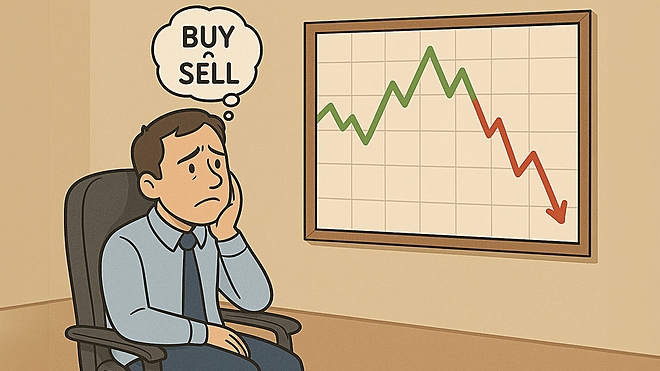
 AI-generated image
Over the last 25 years that I have been in asset management, one truth has never changed: Markets are full of surprises. You think they’ll rise, they fall. You fear they’ll crash; they rally. Many investors try to ‘figure it out’, hoping for some formula or certainty. But the truth is that markets are not machines with defined inputs and outputs. They are living ecosystems, influenced not just by earnings and interest rates but by human behaviour – full of emotion, psychology and reactions to the unknown.
When I say, “a bend in the road is not the end of the road,” I don’t say it for dramatic effect. I say it because it is a deeply profound way to look at investing. A bend doesn’t signal the journey’s over; it signals a change in direction, a moment to stay alert and not panic. It’s during these moments of uncertainty that true resilience and adaptability are tested and often rewarded.
Bends are features, not flaws
Let’s be honest: If there were no bends, there would be no roads. A road that’s perfectly straight and unchanging doesn’t exist, and if it did, we would give up on such a journey out of sheer boredom or the feeling of being directionless and getting nowhere at the end of what seems like an endless journey. Just like in life, in the markets too, change is constant. The problem is that we often see bends as something to fear rather than something to navigate and possibly find key milestones around the corner.
Just imagine if an ECG showed a flat line – it would be a cause for alarm. Similarly, a market without volatility, without ups and downs, is either dead or manipulated. Volatility, like the curves in a road or the waves in an ocean, is a sign of vitality.
Stop seeking absolutes; learn to think in probabilities
We live in a world where people demand clarity: “Will the market go up or down?”, “Which fund is the best?” Unfortunately, there are no certainties in the investing world – only probabilities.
I often joke that human beings are deterministic – they want clean, binary answers. But the world operates in shades of grey. We want black-or-white answers to questions that don’t have them. In reality, the successful investor is not the one with absolute clarity but the one who is open-minded and probabilistic. The one who knows there will be bends and negotiating them needs agility, not forecasting the precise nature of the next bend.
You don’t need perfect timing, you need participation
Here’s something from my early days in Mumbai: If you want to go from Goregaon to Churchgate at 7:30 am, you won’t get the perfect train to get fast to Churchgate; most fast trains don’t stop there, and any that do are overcrowded. Sometimes, you board the train that goes in the opposite direction first, get a seat at Borivali and then continue to head in the right direction more comfortably and be assured of safe arrival at the final destination.
In investing, too, the perfect entry point doesn’t exist. Markets don’t toot a horn before going up. If you’re waiting for the ‘right moment,’ you might just miss the train altogether.
The escalator metaphor: Wealth creation is frictionless if you stay on
If you simply step onto an escalator, you rise. Our economy is like that. Over the long term, GDP grows, earnings grow and markets follow. If you had done nothing and stayed invested since liberalisation, your wealth would’ve doubled every 5-6 years on average.
Yet, how many people actually double their money every five years? Why don’t more people benefit from this upward movement? Because they jump off. They overthink. They fear. They wait. Or worse, they try to come down the escalator that is moving up. When markets don’t move or move down for a bit, people think they will get off and get back later. When markets rise, people show the urge to rise faster.
The wiper effect: Chasing what worked yesterday
Many investors behave like windshield wipers. They swing from one side to the other – buying what’s worked recently, only to abandon it when it stops working.
Last year, pharma was hot. Before that, it was PSU banks. This year, it might be autos or defence. Every time you chase the latest winner, you risk arriving late. The best-performing sector or fund of the past often underperforms going forward.
What you should seek is consistency, not peak performance. Find managers, funds and strategies that steadily do well – not the ones who are only occasionally at the top. Investing and asset allocation is about optimising, it is not maximising. Often, Mr Market minimises people who try to maximise. So, optimise; that’s how to stay in the game and reach your goals.
Final thoughts: Don’t seek clarity; seek preparation
Many investors ask their advisors for clarity: “Tell me what will happen.” But no one can. What a good advisor can give you is preparation, not prediction.
Markets will always surprise us – sometimes for the better, sometimes for the worse. The right lesson to learn from surprise is not “Next time, I’ll be ready.” Instead, it is, “The world is inherently surprising, and I will remain prepared for whatever comes.”
To the long-term investor
Markets move like a rising sine wave. Each dip feels like doom, but it’s part of the ascent. In hindsight, every past correction looks like a missed opportunity. Remember March 2020? Missed opportunity in 2022? Perhaps April 2025 will be one too.
Don’t be the one watching from the sidelines. Don’t overthink the bend. Don’t chase, don’t fear. Just stay on the road. Stay invested.
Because a bend in the road is not the end of the road – unless you are inflexible, you made a forecast ready to steer accordingly, but it turned the other way, or you are sleeping at the wheel and fail to turn.
Aashish P Somaiyaa spearheads WhiteOak Capital Asset Management Limited as their CEO
Ask Value Research 
 New episodes every Friday











 New Process Alert
  Seems like you've uploaded a wrong QR code. Please upload the QR code downloaded from MF Central platform.


