




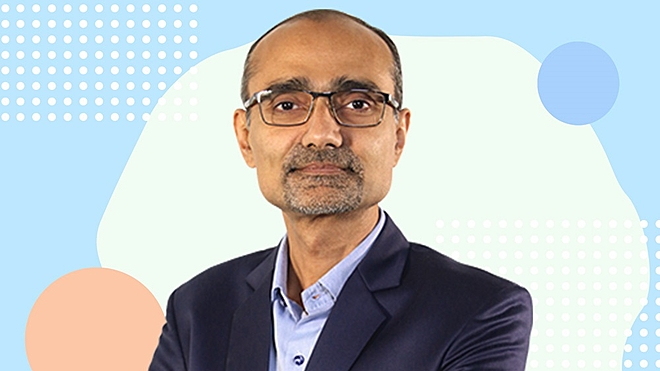

Even as the Indian equity market faces turbulent times, Umesh Kumar Mehta remains optimistic about the country's economic growth. The CIO and Fund Manager at Samco Mutual Fund believes a mix of tax cuts, manufacturing and infrastructure push, an inward-focused economic strategy and a stable rupee could soon drive a meaningful recovery.
Mehta currently oversees 10 schemes with an AUM (assets under management) of Rs 2,900 crore. In this interview, he shares his take on the current state of the Indian market, takes us through the Hexa Shield framework followed by his fund house, the rationale behind his highly concentrated Flexi Cap Fund, and why maintaining a high active share could be the key to achieving outperformance.
What domestic and global factors do you see driving a recovery in Indian equities over the next 6-12 months?
Domestically, the Indian government plays a pivotal role as the biggest catalyst for economic growth. Reforms, policy implementations and recent tax cuts for the middle class are critical drivers. If strong domestic consumption materialises - and there's every reason to believe it will, given India's young and aspirational population - it will serve as a powerful engine for economic recovery. Manufacturing growth is another key area, particularly as global supply chains reallocate to India. Though slightly slowed, the government's infrastructure investments remain a cornerstone of economic stimulus. If the government accelerates these projects, we could witness significant job creation and economic activity, further bolstering the recovery.
Trade dynamics are at the core of the global issue. While trade tensions and protectionist policies pose risks to India and other economies, India's inward-looking economic strategy provides a buffer. Stable foreign direct investment (FDI) flows are crucial, and if they continue, they will keep India's growth engine growing. And lastly, if India's currency is stable, then that is the single most important domestic factor that will drive real growth for India.
Can you walk us through how the Hexa Shield framework guides your decision-making at Samco?
The Hexa Shield framework is the cornerstone of our investment philosophy at Samco, particularly for our quality-focused schemes. It evaluates companies based on six fundamental parameters designed to identify businesses with enduring competitive advantages.
First, we assess competitive and pricing power, ensuring a company can maintain margins and market share.
Second, we conduct a balance sheet and insolvency test to confirm financial robustness, ensuring the company can withstand economic downturns.
Third, we look at reinvestment and growth tests, focusing on companies that can reinvest cash flows at incrementally higher returns on capital, which is a hallmark of sustainable growth.
Fourth, we evaluate corporate governance and leadership quality, where we check a lot of corporate governance parameters across functions and how decisions are made.
Fifth, the cash flow test examines the sustainability and quality of a company's earnings, as strong cash flows are a reliable indicator of business health.
Finally, the regulatory test ensures that a company's growth isn't hindered by adverse regulations or compliance issues, which can significantly impact long-term performance.
Companies that pass all six tests form our investment universe, particularly for the qualitative side of our schemes.
The Hexa Shield framework reflects our belief that quality businesses can generate superior returns when bought at the right price and managed dynamically. It's not just about identifying great companies but also about ensuring they align with market realities, which we achieve through a combination of qualitative and quantitative analysis. This disciplined approach differentiates us from traditional fund managers who may rely more on subjective judgment.
The Samco Flexi Cap Fund focuses on a concentrated portfolio of 25 to 30 stocks. What's the strategy, and how do you manage the associated risk with the concentrated portfolios?
Let me walk you through the strategy and performance of our flexi-cap fund, which has faced underperformance due to its concentrated 25-stock portfolio. When we launched the fund, we encountered some initial setbacks. Our original plan included a 35 per cent allocation to international exposure; however, we had only a one-day window to deploy this allocation before the Reserve Bank of India (RBI) closed that window, preventing us from deploying it. We were left in a 'hope trade', expecting the RBI to reopen the window, but it didn't happen. The outcome left us with a high domestic exposure, particularly in IT stocks.
Then, in February 2022, the Russia-Ukraine war erupted, and the whole equation changed. Interest rates increased within a year, causing a significant sell-off in global quality stocks. Our flexi-cap fund, which has a quality bias driven by the six factors of our Hexa Shield framework, had an initial hard luck.
Realising that hoping for the RBI to reopen the international window was futile, we pivoted to create a fully India-centric portfolio in the first or second quarter of 2024. We combined qualitative analysis, rooted in the Hexa Shield framework, with quantitative models to dynamically manage the portfolio. Our performance improved significantly during this brief period of one or two quarters. However, the fund took a severe beating when the market corrected in the last quarter of 2024, particularly post-September, and continued into early 2025. This was primarily because we had a bias toward mid-, small- and micro-cap stocks. In contrast, other flexi-cap funds leaned toward large-cap stocks, which held up better during the correction.
Despite this, our qualitative and quantitative churn models have kept the portfolio active and adaptive. We continuously rebalance to exit underperforming stocks and enter stronger ones. Let me give you a recent example. Two months ago, our system flagged Apar Industries for underperformance when its price was around Rs 7,600. We exited the stock, and the algorithm signalled an entry into Mazagon Dock at around Rs 2,100. The principle is simple: eliminate losing stocks, and the winners will take care of themselves. Today, Apar Industries is trading at approximately Rs 5,000, down by around Rs 2,000 from our exit price, while Mazagon Dock has risen by about Rs 800, nearing Rs 3,000.
We design our flexi-cap fund's strategy to outperform over the long term, but we are not an index-hugging fund. Instead, we maintain a high active share - meaning our portfolio diverges significantly from the benchmark. This gives us the potential to outperform substantially, but also means we can underperform in tough markets, as we've seen. Our legacy underperformance is a hurdle, and investors often focus on it. However, we need a bull market runway for new investors and to overcome past challenges. Suppose we get a sustained bull market in two to three years. In that case, our system will systematically exit underperforming stocks and allocate to stronger names, like Mazagon Dock in the example I shared.
Given its mid-cap tilt, the ELSS Fund has also underperformed over the past year. Do you attribute the underperformance to market conditions, stock selection or sector exposure?
The ELSS fund's performance mirrors the flexi-cap fund's, as both share a quality and mid-/small-cap bias. The underperformance is mainly due to the quality bias, which impacted returns more than the mid- and small-cap tilt. Over the past six to seven months, mid and small caps faced negative market sentiment. However, the primary driver was our emphasis on quality stocks, which impacted performance.
Your funds actively deviate from benchmark indices, as seen in the low overlap with the Nifty 500 in the flexi-cap fund. Given the recent volatility and underperformance, how do you balance the pursuit of outperformance through a high active share with the risks of increased portfolio volatility?
Maintaining a high active share is the only way to achieve significant outperformance. If we had a low active share or, to be precise, a portfolio that mirrors the index, we would never outperform meaningfully. By definition, if the index returns 10 per cent, an index-tracking portfolio might deliver slightly more. However, with a high active share, we can far exceed the index, achieving returns of 18-20 per cent when the index gives 10 per cent. Our back-tested data supports this, showing that our stock selection sometimes significantly outperforms the index.
Of course, there are periods when our portfolio underperforms the index. During those times, our churn allows us to exit underperforming stocks, and our hedging strategy helps protect the portfolio during market downturns. These are the two primary ways we manage a highly active portfolio. An index-tracking portfolio is fine for some, but managing a high active share portfolio is a double-edged sword. We can outperform in favourable markets, but we will do better in challenging markets as people compare the returns with the index.
For example, as mentioned earlier, we exited Apar Industries and entered Mazagon Dock in our flexi-cap fund. Similarly, in our active momentum and other funds, our hedging mechanism allowed us to hedge the portfolio during market downturns, reducing the impact of declines.
How do you see the interplay between large-, mid- and small-cap stocks evolving over the next 12-18 months, especially with Samco's funds being tilted towards the latter two categories?
Mid- and small-cap stocks are currently experiencing both time and price corrections, as their valuations adjust to align with earnings expectations. Once this corrective phase concludes, resilient stocks will lead the next market rally. Our algorithm is specifically designed to identify early movers and fundamentally strong stocks, allowing us to maintain our tilt toward mid and small caps. Through dynamic portfolio management, we hedge our positions during market downturns and fully invest during rising markets, ensuring we capture gains from high-potential stocks poised for strong performance.
Also read: Global risks at this point may outweigh potential returns: SBI Mutual Fund's Saurabh Pant
Ask Value Research 

 New episodes every Friday











 New Process Alert
  Seems like you've uploaded a wrong QR code. Please upload the QR code downloaded from MF Central platform.


