 Widely read:


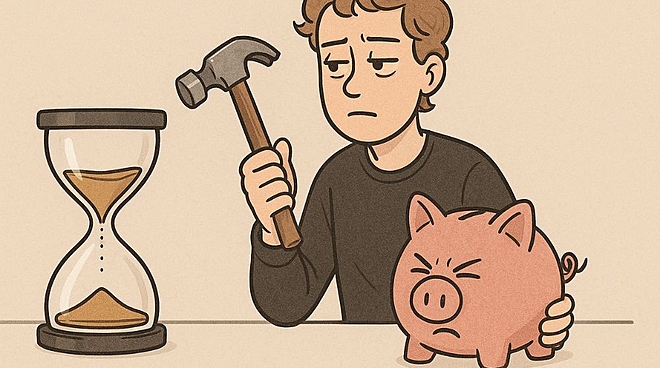 AI-generated image
If there's one financial product that has stood the test of time — across interest rate cycles, changing tax regimes and even new generations of investors — it's the Public Provident Fund, or PPF.
It's the kind of investment your parents (and probably their parents) would swear by. With its blend of tax savings, sovereign guarantee and fixed returns, it has long enjoyed a spot in the Indian saver's toolkit. You may even remember being nudged into opening a PPF account with some version of: "Beta, yeh toh karna hi chahiye (Son! You should open a PPF account)."
But in recent years, many investors — especially younger ones — are asking a different question: What if I need the money before 15 years? Can I get it out?
The need for liquidity is real. Life doesn't follow lock-in periods. Whether it's a medical emergency, your child's college fees or just a cash crunch, you may be tempted to dip into your PPF. And while PPF is one of the most rewarding fixed-income options out there — offering 7.1 per cent tax-free interest, backed by the government — it isn't the most flexible.
Can you close your PPF account before maturity?
Yes, but only in special cases.
While PPF comes with a 15-year lock-in, early closure is allowed after completing five full financial years, but only for specific reasons:
- Medical treatment of a serious illness, for the account holder, spouse, children or dependent parents.
- Higher education of the account holder or their children, subject to proof of admission.
- Change in residency status
Let's say you opened your PPF in FY2018-19 (any time between April 2018 and March 2019), you'd become eligible for premature closure starting April 2024 — provided your reason meets one of the above conditions.
But there's a cost. The government deducts a bit of your interest. The proceeds will be recalculated at an interest rate that's 1 percentage point lower than what you actually earned throughout the investment period.
How to go about it: You'll need to fill Form-5 and submit it to your bank or post office, along with documentary proof — hospital bills, admission letters or proof of NRI status — and carry your passbook or updated account statement.
Don't qualify? Partial withdrawal is your fallback
If your reason doesn't meet the premature closure criteria but you still need some funds, partial withdrawal offers a way out — albeit in moderation.
Here's how it works:
- You can make one withdrawal per financial year, starting from the sixth year.
- The amount is capped at 50 per cent of the balance, calculated as the lower of:
- Balance at the end of the fourth year preceding the withdrawal, or
- Balance at the end of the previous financial year.
Example: If you want to withdraw in FY 2024-25, and your PPF account was opened in FY 2018-19, then:
- Look at the balance as of March 31, 2021 (end of FY 2020-21 — the fourth year before 2024-25),
- And the balance as of March 31, 2024 (end of FY 2023-24).
- You can withdraw 50 per cent of the lower of these two balances.
Another lesser-known option: Loan against PPF
You can take a loan against your PPF only after the expiry of one year from the end of the financial year in which the account was opened — and before the expiry of five years from that same point.
For example, if your PPF account was opened in FY 2020-21, you become eligible to take a loan from FY 2022-23 (i.e., after one full year from the end of FY 2020-21) and you can continue to avail of the loan facility until FY 2025-26 (before five full years have passed from the end of FY 2020-21).
- You can borrow up to 25 per cent of the balance at the end of the second year preceding the year in which the loan is applied. Let's say you want to take a loan from your PPF in 2025. You can borrow up to 25% of your PPF balance as on March 31, 2023 (that's two years before 2025). So if your PPF balance on March 31, 2023, was Rs 4 lakh, you can borrow up to Rs 1 lakh (which is 25 per cent of Rs 4 lakh).
- The loan has to be repaid in 36 months, and you'll be charged 1 per cent interest above the prevailing PPF interest rate. In case the loan is not repaid within 36 months, interest rate is hiked to 6 per cent above the prevailing PPF interest rate.
- No new loan is allowed until the previous one is fully repaid.
Stay invested, but know your options
PPF is designed to be a safe, long-term savings vehicle — and it's best used that way. Its 7.1 per cent tax-free return, when combined with government backing and compounding, makes it a powerful tool for capital preservation.
But it's not a growth engine. For long-term wealth creation, equities will always do the heavy lifting. PPF plays a quiet supporting role.
That said, knowing the rules around early access — whether via closure, withdrawal or loans — puts you in control and helps you avoid making costly mistakes under pressure. Just because PPF isn't liquid doesn't mean it's locked forever. But if you must tap into it early, tread carefully — and only for the right reasons.
Also read: Your PPF account can be extended. Know the withdrawal rules.
This article was originally published on May 05, 2025.
Disclaimer: This content is for information only and should not be considered investment advice or a recommendation.
For grievances: [email protected]
Ask Value Research 
 New episodes every Friday











 New Process Alert
 Seems like you've uploaded a wrong QR code. Please upload the QR code downloaded from MF Central platform.


