 Widely read:


 AI-generated image
Imagine a wise sage who challenges a king to a game of chess. Victorious, the sage requests a seemingly humble reward: one grain of rice on the first square of the chessboard, two on the second, four on the third, and so on—doubling the grains on each subsequent square.
Amused by the simplicity of the request, the king agrees. But as the grains double with each square, the total quantity skyrockets beyond comprehension. By the 64th square, the number reaches 18 quintillion grains of rice, more than all the rice in the world.
This is the power of compounding, a force that starts small but grows exponentially over time.
Now, replace grains of rice with money, and you have the secret to wealth creation.
How compounding works in investing
Compounding occurs when your returns start generating their own returns. At first, the growth seems slow. But over time, it picks up pace, eventually leading to exponential wealth accumulation.
Think of it like rolling a snowball down a hill. At first, it is small, but as it keeps rolling, it picks up more snow, growing faster and bigger with each turn.
This is why time is the most critical factor in investing. The earlier you start, the greater the impact of compounding.
Why index funds are the simplest way to benefit from compounding
Many investors struggle with choosing the right mutual fund. Should you go for a large-cap fund, a mid-cap fund or a multi-cap fund? Which fund manager will outperform in the next ten years?
Even professionals find this challenging. Predicting which actively managed fund will consistently beat the market is incredibly difficult.
This is where index funds come in.
- No need for fund manager selection - Index funds simply mirror the market.
- Low cost - Actively managed funds charge higher fees, which eat into returns. Index funds are significantly cheaper.
- Diversified and reliable - Investing in an index fund means owning a basket of companies.
Put simply, index funds allow you to ride the power of compounding in the easiest way possible.
The power of time
To see compounding in action, let us look at Sensex Total Return Index (TRI) data from January 2000 to February 2025.
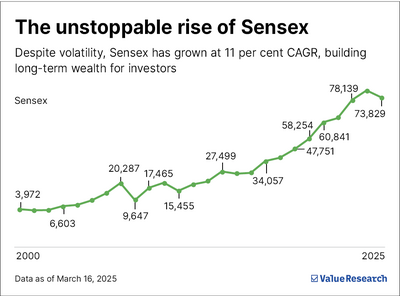
- Average annual return: 11 per cent
- Best one-year return: 81 per cent
- Worst one-year return: -52 per cent
Despite short-term ups and downs, the Sensex has consistently created wealth for long-term investors.
The cost of waiting
To understand how time multiplies wealth, let us take two investors—Pooja and Rohit.
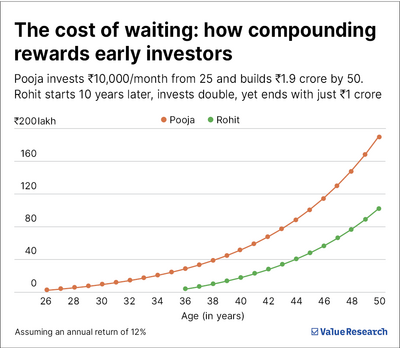
- Pooja starts investing Rs 10,000 per month at age 25 and continues until she turns 50. Assuming an annual return of 12 per cent, she would accumulate around Rs 1.9 crore.
- Rohit delays investing by 10 years and starts at age 35. To compensate for lost time, he doubles his monthly investment to Rs 20,000. However, despite investing more, he ends up with just over Rs 1 crore by age 50.
Even though Rohit invested Rs 36 lakh (compared to Pooja's Rs 30 lakh), his corpus is still significantly smaller. This is the power of compounding—the earlier you start, the greater the benefits. Once lost, time cannot be recovered.
Key takeaways
Most investors keep waiting for the perfect time to invest. But the only thing that truly matters is how long you stay invested.
1. You do not need a large sum to begin. Even a small monthly investment grows into a large corpus over time.
2. The earlier you start, the greater your wealth. A delay of even five to ten years can cost you lakhs or even crores.
3. Index funds make investing easy. You do not need to track fund managers, market cycles, or fund categories—just invest and let time do the work.
The best time to start investing was yesterday. The next best time is today.
An investor education and awareness initiative of Nippon India Mutual Fund.
Helpful Information for Mutual Fund Investors: All Mutual Fund investors have to go through a one-time KYC (know your Customer) process. Investors should deal only with registered mutual funds, to be verified on SEBI website under 'Intermediaries/Market Infrastructure Institutions'. For redressal of your complaints, you may please visit www.scores.gov.in For more info on KYC, change in various details and redressal of complaints, visit mf.nipponindiaim.com/InvestorEducation/what-to-know-when-investing
Mutual fund investments are subject to market risks, read all scheme related documents carefully.
Also read: SIP investing: 8 golden rules to follow (and when to stop!)
This article was originally published on March 18, 2025.
Disclaimer: This content is for information only and should not be considered investment advice or a recommendation.
For grievances: [email protected]
Ask Value Research 
 New episodes every Friday











 New Process Alert
 Seems like you've uploaded a wrong QR code. Please upload the QR code downloaded from MF Central platform.


