 Widely read:


 AI-generated image

As the market continues to stay in the red, it is no surprise that investors are panicking and selling off or halting their investments altogether.
The SIP stoppage ratio, which measures the number of discontinued SIP (systematic investment plan) accounts versus new registrations, hit a staggering 109 per cent in January, the highest for some time.
Like many investors, I, too, was tempted to pull the plug on my SIPs. After all, who likes to see their hard-earned money lose value? However, I quickly realised that mixing emotions with investing will only do more harm than good for my wealth. And thus, I decided to keep going, and so should you.
Why halting your SIPs during downturns is a bad idea
#1 Corrections are part and parcel of the equity market
Markets fluctuate, but they've always bounced back in the long run. Selling during a downturn locks in losses, while staying invested allows you to ride the recovery wave.
Here's why. Over a five-year period, SIP investors in Sensex experienced returns ranging from a high of 78.6 per cent to as low as -14.5 per cent. But if this timeline is extended to 20 years, the range narrows significantly - from a high of 20.8 per cent to a low of 9.2 per cent.
Why does this happen? This is because market highs and lows even out over time. Thus, the longer you stay invested, the less market volatility matters for your wealth creation, helping you grow your portfolio.
Suggested read: The compounding magic: When your money starts working overtime
#2 SIPs help you benefit from market lows
By continuing your SIPs over market cycles, you invest at varying price points, averaging the cost of your units over time, known as rupee cost averaging . This reduces the average cost, especially when prices are low. The table below shows how.
| Month | SIP amount (Rs) | NAV (Rs) | Units purchased |
|---|---|---|---|
| January | 5000 | 55 | 90.90 |
| February | 5000 | 50 | 100.00 |
| March | 5000 | 40 | 125.00 |
| April | 5000 | 45 | 111.11 |
| May | 5000 | 35 | 142.86 |
As you can see, as the NAV (net asset value) of the mutual fund reduces, you are able to buy more units. Further, the average NAV of your mutual fund comes out to be Rs 43.87, which is lower than three of the five NAVs at which you bought the fund.
#3 Time in the market is more important than timing it
Predicting the market is nearly impossible. If you keep waiting for the right or the perfect time to invest, you would miss out on earning substantial returns over time.
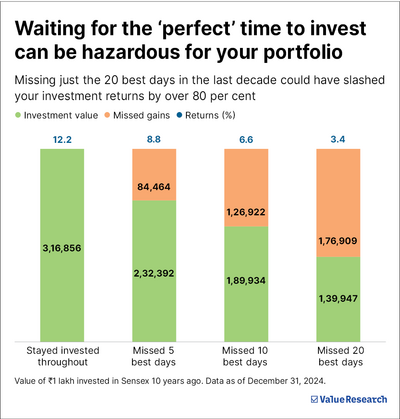
This is evident from the graph, which shows that even if you had missed just the 20 best days in the last decade, your returns could have been reduced by a whopping 80 per cent. By contrast, staying invested throughout would have not only fetched double-digit returns (12.2 per cent) but also a sizable corpus after 10 years.
Therefore, stopping your SIP means missing out on compounding, which, in turn, may slow down your financial growth and lead to a lower corpus in the long run.
The takeaway
SIPs are all about consistency. Continuing to invest, even during tough times, helps you stay focused on long-term financial goals and build wealth over time. While the current market slump may seem concerning, you shouldn't let short-term fluctuations derail your investing journey. Stay calm, stay invested and remember that SIPs are a tool for building wealth over time, not a quick fix to market changes.
Also read: Small-cap mutual funds are down 13 per cent. Should you halt, continue or increase your SIPs?
This article was originally published on February 20, 2025.
Disclaimer: This content is for information only and should not be considered investment advice or a recommendation.
For grievances: [email protected]
Ask Value Research 
 New episodes every Friday











 New Process Alert
 Seems like you've uploaded a wrong QR code. Please upload the QR code downloaded from MF Central platform.


