




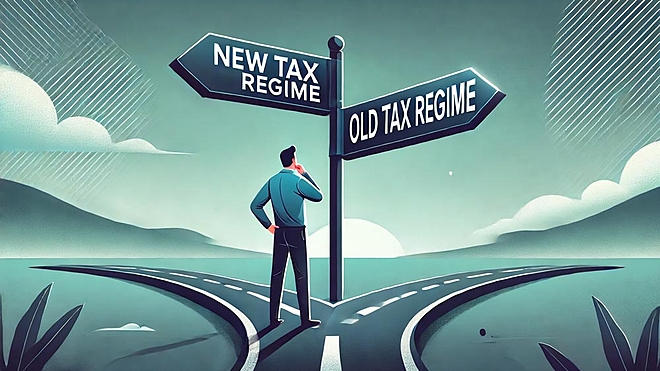
Union Budget 2025 has sweetened the new tax regime even more. With a higher basic exemption limit and lower tax rates, the buzz suggests that the new regime is now the better choice for most taxpayers.
At first glance, it does seem like a no-brainer. Why complicate things with deductions when the new regime offers lower tax rates and a simpler structure?
But before you make the switch, let us double-check the numbers. The old regime still allows tax-saving deductions; if you can claim enough of them, it might still be the more tax-efficient option.
So, when is the old tax regime more beneficial for you?
When does the old regime win?
The table below shows the minimum deductions required in the old regime for your tax liability to be the same as in the new regime. If you can claim more than this, the old regime is the better choice.
| Annual income (Rs) | Deductions needed to match new regime (Rs) | Tax liability in old regime (Rs) | Tax liability in new regime (Rs) |
|---|---|---|---|
| Up to 12.75 Lakh | Opt for new-regime, it's a no-brainer | - | 0 |
| 15 lakh | 5,43,750 | 97,500 | 97,500 |
| 18 lakh | 6,41,667 | 1,50,800 | 1,50,800 |
| 20 lakh | 7,08,333 | 1,92,400 | 1,92,400 |
| 25 lakh | 8,00,000 | 3,19,800 | 3,19,800 |
| 30 lakh | 8,00,000 | 4,75,800 | 4,75,800 |
| 40 lakh | 8,00,000 | 7,87,800 | 7,87,800 |
| Amount of required deductions excludes standard deduction of Rs 50,000 tax liability includes 4% cess | |||
What this means for you
If your total deductions (80C, 80D, House Rent Allowance (HRA)/home loan interest, NPS, etc.) exceed the amount in the table, the old regime is still more tax-efficient for you. If not, the new regime is the smarter choice—less paperwork, fewer calculations and lower tax rates.
Are these deduction amounts achievable?
For incomes up to Rs 15-18 lakh, the required deduction is around Rs 5-6.5 lakh, which is roughly one-third of your income. This may be achievable if you fully utilise multiple tax-saving options like 80C investments (EPF, PPF, ELSS), NPS (80CCD(1B)), health insurance (80D) and home loan interest or HRA.
Beyond Rs 18 lakh, achieving such a high deduction amount can be very difficult.
So, go with the new regime if:
-
You do not claim many deductions (no home loan, no 80C investments, minimal NPS contributions).
-
You prefer simplicity over tax optimisation.
- Your annual income is Rs 12 lakh or lower—since the new regime offers zero tax liability up to Rs 12.75 lakh (after the standard deduction).
Stick to the old regime if:
-
You regularly invest in tax-saving instruments like PPF,
ELSS
, NPS or claim HRA and home loan deductions.
-
Your total deductions exceed the break-even limit in the table above.
- You are willing to manage tax planning for better long-term savings.
Final verdict
The new tax regime has been made more appealing with recent budget changes, and for those who do not claim many deductions, it is a straightforward win.
But if you maximise your tax-saving investments, the old regime could still be the better choice. Which means the right tax regime is not about what is trending; it is about what saves you more money. Choose wisely!
Confused about tax regimes? Our tax calculator crunches the numbers so you can keep more money in your pocket. Instantly compare old vs new tax regime and make the smarter choice for your savings.
Also read:
Budget 2025: Taxpayers to save Rs 35,000-Rs 1.1 lakh after tax slab revision
New tax regime? These three 80C investments still make sense
This article was originally published on February 04, 2025.
Ask Value Research 

 New episodes every Friday








 New Process Alert
  Seems like you've uploaded a wrong QR code. Please upload the QR code downloaded from MF Central platform.


