




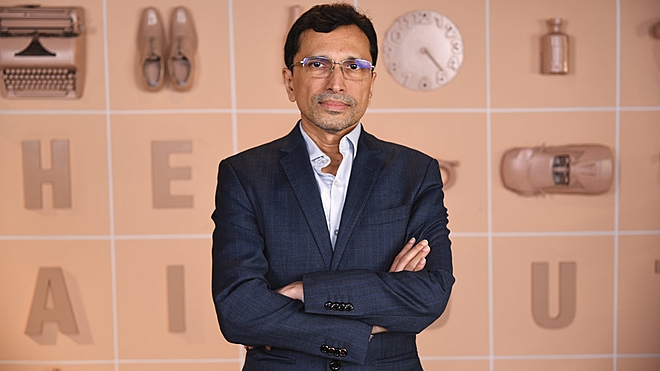

Mahesh Patil began his career as an engineer, but quickly realised his true potential lay in finance. This led him to stints at Motilal Oswal and Parag Parikh, followed by Aditya Birla Sun Life AMC, where he's been for the past 20 years.
Currently serving as the Chief Investment Officer (CIO) at the fund house, Patil oversees assets worth nearly Rs 3 lakh crore. He believes his extensive tenure has profoundly shaped both his personal investing philosophy and the investment approach at the AMC, which focuses on "avoiding excessive risks" and prioritising "high-growth companies".
In this interview, the computer engineer-turned-fund manager-turned-CIO opens up about his stock-picking strategy, whether active large-cap funds can still outperform their benchmarks and the key factors that helped his funds rebound.
You started your career as a computer engineer before moving into finance. What sparked your interest in investing?
As a student, I think my aspiration was to become an engineer. In the earlier days, either you became an engineer or a doctor. During the late 80s, my father, who was a government servant, had some investments in bluechip and MNC companies. At home, he kept telling us how these investments had paid off and gave him good dividends. But I think in 1992 when India announced the economic reforms and had the Harshad Mehta Bull Run, it was an exciting period. It was quite interesting how quickly you could make money in the markets, and, to some extent, that sparked my interest in the stock market. Also, that was the time when equity research was just emerging as a field. I believed that my strengths as an engineer, particularly my analytical skills, were more suitable for pursuing a career in equity research, and that's when I began to delve deeply into the stock market.
What key takeaways shaped your approach in your early days at Parag Parikh Financial Advisory and Motilal Oswal as a research analyst?
Working with hardcore firms in the early days of equity research helped me analyse companies, build models and learn more about sectors. In those days, we tracked fewer companies, which allowed us to dig deeper and spend more time analysing them. So, the depth of research was critical as we had to build our own models from scratch and look at the balance sheet and annual report. The annual report shows how the company has grown and what accounting tricks some companies were doing. Therefore, a thorough examination of the financial statement, line by line, shaped my understanding of granular details, a skill that proved invaluable when I transitioned into a fund management role. I think grounding in research in some of these firms known for high-quality equity research laid the foundation for analysing and helping me as a portfolio manager.
You've been with Aditya Birla Sun Life AMC for nearly 20 years, progressing from fund manager to CIO. How has this journey influenced your investment style?
I think it also depends on the phases of the market. So when I joined this company in 2005, we were in the midst of the big bull market. During that period, certain sectors, such as Capital Goods, Infrastructure and Telecom, experienced significant growth, aligning with my research analyst expertise. My strengths in a few sectors helped me get in quickly and do well.
But later, after the Global Financial Crisis, when we saw a sharp meltdown, one realised that one needs to have a good understanding of not only a few sectors but also a good grasp of macro understanding. Who would have thought the Global Financial Crisis could lead to a similar drawdown, even in our markets? So that's where you realise that all the financial markets are correlated and linked. Anything that happens in other markets can impact your markets, and understanding the macro is equally important for you to calibrate risk depending on the macro. So I think a lot of emphasis went into understanding the macro, what's happening globally and how global liquidity or risk can influence our markets. We tried to build models to look at the macro part of the research in that area.
Due to all such shocks, drawdowns and their impact on the portfolio, the first focus was risk management. How do you build up a risk framework to withstand some of the shocks? That's what we've considered for portfolio risks and needs. So we came up with a framework regarding the active risk that a fund manager should take in a portfolio at a stock level and even at the sector level, vis-à-vis the benchmark, and work within that framework so that you are not taking excessive risk. This is because you've seen that when I was not in this firm during the dot-com crisis, they had substantial exposure in a particular sector or stock. After all, it was doing well. However, when the sector began to underperform, it became extremely difficult to exit, leading to significant volatility.
Later, somewhere in 2011-12, what I saw in the Indian markets was that there were a lot of sunrise sectors, as India has been a growth economy. While we wanted to grow, we also wanted to be slightly conscious of valuations. Therefore, we established a framework where we would prioritise GARP (growth at a reasonable price), a strategy that significantly influenced our investment philosophy at the fund house. However, during the 2019-20 market period, stocks with growth at any price performed well. As a result, we recalibrated our approach, focusing on high-growth companies and developing a framework that would allow us to participate in them while adhering to our philosophy. So, I think there has been a lot of learning. I believe every market correction is a learning phase, and that's how you learn in the capital market. You make mistakes, learn from them and try not to repeat them. It's a journey; hopefully, as time passes, you make fewer mistakes and develop your own philosophy about what you want and don't want to do. So, I think that has clearly evolved over the last 20 years.
How would you describe your investment philosophy? Are there any specific market conditions or types of stocks that excite you?
I would say my investment philosophy is GARP, as mentioned earlier. So, essentially, we are looking to buy companies that we think can grow faster than the economy and even within that particular sector. A company growing faster than the industry is doing something different and can gain market share, either because it has some kind of a moat in the business or they have some competitive advantage in doing it profitably. When I say profitably, I mean that it should be at least 15 per cent or more than the return on capital because that is how a company utilises the capital efficiently. I think it is essential for long-term wealth creation. Concentrating on cash flows is crucial, as I've come to understand that these are the primary drivers of real wealth over an extended period.
Apart from that, another dimension that has really built up our philosophy is also looking at management. I believe that management, despite its intangible nature, plays a crucial role in shaping and testing a company during challenging times. We've seen that good managers who are able to make good capital allocation decisions can even pivot their businesses when they go through a crisis or when disruptions are happening in the industry. I think the best companies survive, so evaluating management and having a framework to see which ones can deliver future growth is also crucial. This is a broad philosophy, and while it may seem simple, adhering to it is crucial.
Another significant lesson I've learned is the importance of retaining your winners. Many times, we identify a good company that does well and meets your expectations, and then you probably want to book some gain over there. However, when you identify a great company, you will initially start with a small position. But, the idea is to really hold on to it and drive the whole journey because that's where you'll see a lot of wealth. I believe the key is not to focus solely on valuations but to truly understand the business. If it's a great business run by great management and there is a big opportunity, you must hold on to it. So, holding on to your winners, I think, has been a significant learning experience because, in my early phase, I identified companies but also sold them. If I had had them in the portfolio, they could have made a big difference.
What are the key things you look for when picking a stock for investment?
First is growth, and I would like to have a stock in a portfolio that I would like to own for the long term; that's the core of the portfolio. So, growth should be better than nominal GDP growth. I would prefer a stock that grows at approximately 15 per cent, or slightly above that. If you can get that well and good, otherwise slightly better than the nominal GDP, growth is good but important. This growth should not be limited to the next one or two years but rather to the next five or 10 years. Second, look at the return on capital, which should be at least 15 per cent over a business cycle. So, I think there are some things that I will look at, and if I have to add something on top of that, it is management quality. It's intangible, but one needs to trust management to make good decisions. More importantly, capital deployment is happening because many companies we see generate good cash flows but misallocate capital. If the management does that down the line, then the premise of what you bought that company for changes completely. So, management is quite crucial from the standpoint of making the right capital allocation decisions.
Some of your diversified funds - ELSS, Flexi, Focused, Multi-cap - faced challenges but are now bouncing back (moving out of the bottom quartile). What went wrong earlier, and how tough was it to steer through that phase?
I think on the fund management side, you go through various cycles. This could potentially be attributed to your investment philosophy, which may not align with the current market realities. For example, the tax relief fund focused more on the quality and the MNC companies, and the fund did very well in the pre-Covid-19 period, but after that period, a cyclical rally happened, and it didn't participate and could not make that adjustment. Therefore, in addition to adhering to your core philosophy, it's crucial to stay informed about market trends, appreciate them, and implement necessary changes. Also, stick to the guardrails to avoid being overexposed to a particular sector, even if you like that and keep them within a particular range. You obviously want fund managers to take active bets in the portfolio to generate alpha but keep them within guardrails. We deviated from that; we took a slightly larger exposure and were unwilling to recognise the market reality, so we made those changes that led to underperformance in that period. But we've taken corrective action and made changes over there.
Secondly, even the fund managers have their biases toward a particular stock. So keeping your losers in a portfolio for a long time is also one of the reasons that was a drag on the portfolio. Thus, you should prune down your losers in a portfolio, critically evaluate them, and keep some price point where you want to reevaluate or get the whole portfolio. I think the selling decision discipline is crucial. We always know when to buy a stock and have a framework to buy it, so we don't have a framework for when to sell it. That's the lesson I think we got when evaluating some of these funds to see why they underperform. We have taken some measures in terms of how we have the sell discipline in place; we put a monitoring mechanism in place, and whenever stock underperforms by a particular threshold, we ask three questions.
One question is whether to buy more if you have a conviction and the stock is corrected by 20 per cent or more, or whether to sell that stock, or whether we need more data to make a decision later, but clearly take a call and move forward. I think overall, we've done well on the large-cap side. Mid and small caps are areas where we've not done as well. So, we have strengthened our research capabilities on the mid- and small-cap side. We are trying to get more deeply into the companies; we've hired a mid-/small-cap specialist, which can make a big difference to the portfolio.
Do you believe active large-cap funds can still beat the market in the long run? How do you manage Frontline Equity to stay ahead?
In the last three years, if you look at the Nifty or the NSE 100, they have underperformed the broader market, the BSE 500. Even the mid- and small-cap indices outperformed them due to the significant amount of retail money allocated to these funds. Foreign portfolio investors (FPIs) have also been big sellers in the last two years, which has taken a toll primarily in the large-cap space. The large cap, or the Nifty, has done well in the last few years, and its growth is in line with the earnings growth. So, the Nifty is in the fair zone while the broader markets have gone up.
If you look at the mid- and small-cap indices, the returns are probably double the earnings. So clearly, there was a lot of exuberance over there; now we think there is some mean reversion. I think the market is becoming much more discerning now, and that's where larger cap companies offer much more stability. They might not be the fastest growing, but they are much more stable. Therefore, large caps offer a better risk-reward in this market environment due to their relatively higher valuations than the mid- and small-cap space, and they are likely more resilient to market uncertainty.
Now, as a large-cap fund manager, the challenge is also to beat the benchmark, and we've seen that was a bit of a challenge around the 2018-20 period when the market breadth was very narrow. So, when managing the frontline equity fund, I think the objective is to beat the benchmark again, not by a large margin because that's not possible on a consistent basis, but, say, by around 100-200 basis points. We believe this is the target we are aiming for, and we expect you to manage your portfolio accordingly, both in terms of discipline and portfolio construction. I would say that this is a market that is now going bottom-up. A bottom-up market is suitable for a fund manager to pick up stocks and outperform the benchmark. This contrasts with a trending market, where stocks tend to move upward. In this current period, adopting a bottom-up approach should enable you to outperform the index. You've seen that in the last one to two years, many funds - even the ABSL Frontline Equity Fund -have generated around 200 basis points of alpha.
In today's market, which sectors look attractive to you? Are there areas you feel are overpriced? Are there any emerging trends that have shaped your strategy?
The framework we follow and the sectors I prefer in this market are the ones that have probably underperformed for various reasons; the valuations are not expensive, as are those sectors where we could see a turnaround down the line. Private banks exhibit significant underperformance in that framework, and their valuations remain reasonable. Obviously, there is a credit slowdown, but we think it's cyclical, and it's a good time to look at some of the good quality private banks. Another sector that has underperformed is Cement and is going through the worst cycle.
Even Consumer Discretionary has hit a slowdown, but we are seeing early signs of improvement. This is due to the favourable monsoons and rising food prices, potentially boosting consumption. These stocks have corrected, and there are some good-quality names over there that you would want to buy from a long-term construct. Even the Pharma sector, which has outperformed, still looks good. Another sector is IT, which is coming from a slowdown last year, where we saw discretionary IT spending go down because of concerns about US growth, which is not likely to be as bad as expected. Slowly, we are seeing IT sector spending improve again, so there is a recovery. Despite the sector's performance in the last six months, we believe it provides reasonably good visibility and strong cash flows, making it a viable defensive strategy in this environment.
Also read: Interview with Ihab Dalwai of ICICI Prudential Mutual Fund
Ask Value Research 

 New episodes every Friday









 New Process Alert
  Seems like you've uploaded a wrong QR code. Please upload the QR code downloaded from MF Central platform.


