




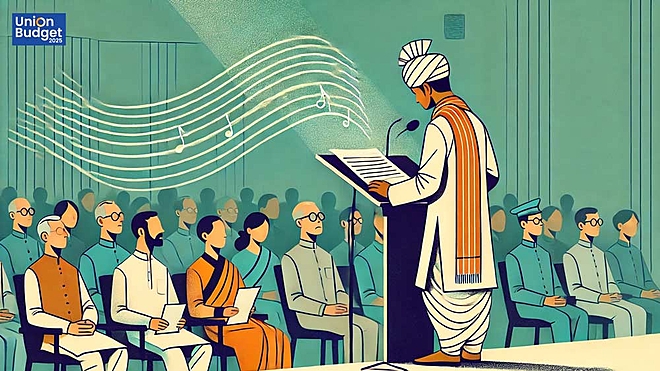
Budget speeches may be synonymous with data and policies, but in India, they have often transcended numbers to become moments of inspiration. From quoting Victor Hugo during liberalisation to weaving in Tamil wisdom and Urdu couplets, Finance Ministers have used poetry to communicate resolve, optimism, and cultural depth. This article takes you on a journey through India's most memorable Budget speeches, where verses met vision to transform fiscal plans into cultural milestones. These poetic interludes remind us that even in the most technical of discourses, words have the power to move a nation.
Manmohan Singh: Reform and resolve (1991 & 1992)
The reform architect's poetic message
Amidst India's 1991 economic crisis, Finance Minister Manmohan Singh delivered a landmark Budget. Facing a balance of payments crisis, he began his speech with Victor Hugo's words:
"No power on earth can stop an idea whose time has come."
This was more than inspiration - it was a call to embrace the liberalisation reforms that would redefine India's economy.
In 1992, Singh turned to Urdu poetry to reflect on the gravity of past missteps:
"Tareekhon mein kuchh aise bhi manzar humne dekhe hain,
Ki lamhon ne khataa ki thi aur sadiyon ne sazaa paayi."
Translation: "Even this has happened in history; mistakes made in moments created trouble for centuries." Singh subtly underscored the importance of learning from the past to ensure a sustainable future.
Yashwant Sinha: Bold reforms in troubled waters (2001)
Encouraging risks with Urdu poetry
Yashwant Sinha's 2001 Budget, which focused on bold reforms, came with a poetic flourish. To inspire confidence, he recited:
"Taqaazaa hai waqt ka ke toofaan se joojho,
Kahaan tak chaloge kinaare kinaare."
Translation: "The times require you to fight the storms. How long will you keep walking on the shore?" This sentiment echoed the risks necessary for India's fiscal stability and growth amid global uncertainty.
P. Chidambaram: Drawing from Tamil wisdom (2008 & 2013)
The poet-statesman's Tamil connection
P. Chidambaram, a lover of Tamil literature, frequently quoted from Thirukkural, a classical Tamil text by Thiruvalluvar, to emphasise timeless governance principles.
Budget 2008:
"If ploughmen keep their hands folded, even sages claiming renunciation cannot find salvation."
This analogy underscored the importance of agriculture as the backbone of economic prosperity.
Budget 2013:
"Kalangathu Kanda Vinaikkan Thulangkathu Thookkang Kadinthu Seyal."
Translation: "What clearly eye discerns as right, with steadfast will and mind unslumbering, that should man fulfil." Chidambaram used this to stress the need for unwavering focus and disciplined decision-making in navigating economic challenges.
In the same speech, he quoted Swami Vivekananda:
"All the strength and succour you want is within yourself. Therefore, make your own future."
This was a rallying cry for a self-reliant India aiming to be among the world's leading economies.
Pranab Mukherjee: Tough decisions with kindness (2009 & 2012)
Tough choices with Shakespeare and Chanakya
Known for his love of literature, Pranab Mukherjee often quoted from Indian and Western classics in his speeches. In 2009, he turned to Mahatma Gandhi for inspiration:
"Democracy is the art and science of mobilising the entire physical, economic, and spiritual resources of various sections of the people in the service of the common good."
During his 2012 speech, he quoted Shakespeare's Hamlet:
"I must be cruel only to be kind."
This line justified tough economic measures during a period of fiscal challenges, including rising deficits and slowing growth. Mukherjee also invoked Kautilya's teachings, highlighting the balance between revenue collection and public prosperity:
"A wise king ensures that production and consumption are not injuriously affected by taxation."
Arun Jaitley: Poetry in policy (2016 & 2017)
Resilience, reforms, and a war on black money
Arun Jaitley brought Urdu couplets and Hindi poetry into his Budget speeches, adding emotional depth to complex fiscal measures. In 2016, he recited:
"Kashti chalaane walon ne jab haar kar di patwar hamein,
Laher-leher toofan mile aur mauj-mauj majhdhaar hamein,
Phir bhi dikhaya hai hamne aur phir yeh dikha denge sabko,
Ki in halaat mein aata hai dariya karna paar hamein."
Translation: "When the sailors handed the oar to us, we encountered storms and rapids. Yet, we showed that we can navigate through such waters." This symbolised his government's resolve to tackle economic challenges inherited from the past.
In 2017, addressing the fight against black money, he quipped:
"Roshni aake jo andheron se takrayi hai,
Kaale dhan ko bhi badalna pada aaj apna rang."
Translation: "When light collided with darkness, even black money had to change its colour."
Nirmala Sitharaman: Hope and culture (2019-2022)
Optimism amidst challenges
In 2019, Nirmala Sitharaman quoted Urdu poetry to inspire hope:
"Yakeen ho to koi rasta nikalta hai,
Hawa ki ot bhi lekar chirag jalta hai."
Translation: "You can find a way if you have faith, just as an earthen lamp can light up despite the wind."
During her 2020 speech, she celebrated India's unity with Kashmiri poet Dina Nath Kaul's verse:
"Hamara vatan khilte hue Shalimar Bagh jaise,
Hamara vatan Dal Lake mein khilte hue kamal jaisa."
Amidst the pandemic, Sitharaman quoted Rabindranath Tagore in 2021:
"Faith is the bird that feels the light and sings when the dawn is still dark."
These verses reflected her efforts to infuse optimism into an uncertain economic climate.
In 2022, quoting the Mahabharata, she emphasised good governance:
"The king must make arrangements for Yogakshema (welfare) of the populace by governing in line with Dharma."
Poetry in policy: Words that echo through time
India's Budget speeches are not just about policies and numbers; they are moments where leadership meets literary brilliance. By weaving poetry, shlokas, and shayari into the fabric of their fiscal plans, Finance Ministers have transformed these speeches into powerful messages of hope, resilience, and vision. These poetic interludes do more than soften economic discourse - they connect with the heart of a diverse nation, reminding us that even in the realm of finance, words hold the power to inspire and unite. As we look back, these verses continue to resonate, proving that the true essence of leadership lies in striking a balance between reason and emotion, between numbers and the soul.
Also read:
India's first Budget: The birth of economic sovereignty
The Budgets that changed India - but no one talks about them
Union Budget explained: What it is and why it matters
Ask Value Research 
 New episodes every Friday









 New Process Alert
  Seems like you've uploaded a wrong QR code. Please upload the QR code downloaded from MF Central platform.


