 Widely read:


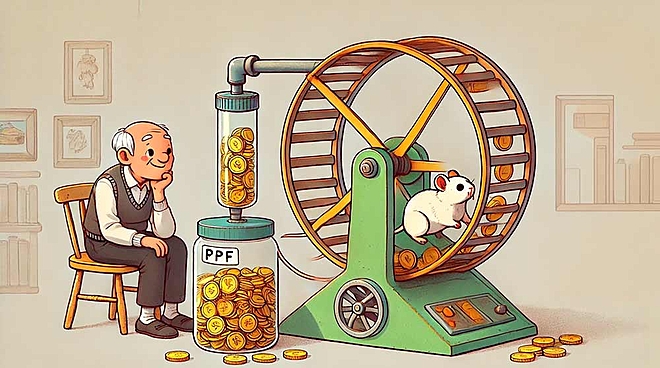 AI-generated image
Your Public Provident Fund (PPF) can work hard and earn money for you even during retirement.
So, it would be better if you don't pull out your PPF money either after its maturity or in your retirement years.
We give you three reasons why:
1. Need a balanced portfolio
A good retirement portfolio needs both growth and stability.
For growth, consider investing in equity. Even retirees need some portion of their money to be in equity. It will ensure you don't run the risk of eventually eating into your corpus.
That said, not all your money should be subject to market swings.
For stability, you need a fixed income. These investments preserve capital and provide predictable returns. This is where PPF can continue to be a powerful tool, offering a balance of safety, steady returns and tax efficiency even after maturity.
2. PPF can work for you even after maturity
When your PPF matures, you don't have to withdraw the entire amount immediately. One highly effective option is to let the corpus stay put while continuing to earn the guaranteed 7.1 per cent tax-free return (For those unaware, PPF interest rates can change every quarter, though the revised number is in a similar ballpark).
For instance, say you have Rs 50 lakh in a matured PPF account. If you leave the corpus untouched for another year, it would generate Rs 3.55 lakh annually. This income is entirely tax-free.
Further, to match PPF's post-tax return, you'd need a taxable investment option earning over 10 per cent - especially if you're in the highest tax bracket.
So, here's how staying invested works:
- You can extend the PPF account without fresh contributions.
- You're allowed one withdrawal per year, as per your needs.
- You can close the account at any time if you need the entire corpus.
This structure offers a rare combination of growth and flexibility, which is not easily found in other fixed-income options.
3. PPF's tax advantage
PPF's tax efficiency becomes even more valuable.
Consider this: If you were to shift Rs 50 lakh into an FD (fixed deposit) earning 7.5 per cent interest, you'd generate Rs 3.75 lakh annually. However, if you're in the highest tax bracket (30 per cent), your post-tax return would shrink to just Rs 2.63 lakh.
In contrast, your PPF earnings of Rs 3.55 lakh remain entirely tax-free.
Even for someone in the 20 per cent slab, a taxable fixed-income instrument would yield less than Rs 3 lakh after tax.
SCSS (Senior Citizens Savings Scheme) can be another attractive fixed-income option for retirees with limited taxable income. It currently offers a higher return of 8.2 per cent, paid out quarterly, but the interest earned is taxable.
Let's break it down for a Rs 30 lakh SCSS deposit:
- Interest earned annually: Rs 2.46 lakh
- Taxable amount for a 30 per cent slab: Rs 1.72 lakh (post-tax)
While the interest rate is higher than PPF, the tax impact reduces its advantage, especially for those with higher incomes. Additionally, SCSS has a maximum investment limit of Rs 30 lakh, which may not be suitable for a larger corpus.
When should you move out of PPF?
While PPF offers unmatched safety and tax efficiency, it may not suit every situation. Consider withdrawing if:
- You need higher liquidity: PPF allows only one withdrawal per year, which could be restrictive if you require frequent cash flows.
- You need more growth: If your portfolio already has substantial fixed-income allocation and can handle moderate risk, reallocating a portion for higher returns might make sense.
Your takeaway
Don't exit your PPF in your silver years.
Keeping a portion invested in it can help you continue earning a guaranteed tax-free return.
SCSS is worth considering only if you have a lower taxable income.
Last but not least, don't neglect equity. It will ensure your wealth grows and keeps pace with inflation.
Also read: Is it advisable to continue with PPF after retirement?
This article was originally published on January 16, 2025.
Disclaimer: This content is for information only and should not be considered investment advice or a recommendation.
For grievances: [email protected]
Ask Value Research 
 New episodes every Friday











 New Process Alert
 Seems like you've uploaded a wrong QR code. Please upload the QR code downloaded from MF Central platform.


