




 AI-generated image
Since the market has heated up, many are wondering how to capture this growth without going too heavy on a handful of companies and invoking high risk.
This is where the Nifty 500 Equal Weight Index can come into play.
How does the Nifty 500 Equal Weight Index work?
It provides equal exposure to 500 companies across large, mid and small caps. So, if the index has Rs 1,000 to invest, it will be equally distributed across 500 companies, which comes to Rs 2 each.
Let's now take a look at a real example. Although the Nifty 500 Index has allocated 71.3 per cent to large-cap stocks, 18.5 per cent to mid caps and 10.2 per cent to small-cap stocks as of November 30, 2024, the Nifty 500 Equal Weight Index has a significantly different allocation due to its equal weighting approach. Large-cap stocks account for just 20 per cent, mid caps make up 30 per cent, and small caps dominate with a 50 per cent allocation.
Basically, equal allocation automatically increases the index's tilt toward mid and small-cap stocks. That's because they make up most of the universe.
But does this strategy deliver over the long term? Let's find out.
Performance during bull and bear-case scenarios
The Nifty 500 Equal Weight Index behaves differently in different market cycles due to its higher allocation to mid and small-cap stocks. This makes the index:
1. More responsive to rallies driven by mid and small caps.
2. Less reactive during large-cap-led bull phases, as the lower weight to large caps limits its upside.
3. More volatile during downturns because mid and small caps typically fall harder than large caps.
Performance during mid-/small-cap and large-cap-fueled rallies
| Market Phase | Period | Nifty 500 Equal Weight TRI (%) | Nifty 500 TRI (%) | Reason |
|---|---|---|---|---|
| Global financial crisis | Jan 2008 - Feb 2009 | -63.5 | -57.7 | Broad market downturn |
| Mid- and small-cap falter (pre-Covid) | Jan 2018 - Dec 2019 | -14.6 | 3.6 | Mid- and small-caps turn bearish |
| Covid crash* | Jan 2020 - Mar 2020 | -39.9 | -37.9 | Broad market sell-off |
| Post-Covid bull run | Mar 2020 - Nov 2024 | 43.4 | 32.6 | Mid and small-cap rally |
| *Absolute returns | ||||
Long-term performance: Consistent, but modest outperformance
Over longer horizons, the Nifty 500 Equal Weight Index has delivered consistent, albeit modest, outperformance.
It has outperformed the Nifty 500 TRI 53 per cent of the time over a 7-year period and 57 per cent of the time in a 10-year period.
During instances of outperformance, it stays ahead of Nifty 500 TRI by an average of 1.5 per cent.
Nifty 500 Equal Weight vs multi-cap funds
Both Nifty 500 equal Weight and multi-cap funds offer broad diversification across large, mid and small-cap stocks, with a higher tilt to mid- and small-caps.
However, the Nifty 500 Equal Weight Index and multi-cap funds adopt distinctly different investment approaches. The Nifty 500 Equal Weight Index follows a passive, rule-based strategy, distributing investments evenly across all 500 stocks, ensuring no single stock or market cap segment dominates the portfolio.
In contrast, multi-cap funds are actively managed by fund managers and have a mandate to allocate 25 per cent each to large-, mid- and small-cap stocks.
This divergence in stock selection has led to varying performances.
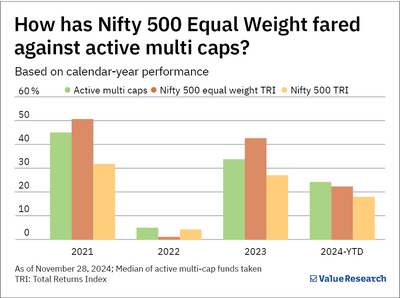
The Nifty 500 Equal Weight Index has outperformed multi-cap funds in two of the last four calendar years, largely due to the current market rally being driven by mid and small caps, where this index tends to perform well.
On the other hand, multi-cap funds, due to their higher allocation to large-cap stocks, tend to experience smaller declines during corrections in mid and small caps, as seen in 2022.
Final verdict
The Nifty 500 Equal Weight Index can be considered by those with a long-term horizon and a higher risk appetite, as it benefits when mid and small caps lead a market rally.
However, it may underperform during large-cap-driven rallies or market downturns.
Alternatively, if you're looking for a strategy that adjusts to changing market conditions, actively managed multi-cap funds might be a better fit.
If you are still unsure of which mutual funds to invest in, subscribe to Value Research Fund Advisor. Get customised recommendations, insights on mutual funds and strategies to help you achieve your financial goals. You can also get a list of the top-rated funds across each category, helping you make better investment decisions.
Visit Value Research Fund Advisor to learn more.
Also read: Can Nifty 100 Equal Weight index fund earn you more than Nifty 100 fund?
Ask Value Research 

 New episodes every Friday









 New Process Alert
  Seems like you've uploaded a wrong QR code. Please upload the QR code downloaded from MF Central platform.


