





A theme represents a broader concept, amalgamating various interconnected sub-sectors. A structural theme, also known as a strategic theme, embodies a long-term, fundamental perspective on an investment or market trend. It is rooted in comprehensive analyses of macroeconomic, demographic, technological, and other fundamental factors expected to shape the market over an extended period. In contrast, a tactical theme reflects a shorter-term, opportunistic viewpoint influenced by near-term market conditions, price movements, or specific events impacting asset prices.
Several structural themes prevail in India, such as healthcare, consumption, BFSI (banking, financial services, and insurance), manufacturing, and digital. A structural theme is propelled by shifts in the underlying economy, industry, or market structure, often exerting a lasting impact spanning years.
The healthcare sector has significant long-term growth potential, driven by factors such as the rising prevalence of lifestyle diseases, increasing health insurance penetration, under-investment in healthcare infrastructure, an ageing population, and global cost competitiveness. This includes gaining market share in pharmaceutical exports and capitalising on the growth of medical tourism.
The healthcare theme in India exemplifies a long-term structural theme capable of potentially enhancing investor wealth over the long term and serving as a valuable diversifier within the equity asset class. Moreover, the diversity of business models within this theme presents opportunities for active fund managers seeking to generate alpha.
Wealth creation over long term, low correlation with broader market indices
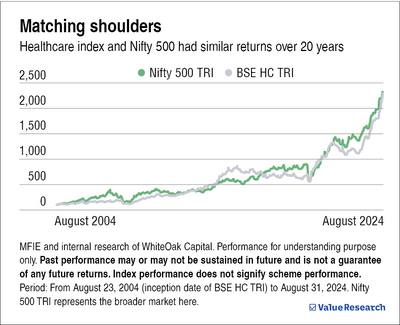
Over the last 20 years (August 2004 to August 2024), the BSE HC TRI has delivered a comparable return of 16.8 per cent CAGR, versus 16.3 per cent CAGR from the Nifty 50 TRI and 17.0 per cent CAGR from the Nifty 500 TRI (an index representing the broader equity market). What makes this particularly interesting is the return stream compared to the broader market, specifically the correlation between these indices.
The correlation between the BSE HC TRI and the broader market (Nifty 500 TRI) is 0.66 on a one-year basis and only 0.31 on a three-year CAGR daily rolling basis. This shows that the healthcare sector can provide a low-correlated return stream compared to the broader market, potentially enhancing the risk-adjusted returns of an investor's overall portfolio over the long term.
Defence during large market fall
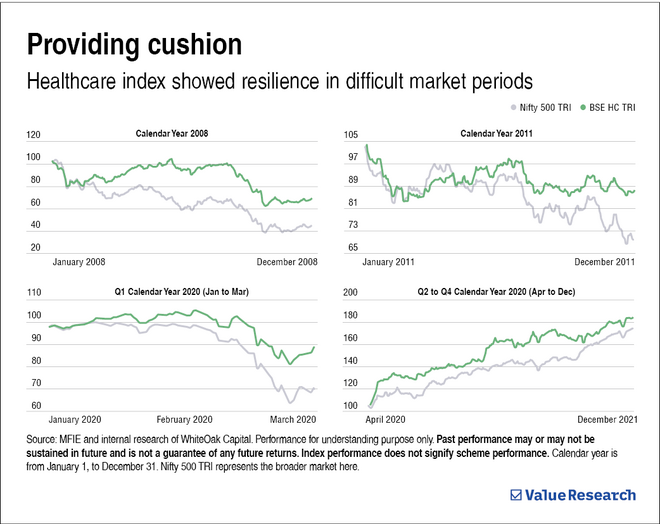
As observed in the adjacent graphs, the Healthcare index has limited downside during challenging years such as 2008 and 2011 compared to the broader market. The calendar year 2020, one of the most volatile years in recent times, saw the Healthcare index deliver a better investor experience compared to the broader market index.
A heterogeneous sector
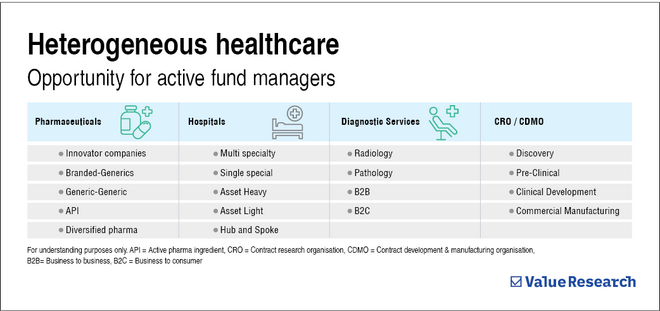
Healthcare is a heterogeneous sector providing opportunities to active fund managers. Within each healthcare sub-segment, there are diverse business models with varying economic characteristics. Therefore, bottom-up stock picking is of utmost importance in this sector.
Manuj Jain, a CFA charterholder, is an Associate Director and Co-Head of Product and Strategies at WhiteOak Capital Asset Management Company. He has been with the company for over two years and has over 16 years of experience in asset management. Part of the WhiteOak Capital Group, WhiteOak Capital Asset Management Company is the sponsoring entity of WhiteOak Capital Mutual Fund.
Also read: Winners rotate
Ask Value Research 
 New episodes every Friday











 New Process Alert
  Seems like you've uploaded a wrong QR code. Please upload the QR code downloaded from MF Central platform.


