




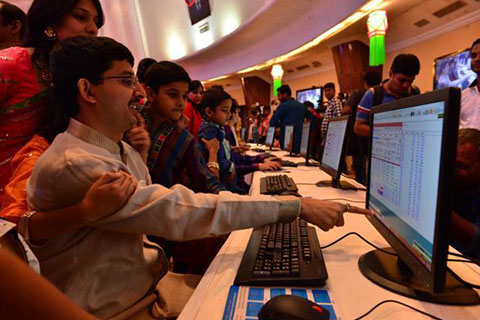
Just like in 2015, equity mutual funds bore the brunt of volatile markets in 2016 as well. With the S&P BSE Sensex ending 1.2% lower than at the start of the year (as on 26 December), diversified equity funds fell by 2% on an average and mid- and smallcap funds fell by about 3% on an average. But despite the volatility, retail investors embraced mutual funds in what seemed like an act of maturity. Here's what left a mark on the mutual funds street in 2016.
Impressive inflows and SIPs
Between January and November this year, equity-oriented funds saw a net inflow (more money came in than going out) of about Rs58,000 crore. This is the third straight year of positive net inflows into equity funds, despite the past two years' volatility (last year, Sensex had lost 5%). The real story was in the inflows through systematic investment plans (SIPs). In 2016 so far, 2.65 million new SIP accounts got registered, up from 2.56 million a year before, in the top 15 cities. Even in cities beyond the top 15, the number of new SIP registrations jumped to 2.19 million, up from 1.96 million a year before. The average ticket sizes (amount invested per SIP instalment) went up as well in 2016, according to figures provided by CAMS MFDEx data bureau (a division of Computer Age Management Services; one of the largest registrar and transfer agents in the mutual funds industry), which represents 92% of the mutual funds industry.
"Year 2016 represented a coffee-table book style of investing. Investors invested in openended funds; closed-end funds were very few; no investments in sector or thematic funds; bulk of investments came through SIPs; commissions were low; and so on. Yet, investors invested, taking advantage of volatility... this is the way investments are done," said Manoj Nagpal, chief executive officer, Outlook Asia Capital.
Vinod Jain, principal adviser, Jain Investment Planner Pvt. Ltd, feels a significant chunk of this money has come due to past performance. He said that although investors understand long-term investing, the coming year could test their patience severely. "Equity markets have been challenging. For the past 2 to 2-and-a-half years, SIP returns have been abysmal. If markets don't deliver in 2017, investors could end up being frustrated," said Jain.
Say hello to robots
The number of robo-advisors grew and estimates suggest that there are about 50 of them already. Different robo-advisors offer variety of services and offering. Some allow you to buy mutual funds and a few other financial products, like insurance policies, and also help you do budgeting; others offer just mutual funds, after risk profiling. Some robo-advisors offer
One of the big events for investments and investment products in 2016 was the Securities and Exchange Board of India (Sebi) publishing its consultation paper clarifying the Sebi investment adviser guidelines. This is still at the consultation stage; responses from industry were to come in by 30 November. If implemented in the current avatar, the amendments spell big change for investment advisory.
What might change
So far, if you charged your client a fee for the advice and didn't receive any compensation from the asset manager, and used the term adviser or advisory to describe your services, you had to register as an investment adviser under Sebi's (Investment Adviser) Guidelines. However, a distributor who received compensation from an asset manager, did not charge a fee and only gave advice incidental to the product, did not have to register under the above mentioned guidelines.
The proposed amendment suggests that all mutual fund distributors who provide advise-incidental or otherwise-will also have to register as investment advisers distributor plans, but most offer direct plans and charge a fee.
Many robo-advisors have also started catering to do-it-yourself investors, who just wish to invest and seek no advice. Such platforms are available for a flat annual fee and you can buy or sell as many times as you want. But do roboadvisors have an audience? "Yes, it has been better than expected," said Sharad Singh, co-founder and chief executive officer, Valuefy Solutions, which started one of India's first robo-advisory platforms, Invezta. Once you open an online account, upload your documents to ensure compliance with know-yourclient (KYC) norms, your robo-advisor will do your risk profiling. Next, it offers you a basket of products based on your risk profile and goals.
Since one needs to be tech savvy to make use of this service, most customers tend to belong to the young generation. At one robo-advisor, 29% of the customer base is in the age group of 30-35, 24% belongs to the 25-30 age group, and 19% belongs to the 35-40 age group.
Paperless KYC takes off
Investors got a bit of a breather from the tedious process of doing the KYC paperwork as online KYC improved. Last year, some fund houses allowed investors to scan and upload KYC-related documents and a few days down the line, a fund official would do the in-person verification (IPV) over a video call online to authenticate. This year, Aadhaar-based KYC took off for investments up to Rs50,000 per year per fund house. Once you enter your Aadhaar number, you will get a one-time password (OTP) on your mobile number. Once you enter this, you are said to be KYC-compliant and you are good to invest.
In 2017, C-KYC (centralized KYC) will be implemented across all financial market products, including banks, insurance companies with Sebi. The proposal suggests that any distributor or intermediary who uses the terms adviser, investment or financial or wealth adviser, will need to register. Lastly, mutual fund distributors who don't wish to register can continue to distribute but not give advise. It has been proposed that distributors get 3 years for the changeover.
After the guidelines were introduced in 2013, so far, around 500 distributors have registered. Many, however, felt it was better to continue as distributors since the advice was only for one product, mutual funds, and for that registering with the Association of Mutual Funds of India was enough.
The objective of the proposals is to standardize advisory services across platforms under Sebi rather and mutual funds. While this will be centralized, it will ask for a few more details and will, therefore, supersede the existing KYCs, even if you are compliant with the latter.
Additional disclosures
Transparency improved in 2016 also, though it came with its share of controversies and much debate. Effective 1 April 2016, fund houses were mandated to disclose fund managers' salaries, as well all of those whose annual remuneration was in excess of Rs60 lakh. The ratio of the chief executive officer's (CEO's) remuneration to the median remuneration of fund house's employees had to be disclosed to see if the CEO is paid exceedingly higher than the rest of the team. "Fund manager's salary is one component of the total expense ratio (TER). We look at TER. So even if a fund house pays high salaries, but keeps the other costs low and thereby results in a more acceptable TER, we are okay with it. These disclosures are good and are in line with those of listed companies, but for us they are not the deciding factor as to should we pick scheme A or scheme B," said Vishal Dhawan, founder and chief executive officer of Mumbai-based Plan Ahead Wealth Advisors.
Another disclosure started from 1 October, when fund houses started disclosing commissions that investors pay to distributors. Your half-yearly account statement will now contain the commissions that your distributor earned on your investments in the past 6 months. As expected, distributors protested against the move, but the Securities and Exchange Board of India (Sebi) stuck to its guns.
"The older distributors who have been in the business for many years didn't get many questions from their investors as the trust has been built over years. But new distributors had a bit of a challenge justifying," said R.N. Guru Simha, an independent financial adviser.
In arrangement with HT Syndication | MINT
Ask Value Research 
 New episodes every Friday

 New Process Alert
  Seems like you've uploaded a wrong QR code. Please upload the QR code downloaded from MF Central platform.


