 Widely read:




Small-cap funds have dominated the past one year with a remarkable 24.57 per cent return. They have outperformed mid-cap and large-cap funds, which delivered 21.22 per cent and 12.84 per cent, respectively.
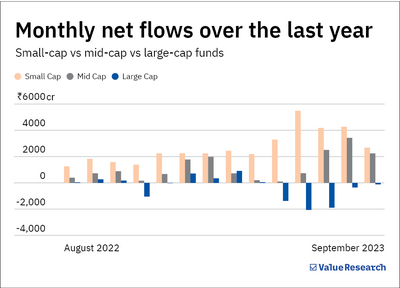
This remarkable performance has also driven a surge in investor interest towards small-cap funds. In September, small-cap funds attracted Rs 2,678 crore in investments, overshadowing mid-cap funds' Rs 2,234 crore. A similar trend was observed in August. However, large-cap funds witnessed outflows of Rs 110 crore primarily due to their underperformance.
However, for those interested in investing in small-cap funds, it is necessary to understand the risks that come with it.
More volatile in the short term
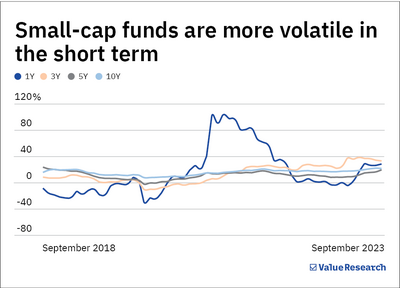
Historical data from the past 18 years reveals that for a one-year investment in small-cap funds, the worst-case scenario is a 61.2 per cent decline. However, there is a stark trend - this risk diminishes with time. Over three years, it drops to 16.4 per cent, and over five years, it's a mere 2.9 per cent. Even in a 10-year worst-case scenario, small-cap funds return a positive 7.4 per cent CAGR.
The graph starkly illustrates the rollercoaster nature of one-year returns, gradually smoothing out as we extend our investment time frame.
A double-edged sword
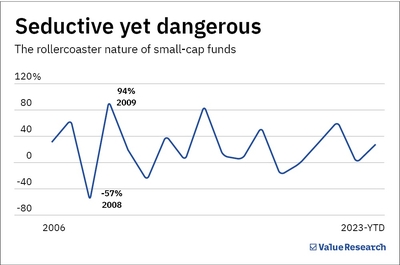
In investing, small-cap success stories are common, but so are wealth-eroding disasters. Small-cap investments can yield a staggering 94 per cent return in a year (as witnessed in 2009) but can also drain your wealth by a brutal 57 per cent (as demonstrated in 2008).
Furthermore, it is also noteworthy that over the last 23 years, just 13 per cent of small-cap stocks graduated to mid-caps or large-caps, while 29 per cent tumbled into the micro-cap territory.
Therefore, when considering small-cap investments, it's imperative to grasp these risks.
What should you do?
Allocate small-cap funds judiciously in your portfolio. They can be a valuable addition, but also come with higher risk and volatility. Over the long term, they can boost your overall returns.
Generally, it's recommended to allocate 50-70 per cent to your core portfolio in large-cap funds, 20-30 per cent in mid-cap funds, and 10-20 per cent in small-cap funds. To maximise returns, make portfolio rebalancing your ally. When small-cap stocks surge, sell some (since their value in your portfolio will increase) and adjust back to the recommended allocation. When they decline, buy them at discounted prices to maintain the desired allocation.
Click here to know the exact proportion of small-cap funds in your portfolio.
Also read: Equity funds inflows surpass Rs 20,000 crore
Disclaimer: This content is for information only and should not be considered investment advice or a recommendation.
For grievances: [email protected]
Ask Value Research 
 New episodes every Friday










 New Process Alert
 Seems like you've uploaded a wrong QR code. Please upload the QR code downloaded from MF Central platform.


