 Widely read:



When it comes to managing your investments, it's important to be aware of the strategies that can optimise your returns. One such strategy is cancelling out or offsetting capital losses against capital gains, a practice permitted under Section 70 of the Income Tax Act.
Offsetting is an accounting practice where one kind of accounting entry can be cancelled by an equal but opposite entry.
For instance, in our investment scenario,
- Short-term capital losses can be offset against both short-term and long-term capital gains.
- Long-term capital losses can be offset only against long-term capital gains.
- Any remaining unutilised loss can be carried forward for eight consecutive years, and can be offset against gains in those years.
Let's look at an example.
Suppose you've experienced a short-term capital loss from selling stocks. You can offset this loss against both short-term and long-term capital gains from mutual funds, NCDs (non-convertible debentures) or other stocks.
How to ascertain whether an asset is long-term or short-term
The holding period of an asset determines whether the gains/losses on that asset are considered short-term or long-term.
| Holding period | Capital gains/losses | |
|---|---|---|
| Equity-oriented mutual funds | Up to one year | Short-term capital gains/losses |
| Equity-oriented mutual funds | Beyond one year | Long-term capital gains/losses |
| Non-equity-oriented mutual funds | Up to three years | Short-term capital gains/losses |
| Non-equity-oriented mutual funds | Beyond three years | Long-term capital gains/losses |
| Stocks | Up to one year | Short-term capital gains/losses |
| Stocks | Beyond one year | Long-term capital gains/losses |
| NCDs (Non-convertible debentures) | Up to one year | Short-term capital gains/losses |
| NCDs (Non-convertible debentures) | Beyond one year | Long-term capital gains/losses |
How to ascertain your capital gains or losses in a given financial year
Use Value Research Online's ' My Investments ' tool to your advantage.
To ascertain your capital gains or losses in a given financial year, simply upload all your investment transactions on 'My Investments' . The process is smooth as butter.
Then, simply navigate to the Tax Report section, select the financial year and tax slab, and voila!
A comprehensive overview of your gains or losses across different investment avenues for that specific financial year is now at your fingertips.
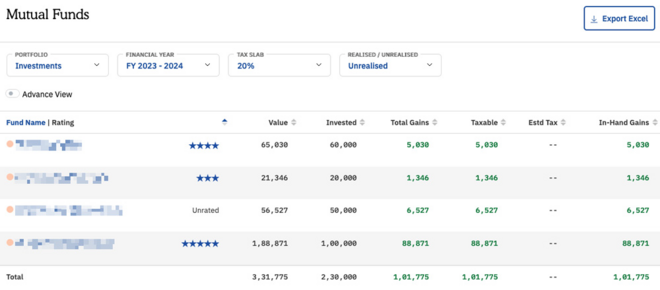
Tracking capital gains and losses is important for simplified tax planning and strategising your future investments effectively. It enables you to make informed decisions about realising gains or carrying forward losses into the next financial year.
The final word
While tax planning is important, it should not be the sole driver of investment decisions. Remember to focus on your broader financial goals and strive for a balanced approach that aligns with your long-term objectives.
Also read: Is tax harvesting a good idea?
This article was originally published on June 29, 2023.
Disclaimer: This content is for information only and should not be considered investment advice or a recommendation.
For grievances: [email protected]
Ask Value Research 
 New episodes every Friday









 New Process Alert
 Seems like you've uploaded a wrong QR code. Please upload the QR code downloaded from MF Central platform.


