





This rise in the popularity of investing via the SIP route is a promising trend, which is here to stay. But with it, there is something else which is garnering attention - the creative variants of SIPs. Such SIPs modify your instalment amounts based on some triggers, which are usually linked to the market level on the day of your SIP instalment. But should you go for these innovative SIPs or is this creativity only a gimmick? We compare the good old traditional SIP with its two younger cousins to find the answer.
Traditional SIP
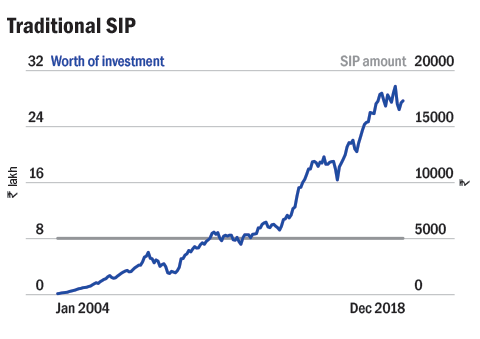
In its basic form, a systematic investment plan is a method to regularly invest a fixed amount in mutual funds. As an investment tool, an SIP enables an investor to spread his investments over a period of time. Besides enforcing the discipline towards saving and investing, it helps you avoid the possibility of catching a market high. It also fits well with the earning cycle of a small investor - you earn monthly, you save monthly and you invest monthly. If an investor had invested Rs 5,000 every month in an average multi-cap equity fund over the last 15 years, he would have earned an average annual return of 13.75 per cent, making his total investment Rs 9 lakh grow to over Rs 27.5 lakh (see the graph below).
SIPs with a valuation trigger
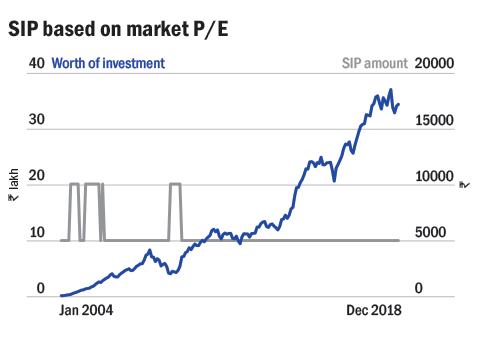
This is an SIP variant where the amount of monthly investment is based upon the level of the markets, typically the price-to-earnings (P/E) multiple of the market index. The idea is to invest more when the markets are cheap and less when the valuations become rich.
Let's continue with our earlier example to understand how this works. Let's say that our investor friend who was looking to invest Rs 5,000 per month in an average multi-cap equity fund 15 years back adds a further condition to his SIP: whenever the P/E of the Nifty 50 Index will be less than 15 on the date of SIP instalment, Rs 10,000 will be invested instead of Rs 5,000 for that particular month. Effectively, he put a valuation trigger to his SIP. The graph below displays what he would have achieved.
Value-averaging SIPs
Now let's look at the third variant, value-averaging SIPs, where the investor invests an amount relative to a desired target return. The main difference between a value-averaging SIP and a traditional SIP is that while the latter keeps the amount of monthly investment fixed, a value-averaging SIP aims to keep the worth of your investment on a predictable path and varies the amount invested every month to achieve that.
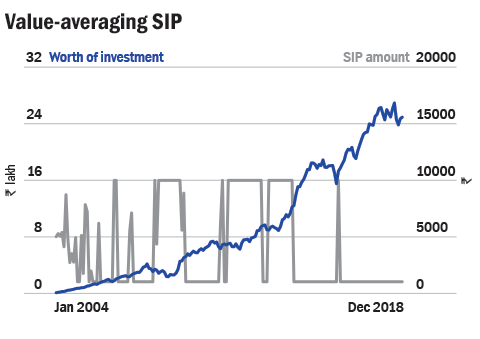
For example, if your underlying expectation is to grow your capital at the rate of 12 per cent per annum, a value-averaging SIP will increase or decrease the amount invested every month so that the total worth of your investment remains close to what it should be assuming a 12 per cent growth rate. To ensure that the monthly investment amount is not too erratic and within the range of what you can afford to set aside every month, you can put an upper and a lower limit to it. This also translates into investing more when the markets perform poorly and vice versa, just like the SIP with a valuation trigger, but here the trigger is the rate of return instead of the market multiple.
So how would such a strategy have fared in the last 15 years? Again, let's assume that an investor started investing Rs 5,000 every month in an average multi-cap equity fund 15 years back. But this time, he opted for a value-averaging SIP with a target rate of return of 12 per cent per annum and the upper and lower limits of monthly investment of Rs 1,000 and Rs 10,000. The graph below illustrates the outcomes.
The verdict
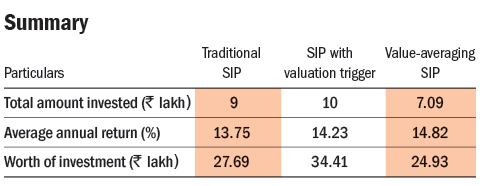
As you can see from the summary table, the variants of the traditional SIP did manage to slightly outperform the latter in terms of overall returns under the given set of assumptions, but the trade-off is a significantly variable monthly investment amount.
Therefore, traditional SIPs should be the default choice for a vast majority of small investors who have tightly defined surpluses available from their monthly earnings. It also scores high on simplicity.
The other alternatives are only viable for those who have enough spare money in their bank accounts to absorb the unpredictability in monthly investment. But then again, wouldn't you rather invest your surplus money and let it generate wealth over time instead of keeping it idle in your bank account waiting for the 'right' time, which is the very shortcoming an SIP aims to overcome?
Ask Value Research 

 New episodes every Friday

 New Process Alert
  Seems like you've uploaded a wrong QR code. Please upload the QR code downloaded from MF Central platform.


