


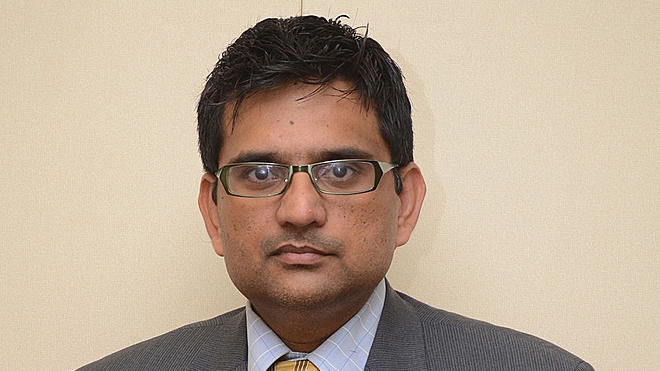
Equity fund managers in India are mostly an outgoing lot, prone to giving interviews and sound bites that are eagerly lapped up by their large fan following in the market. Debt fund managers tend to be more nerdy, sticking to behind-the-scenes analysis of charts and macros. The jargon shrouding the bond market, with terms like yield curves, credit calls, modified duration thrown around also keeps lay investors at bay.
But R Sivakumar, Head of Fixed Income at Axis Mutual Fund, does his level best to break this stereotype. Not only is he quite active (and popular) on twitter, tweeting from the handle @eyeofsiva, his periodic notes on the debt market are jargon-free and widely shared by the investing community. This is why I decided to catch up with Siva for the latest edition of Getting Personal.
Fed risks again?<br> Knowing Siva's avid tracking of macro developments, I flag off with the 4-trillion-dollar question. Everybody's gung-ho about India today. But the trouble's always lurking in the global cues. So after the taper tantrum and Fed rate hikes, what will be the impact of the US Fed unwinding its XXL balance sheet on India? Will it suck out liquidity from the global markets?
Siva thinks there's no need to panic. He points to the fact that it was only the first tranche of QE (quantitative easing) that had a big expansionary impact on the global market. QE2 and QE3 mostly left the markets cold. Therefore, if the QEs didn't have much of an impact, how will their withdrawal lead to a freeze? In fact, there could be some pluses to the Fed unwind, he argues. "Today, US is facing a shortage of safe bonds that are used as collateral. As the Fed unwinds, some of the collateral will go back to the private sector. Markets that were affected by this shortage can ease up."
I'm impressed by this logic and egg him on, asking how this will affect interest rates. "When QE was running, market yields in the US actually rose. Basically, the market anticipated the success of QE and priced it in. It expected US growth to improve and inflation to rise due to this stimulus. If that logic holds now, the withdrawal of QE should see market rates drop! This is why I think it is very important for us to see beyond the first-order impacts of any event. The first-order effect of this unwind may be that yields rise. But the second-order impact may be very different," he says.
But economists watch the difference in interest rates between US and India like a hawk and fear that FIIs can pull out money from India if that spread shrinks, I comment.
Siva coolly disses that idea. "Historically, there is no such relationship. Between 2004 and 2006, there was an extraordinary monetary tightening in the US, when their rates went from 1 per cent to 5.25 per cent in less than two years. The gap between US and Indian rates narrowed from 3.5 to 1.25 percentage points in that phase. But during that period we didn't have any shocks in India due to outflows. In fact, the rupee strengthened. Today the gap is far wider, at 5 to 6 per cent. It will take many years of Fed tightening for it to get to the earlier level. So we do not need to worry so much," he says.
Rates close to bottom
So what is Siva's view on domestic interest rates? Is he in the camp that thinks that RBI is done cutting rates and may even hike?
"I believe that we are very close to the bottom. But one or two cuts may happen this year, given the very low inflation points recently. Who would have thought, when they set RBI's inflation target that the inflation rate would fall to the lower end of the band? The RBI is, therefore, under a lot of pressure to deliver a rate cut or two." He qualifies that the market has probably priced in one cut at least. So there isn't much scope for yields to drop from here.
Should investors then stop betting on medium-term and long-term gilt and income funds? "You may have a tactical opportunity on duration but not a long-term opportunity. I recommend short-term corporate bonds for two to three-year holdings", he says closing the subject.
Credit situation better
But isn't credit risk a hot potato, with all this news of defaulters and insolvency proceedings? Does Siva see the situation on corporate credit improving?
"Yes, at the macro level, we do think credit conditions are improving". He goes on to explain. "What we have seen post 2014 is a sharp fall in commodity prices. This has helped the margins of commodity users. The fall in interest rates has also improved the debt-servicing ability of these companies. But commodity producers in sectors like steel are now stressed. But for every one steel company that is stressed, there are dozens of downstream companies - like autos or auto ancillaries - that have benefitted from the fall in steel prices. Credit-rating data show that for every downgrade in 2016, there were more than two upgrades. So there is this one set of large companies getting downgraded in steel, metals, telecom etc., while the majority of companies are getting upgraded. As a debt portfolio manager, I can avoid these few heavily indebted companies but can buy the many firms that are getting upgraded," he explains.
He thinks that debt funds investing in AAA bonds offer good value at this time. What about Axis funds? "We have low exposure to debt rated below AA. We try to have a very diversified portfolios. We have internal limits on credit risk that are much tighter than SEBI limits."
Accrual - a bad word
Duration and credit calls are both legitimate ways to earn higher returns for debt funds. But why are Indian investors so panicky at the thought of credit risk, I ask him.
Siva disagrees. "I think it is the opposite. If you see retail inflows into debt funds, a lot of them go into credit-oriented funds. In fact, there's this one industry term that I really hate - 'accrual funds'. It somehow suggests that credit funds have less risk. It is misleading. When you own a portfolio with AA and A rated paper, a lot of that paper is not liquid. Therefore, when rates move, it does not show up too much in your NAV. But the truth is that this credit fund is riskier than the AAA fund. This is one aspect on which both the industry and the rating entities like you have to educate investors," he asserts lobbing the ball at Value Research.
I agree and ask him to go on. "I see debt investors making two basic mistakes. One, they buy funds based on past performance, which often misfires. Then, they buy based on portfolio yield to maturity, which can again be risky. Investing needs to be forward looking. But more and more advisors are recognising these factors. The industry needs to be better at communicating this, too."
Inflation assumptions
The conversation gets quite technical and I veer to a simpler question. Does Siva think that inflation in India has been tamed for the good?
Can we start assuming 4 per cent inflation rates in our financial planning rather than 7 to 8 per cent? I quiz him.
Siva thinks it is time to revise the rate downwards but not to 4 per cent. "RBI's inflation band is 2 to 6 per cent. I don't think the lower end of that band is sustainable. Even today, if you break down the CPI index into its 300-odd components, you will find that many items other than food are still at 4 to 4.5 per cent inflation. It is the steep fall in food prices recently that has reduced it to 2 per cent levels. I think 4-5 per cent would be a sustainable level of inflation. At the same time, I think 2008 to 2012 was really an exceptional period for commodity prices, which led to high inflation. We may not go back to that."
Pruning our inflation assumption from 8 to 5 per cent will trim our retirement goals by a lot. So maybe all of us can stop working early... I joke. Siva has a hearty laugh at that one and cautions me not to be too overjoyed! "You must remember that our income will also grow at far lower rates, with low inflation. So you can't assume that you will still get a 10 per cent pay hike every year and build your financial plan around that. In the US, people get pretty excited if they get a 2 per cent pay hike, but in India we would hate it!"
Mr Bond
So what is Siva's personal asset allocation? He surprises me with his answer. His portfolio is mostly invested in fixed income.
He senses my astonishment and elaborates. "Two reasons for this. One I believe my own income, being in an AMC, is highly correlated to how financial markets are performing. So my income growth is quite equity-like. That's why I like to have a higher fixed income allocation. If I worked in any other sector, I would probably have a much higher equity exposure. "Two, it seems to me that, over long periods of time there is not much of a performance difference between debt and equity," he says, truly belling the cat!
"If you see data in India - the Nifty 50 versus the I-Sec bond index from 1994, when they both started, you will find that bond markets have given slightly better returns than the equity market at the index level. Over long horizons, like 20 years, there are some blocks of time where equities do well and some periods where bonds do well. I think it is hard for me to predict when one will outperform the other. So I like to have a balance in the portfolio."
I have to admit he is quite right, as the Nifty 50 return for the last 20 years is barely 11 per cent right now. It was in single digits not so long ago.
Given the higher tax rates on debt returns, what if he fails to beat inflation by sticking to debt investments?
He has a nice counter to that. "It is necessary to keep future tax rates and future inflation rates in mind while investing. In the future, equity gains could become taxable. Debt funds already offer indexation benefits on capital gains. For a multi-decade horizon, you shouldn't go by short-term factors like taxation".
That's food for thought, but I persist. What will happen to his portfolio if interest rates in the market keep falling? Won't that mean reinvestment risk (earning less when current investments mature)?
Siva offers a conceptual comeback to that. "If you have a 20- or 30-year time frame, the price change or mark-to-market component in bonds is irrelevant. Almost your entire return comes from accrual of interest. Yes, in equities, you really have to pay attention to the mark-to-market component. If I am buying equities for the next 10-15 years, I will want my buy prices to be really low and sell prices to be high."
He admits that this is very different from the way most investors approach markets. "They buy when past returns are good. I buy when past returns are looking quite bad. So if at all I time the market, I time it this way. I would like to buy equities when the past returns look pretty bad! But timing decisions only happen when you have unexpected money. Mostly I have an allocation in mind."
His arguments are so reasonable that I am almost tempted to book profits on my equity funds right now.
No credit
Where is his debt money invested? I ask. Here he gives a conventional answer. "Mostly in Axis-managed debt funds. I use a mix of long- and short-duration funds. The exposure is mostly AAA as Axis has only recently added funds in the credit space. But if I own a credit fund, I would like a portfolio that is ultra diversified. I would own a fund with 50 bonds, with a 2 per cent weight in each."
I quip that there is no such credit fund that I have seen.
He points out that debt funds with AAA bonds deliver pretty good returns in India plus "internationally, there is a high correlation between the performance of credit funds and equity funds. Both perform well during the same kind of phases in the rate cycle," he says, clinching the argument.
Second-order impacts
I ask him about his learning from debt-market cycles during his career. I am used to posing this question to equity managers who often cite 2000 and 2008 as the big turning points in their career.
Siva has a very good point to make that can apply both to equity and debt. "One very important lesson is about thinking through the second-order impacts of events. The first order impacts are easily seen and quickly discounted by markets. For example, when 9/11 happened the first-order reaction was that this would lead to a global risk-off. But what really happened was that the Fed then added a lot of liquidity to the markets, emerging markets actually rallied and the EM bond sell-off never happened. I think as a fund manager you need to consciously play for second-order impacts."
He goes on, passionate on the subject, "In my view there are three market drivers - macro factors, valuation factors and technical/sentiment factors. Often you get carried away by the last factor. Macros take many months to play out in bond markets. When you talk valuation, you look at the real interest rates and the spreads between corporate and sovereign debt. These play out over weeks or months. Technical factors play out over days. Very often, if you are in the market, you get real-time technical data. So you get carried away by it. But what makes you money is taking valuation and macro calls."
"Because the Street is focused on the technicals, outperformance comes from moving away from technical factors. That's how I construct my portfolios. I don't react to prices," he states.
Leisure time
So what does he do in his leisure time? Read giant volumes on economics? I ask, suspiciously. Siva laughingly agrees. "I am genuinely interested in economics as a subject. I read a lot. Economics is my passion but I do read a lot of history and science fiction. I watch a lot of British crime serials," he adds unexpectedly.
Maybe Sherlock-like skills come in handy to decipher the mysterious workings of the bond market.
"I spend an hour each day listening to podcasts on a variety of subjects. I do this during my daily commute. I try not to make everything financial," he says. He is also into photography as a hobby.
Is he a fitness buff? "If you see me, you won't ask that," he jokes and says he is slightly lacking in that department, though he swims occasionally.
I tell him that he need not be embarrassed as another fund manager told me that mental fitness is far more important than physical fitness. "That's a good reply. But seriously, the most important thing that people in the markets need to learn is how to switch off. In this field, you are always dealing with information overload. What matters is not the price of the day but what happens over your entire life cycle." I sign off on this nice piece of investing wisdom.
The most important insight I've received from this conversation is that when it comes to your personal investments, you should chart your own path. Don't be afraid to question even the basics - like equities being the best investment for everyone!
Ask Value Research 

 New episodes every Friday


 New Process Alert
 Seems like you've uploaded a wrong QR code. Please upload the QR code downloaded from MF Central platform.


