


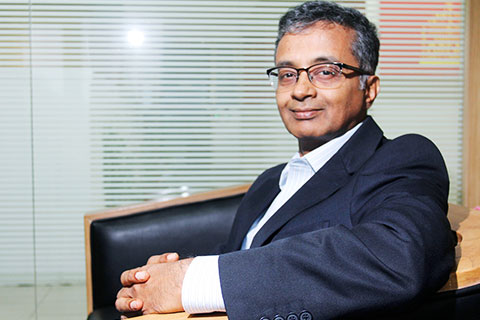
It was not just my lively interactions with him in the past that gave me the idea of chatting with Ashutosh Bishnoi, CEO of the brand-new Mahindra Mutual Fund, for this column.
I was also curious to know why this large automotive group was making its entry, as a late mover, into the crowded mutual fund industry. After all, with 40-odd players in the fray and the top five only getting bigger, smaller fund houses already complain about getting stomped on by the Goliaths.
I managed this chat over two phone conversations, as he was on the road, scouting the market. After some reminiscences, my first question was 'what is the new thing that Mahindra Mutual Fund hopes to offer investors, which the 41 other AMCs don't?'
Bharat is ready
Ashutosh says immediately that it is going to be the first mutual fund in India to specifically target Bharat rather than urban India. He goes on to give a bit of a backgrounder about Mahindra & Mahindra Financial Services (Mahindra Finance). Mahindra Finance, he says, is one of the largest NBFCs financing the purchase of automotive products in semi-urban and rural India. It is today present across 1,200 locations, reaching out to an impressive 2.6 lakh villages.
"The whole culture of the firm is built around serving the needs of the underserved customer in somewhat remote areas. We have a captive customer base of 45-46 lakh. So having done lending for so long, we thought we should also offer products on the investment side. The customers that Mahindra Finance caters to - those who buy automotive products - are not poor farmers. They are essentially land owners, dairy farmers, mill owners and so on. We conceived the idea of creating an investment solution for them."
Ashutosh thinks that far from being a late-mover, Mahindra Finance is an early mover to this neglected segment. "There are only two or three financial-product firms in India which have tried to tap this segment before: UTI, LIC and so on. We did a survey before we started out. According to it, less than 4 per cent of Mahindra customers in 1,200 centres had engaged with mutual funds in any way."
Suit-boot and Ponzis
That's very true, but is there an appetite among non-city folk for a complicated product like mutual funds? He is convinced that there is. "What we are seeing today is a big shift in rural India's savings preferences. In the past, maybe 90 per cent of the savings in rural India and small towns went into land and gold. But in the last 5 or 10 years, the galloping price of land has put it out of reach for the common man in Bharat. Gold also has become less affordable, with prices heading steadily up. There is now a lot of confusion in rural people's minds about what to do with their money."
This is the gap that Ponzi schemes have exploited, Ashutosh observes. "There's this guy with a suit and tie in an AC office and people think that the investment can't go wrong. But after the frauds, people are increasingly more suspicious."
In small-town India, he says, the latent appetite for mutual funds is huge. "We saw tremendous appetite for investment products in towns like Azamgad, Hardoi or Gorakhpur, which is largely unmet. It isn't easy to compensate distributors to serve such markets. We have also had many eager youngsters from these towns trooping into our offices to ask how they could scale up in the advisory business."
To reach out to such towns and villages, Mahindra Mutual Fund is getting Mahindra Finance staff who handle lending trained in mutual fund selling. About 300 personnel have received ARN certifications. The fund is also reaching out to banking correspondents. Also, "some large IFA consolidators are keen to expand into the next level of cities. There are hardly any fund houses who have told them 'you are doing business in Kolhapur, let's go to Ichalkaranji'."
Brands and mehengai
But even city-slickers get cold feet about investing in equities, so how will Mahindra Mutual Fund persuade rural folk to invest in equity funds? Ashutosh has some very innovative marketing ideas.
"It is a matter of how you explain it. I travelled all over North India, from Rajasthan to Eastern UP. I talked to many rich farmers who would ask me 'yeh mutual fund kya hota hai?' So I would ask them about the home appliances they had bought recently and they would point to a Mahindra tractor, a Videocon fridge, branded cooking oils and FMCGs. I explain to them that they too can invest in these companies and make a share of their profits. They are stumped and ask how it is possible! So when I tell them that this is the kind of companies that mutual funds invest in, they are interested."
People in small towns are far more suspicious and canny than city folk. But Ashutosh has found that rural folk aren't afraid of risk. Farming is highly risky after all and they are used to crop failures.
"These guys have an instinctive understanding of inflation and volatility, which they see in their produce prices at the mandi every day. They understand that money loses value and they need to do better than mehengai. Because the Mahindra brand has been familiar to them over three generations, the comfort level they have with the brand is high," says Ashutosh.
Be local
Mahindra Mutual Fund has also broken with the industry's tradition of naming its products in a jargon-bound manner and is going with Hindi names.
"People relate more easily to products named in their local language. So our tax fund has been named Mahindra Mutual Fund Kar Bachat Yojana and that immediately evoked a lot of interest. Our new fund is labelled Mahindra Dhan Sanchay Yojana, a fund for accumulating wealth."
A trick of the trade, he says, is to closely study the way LIC and state governments name their schemes. "If you don't stray too far from the way they name their products, you can't go wrong."
But isn't SEBI finicky about fund names? Ashutosh denies this hotly. "SEBI has been extremely supportive of our plan to go into semi-urban and rural India. We were the first fund house with a Hindi fund name and they approved it without batting an eyelid."
Wrestling, funerals and migration
But it is not just semantics which matter but also the way the schemes are structured. Mahindra Mutual Fund plans to have a small suite of simple products. These will be designed around customer goals and not asset classes.
Mahindra Mutual Fund has found that rural folk have very different financial goals from those of urbanites.
"There are many families in Punjab and Haryana where the daughter of the family wants to be a wrestler. So they are looking at how they can fund this," says Ashutosh quite seriously.
"One of the largest outflows of money in a rural household happens when someone dies. It is bigger than a wedding. So we may need to structure a product that helps them deal with unforeseen emergencies. Also, almost all rural and semi-urban households have this tacit understanding that someone from the family will migrate to a city. When this happens, they have need for income to run a parallel home in a city."
Those are surely not goals that conventional financial planners will budget for, I think to myself. Ashutosh and his team sure have done their homework. He feels that a balanced fund may meet these needs well.
Mahindra Mutual Fund's recently launched Dhan Sanchay Yojana seeks to balance the risk of equities by investing 50 per cent of its corpus in fixed-income securities and equity arbitrage and the remaining 50 per cent in pure equities.
Low-cost structure
To keep the newbie fund house's costs low, Ashutosh is also keen to take a minimalist approach with manning his teams. "Most players in the mutual fund industry have built their teams at very high costs. They have offices in fancy places. That is a sure way to die an early death. In this very low-margin business, you can only scale if you survive. So we took a very hard look at our costs and have tried to set up everything at the lowest-possible costs."
But what about highly paid fund managers? Didn't Mahindra have to poach them from others at a hefty package?
Nope, he has managed to hire his investment team at decent packages without straining the budget, says the CEO. "We have a six-member team based out of Mumbai. Two things I encourage my team to do are to not rely on broker research and to build the ability to analyse any company in any sector, without narrow sector specialisation. We hope this will help cross-pollination of ideas and the keep team size low."
To aid this, Mahindra Mutual Fund has created a proprietory database of nearly 200 companies, with historical data on all these companies with valuation ranges, price ranges and detailed annual-report disclosures. "This gives a long and crisp view of each company. Often this kind of information is not available from brokers, who are short-term oriented."
Up for challenges
Ashutosh's out-of-the-box marketing ideas make me curious about his career and I ask him about his previous stints.
He's had more than the usual share of adventures, for sure. After spending over a dozen years in advertising, Ashutosh jumped into DSP Financial Consultants in the nineties because he was fascinated by financial products.
Soon, the private-sector mutual fund industry was buzzing with action and DSP grew to be a big lead manager and then an actual sponsor of a mutual fund, where Ashutosh headed up sales and marketing.
Ever keen on new challenges, he joined the founding team of Kotak Insurance and then was invited by M Damodaran to help turn around a troubled UTI. After that experience, Ashutosh was keen to strike out on his own.
But his timing sucked. "I tried to set up a quant fund in 2008, which bombed after the global crisis," he chuckles, quite happily. "I have been a consultant for large financial businesses since. I also ran the Reader's Digest franchise in India for a while as CEO and publisher," he adds, surprisingly.
His money
With a career path like this, is he also equally adventurous with his investments? Unpredictable as ever, Ashutosh says he is a very risk-averse investor.
"See, my preferences may not apply to other investors. But I personally look mainly for protection from the vagaries of different markets. I am not an aggressively return-chasing investor. I look more to control risk.
I divide my money into three asset classes: equity, debt and cash equivalents. I go for the highest-quality equity, highest-quality debt and highest-quality cash. Let me explain that," he says before I can pipe up asking him what he means by 'quality'.
"Highest-quality equity to me is a company that does not depend on capital markets for its growth. You can't always buy such companies cheap, but when you get the opportunity you should buy such firms," he says, adding that he has stopped direct equity investing since joining Mahindra Mutual Fund and now has 'skin in the game' in its schemes.
For high-quality debt, Ashutosh prefers companies that tap bond markets with the backing of a huge physical asset base. "I look for debt-raising to be a small fraction of the company's balance sheet. Take NTPC as an example. It has huge physical assets and it taps the bond market rarely, but that's the kind of quality I look for."
Ashutosh turns out to be a gold bug. "I don't treat gold as an asset but as high-quality cash. Gold is after all the ultimate reserve currency of the world. Gold has been for the longest period of human history, the currency of choice for people. No economic sanction or change can take that away," he waxes eloquent. He owns gold through ETFs because of their superior liquidity.
He seems to be a CEO who makes quite a passion out of mutual fund marketing. So does he have spare time, I ask cautiously.
"Plenty of spare time!" he booms. "I travel quite a lot. I spend some time working out in a gym. Reading is constant. I haven't managed to switch to the Kindle. I love the smell and feel of a book. On every flight, I acquire a new book. I read absolutely anything."
He, his wife and his son share a real passion for wildlife. They aren't content watching wildlife on the Discovery channel, but like it up close and personal!
Having been on a few safaris where I only managed to spot monkeys, I ask him if he's seen a tiger. "Many times," is his immediate answer. "We were recently at Kabini and we saw a tigress with three cubs. We spent a longish time around it. I've seen tigers a few times at Corbett and at Madhya Pradesh."
The Bishnoi family has also had some Man vs. Wild type of encounters. "In Corbett, three years ago, we had a tiger make a mock charge at us. It was an open jeep," he says cheerfully.
"Didn't your heart stop?" I ask, thinking of how I would have reacted. "No, no you simply watch. You forget to be scared," he says blithely and comes up with one more anecdote.
"We also ran into a young elephant in Corbett, which started chasing our jeep. We had no time to turn around the jeep, so we just reversed inch by inch. The elephant stopped about a 100 yards from us, uprooted a huge tree and threw it aside as a challenge. That gave us 30 seconds to turn the jeep and run out of there," he says, admitting that he was a little rattled that time.
He urges me to visit the Serengenti National Park in Tanzania, telling me that such grasslands will not "last very long," as they will be converted into farmland. I tell him I will certainly take this advice.
With a CEO who has had tigers leaping and elephants charging at him, maybe Mahindra Mutual Fund wouldn't hesitate to take on 41 other AMCs?
Ask Value Research 

 New episodes every Friday


 New Process Alert
 Seems like you've uploaded a wrong QR code. Please upload the QR code downloaded from MF Central platform.


