 Widely read:


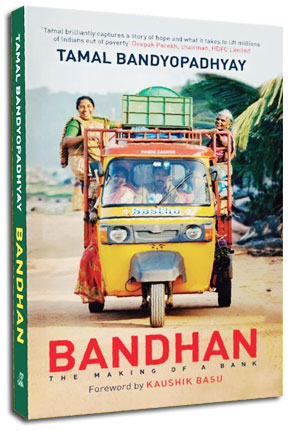 Mohammed Yunus won the Nobel Peace Prize in 2006 for his Grameen Bank, a microfinance institution. Tamal Bandyopadhyay writes the story of Bandhan, the larger and understated Indian counterpart. The microfinance sector has opened itself up to equity and debt investors over the years. In 2010 SKS Microfinance (now Bharat Financial Inclusion Ltd) went public raising Rs 1,653 crore. In 2016 Equitas Holdings and Ujjivan Finance raised 2,170 and 885 crores respectively. The shares of both companies listed at a 10-30% premium to their issue price. Bandhan is not listed but it is also a universal bank unlike its peers (which have sought payments bank licenses). Peer into your debt fund portfolio and you may well find your money making its way towards Bandhan through its bonds and commercial paper; and from there to the women of rural India.
West Bengal's financial history has been one of many tragedies. At Independence in 1947 India had 82 scheduled banks with about 25% located in the State of West Bengal. Partition dealt them a blow. Of the 38 banks that failed in 1947, 17 were in the state. West Bengal also has more companies raising money illegally from the public than any other state in India.104 of 194 companies against whom SEBI took action between mid 2011 and mid 2015 for issuing debentures and equity illegally were located there. Madhya Pradesh was a distant second with only 27 such companies. The Saradha group raised anything between 20,000 to 30,000 crore from the public (primarily in West Bengal) before it collapsed in 2013.
It is this gap that Bandhan stepped into. It was founded by Chandra Shekhar Ghosh the son of a sweet shop owner in Tripura. Ghosh was a man of modest means who initially ran a small knitting workshop and then joined an NGO which had just entered the field of microfinance. A fascinating anecdote surrounds Ghosh's inspiration for his future great endeavor. Ghosh used to watch a daily occurrence at Shobha bazaar vegetable market in Kolkata. Every morning a young man in a red T-shirt would dispense Rs 500 each to several women vegetable sellers in the market and collect Rs 5 from them. That evening the women would return the 500 rupees. Ghosh calculated that the women were paying Rs 5 as interest for half a day which translates to 730% per annum. When he asked them about this they replied that they were just buying a cup of tea for the moneylender. They also asked him, 'will a bank give us the money?' Ghosh decided to tackle the problem they presented. In 2001 he set up an NGO called Bandhan-Konnagar which later morphed into Bandhan. The name was meant to signify a bridge or bond between the haves and the have-nots. In 2002 he got funding for his organization from SIDBI which enabled him to launch operations in full swing. This later matured into a long standing relationship with SIDBI infusing both equity and debt into Bandhan over the years.
In its first year of operations (2002) Bandhan had 2 branches and 512 borrowers and lent out 21.8 lakhs. This grew to 1143 borrowers in 2003 and then accelerated dramatically. Over the next 3 years, this number rose by nearly hundred-fold to 1,49,886. Its loan book also multiplied at the same rate to 22.38 crore. Bandhan also began getting additional funding from SIDBI, HDFC and ICICI Bank along with the Ford Foundation and Friends of Women's World Banking. It slashed its interest rate from 17.5% to 15% in 2005. In 2006, Forbes placed it on the second spot in its rankings of microfinance institutions around the world, far above Bangladesh's famed Grameen bank. It was at this point that Bandhan decided to convert itself into an NBFC to smoothen its journey into the big league. In 2009 it transferred its entire portfolio to the NBFC (Bandhan Financial Services Pvt Ltd) and made Bandhan-Konnagar the original entity, a CSR arm. In 2011 it had about 32,50,000 borrowers and a 2500 crore odd loan book. This when the microfinance crisis triggered by an Andhra Pradesh law struck. Borrowers in Andhra Pradesh stopped repaying microfinance lenders and bad loans multiplied several times over. Bandhan had a limited exposure to the state but Ghosh refused to take any chances. He called in Bandhan's pre-sanctioned loan of 400 crore from IDBI Bank and raised another 110 crore from other banks to create an emergency war chest. A halt was called on new branches and customers. The crisis soon passed and Bandhan came out on the other side with relatively little damage. That said, Bandhan is disproportionately exposed to another state - West Bengal which may well undergo a similar episode.
| 2002 | 2006 | 2011 | 2016 | |
| Branches | 2 | 155 | 1553 | 2022 |
| Borrowers (000s) | 0.5 | 150 | 3250 | 6717 |
| Loan Book (Crores) | 0.35 | 22.38 | 2500 | 15600 |
In 2012 IFC (the private finance arm of the World Bank) picked up a 10.93% stake in Bandhan for 135 crores paying 2.5 times of what SIDBI had paid. Majority ownership of Bandhan continues to rest with public charitable trusts that are engaged in microfinance with its employees' trust also holding a significant stake. In 2014, Bandhan got the RBI's in principle approval to set up a bank and commenced operations in August 2015. It has a capital of 2,570 crore and 2022 branches across 22 Indian states. It has garnered about 12,090 in deposits (a 25-30% monthly growth rate) which it was able to attract by offering interest rates about 0.5% higher than the average and another 0.5% for senior citizens.
Whilst Bandhan's deposit growth has been spectacular, a bank's true arbitrage comes from the differential been current and savings accounts (CASA) and lending rates. Can the bank raise this money? Its current CASA ratio (the proportion of its deposits that comes from Current and Savings Accounts) is 21.55% compared to HDFC Bank's 40%. Bandhan's staff are proficient at lending to small borrowers but they have very little experience with the collection of deposits. Connectivity is a tremendous challenge in rural areas and staff need to be trained to use mobile phones and computers in their work. Attracting top talent to its headquarters in Kolkata will also be a challenge given the city's relatively diminished stature.
The largest challenge for Bandhan is whether it will go down the beaten track selling products such as insurance, mutual funds and credit cards. These products are a juicy income stream for high street banks even though their widespread misselling has cost these banks dearly reputation-wise.They are also greatly different from Bandhan's core expertise. However a singular focus on traditional banking may leave Bandhan over-reliant on a single income stream. Bandhan may instead reject both options and find new and innovative methods of connecting urban savers and rural borrowers - India and Bharat. Considering its founder's track record, I wouldn't be terribly surprised if it does.
This article was originally published on October 10, 2016.
Disclaimer: This content is for information only and should not be considered investment advice or a recommendation.
For grievances: [email protected]
Ask Value Research 
 New episodes every Friday

 New Process Alert
 Seems like you've uploaded a wrong QR code. Please upload the QR code downloaded from MF Central platform.


