




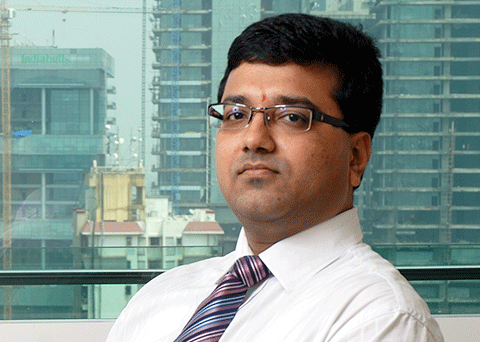
Prashant R Pimple, Fund Manager, Reliance Regular Savings Fund tells us how a long-term fixed income investor can optimise returns.
What is your outlook on interest rates in India?
We expect India rates to gradually fall from current levels mainly on account of disinflationary path to continue and better fiscal management by the government. We expects this lower yields scenario to continue for coming two years as government pursues its reform process further to better India GDP growth and RBI supports governments efforts in doing so by monetary easing.
What is your framework of taking a duration call?
Duration in any debt portfolio is an outcome of the our medium to long term view on macroeconomic parameters and interest rate expectations going forward. The extent of duration maintained in any of our debt fund is result of our mandate in a particular fund and the philosophy on which the fund is managed. In our set of fund the longest duration calls are taken in fund like Gilt, Income and Dynamic and moderate duration calls are taken in short term and credit funds. Currently since our view is bullish on rates we are maintaining high durations ( subject to duration mandate of the fund ) in all our duration funds.
What is your framework of taking a credit call? What kind of credit risk you don't take at all?
Our credit research team conducts a thorough appraisal of the issuer using both financial and non-financial metrics. Based on their risk assessment, they conduct its (a) Business Analysis which includes industry / sector Analysis, market position analysis and operating efficiency analysis , (b) Financial Analysis ,(c) Management Analysis,(d) Project Risk Analysis and (e) Parent Support Analysis.
Credit Research team take into account rating given by external rating agencies as one of the input. That apart, it also appraises the terms and covenants relating to the particular instrument and draw comfort from the security features of the instrument like loan-to-value of the security. guarantees provided by third parties, etc.
Credit Research team interacts with market participants, on ongoing basis, including bankers to understand their views on issuer credit -worthiness, payment track record and financial flexibility to borrow. It also interacts with rating agencies frequently to understand rating processes & their views / concern on various credits. Credit Research team interacts with corporate on regular basis to assess general / specific business environment changes which may impact the creditworthiness favorably / adversely. On periodic basis , they review performance of the companies to monitor its creditworthiness.
The above process is similar for research undertaken by credit team for all of the debt securities whether debentures and commercial papers. In structured products and asset backed securities, credit research team do issuer analysis on above mentioned parameters. Apart from issuer analysis, team do (a) underlying asset analysis ,(b) underlying structure analysis ,(c) collateral analysis ,(d) cash flows structure review and (e) Review of Legal structure .
Research team structures financial instruments with input from strong in-house legal team to mitigate any execution and legal risk. It monitors performance of such instruments on ongoing basis. It interacts with Issuer understanding the changes in their business process and asset behavior. It interacts with rating agencies frequently to understand rating process & their views / concern on Issuer / underlying asset / transaction performance.
We have bottoms up approach. As outlined above, we consider company on its own strengths and weakness. We are sector agnostic, However, in certain sectors we are cautious like gems and jewellery, sugar, etc. However, in those sectors also, we have invested in certain companies / structures where we were comfortable like we have invested in Titan Company Ltd which is part of Tata Group and is in gems and jewellery business and is doing very well. Similarly, we have invested in a structure where commercial paper of Shri Renuka Sugars Ltd is backed by IDBI Bank Stand by Letter of Credit ( SBLC) which means our credit risk is to IDBI Bank and not Shri Renuka Sugars. We are comfortable with IDBI Bank credit risk as it is a Public Sector Bank and is highly rated.
Any rule which you rigorously follow in managing your fixed income fund today?
One rule which we strictly follow in all our funds is avoid one sided calls. The standard strategy what we follow across funds is a two pronged strategy one is core ( medium to long term ) and the other is tactical ( short term market opportunities ). The core position will be reflect our medium to long term views on interest rates and the tactical position would be typically used to generate alpha out of short term market movements.
In your view, how should a long-term fixed income investor optimise his returns?
I think for any investor there one common rule of "sticking to their respective investment horizon" so as to achieve desired results of investments. Similarly long term fixed income investor should stick to the investment horizons of investments made into different fixed income funds. Not only does it generate better post tax returns but it also negates the volatility factor in our investments. In the current scenario a long term fixed income investor should allocate his investments in three basic kind of funds Short term fund, Credit funds and Dynamic bond funds. Short term fund will help achieve investors near term liquidity needs at the same time generate attractive returns with low volatility. Credit funds investment can be a very good substitute to other fixed income instruments available in the market as far as post tax returns and volatility is concerned. And, in the current scenario where the expectations are that of rates softening going forward investment in dynamic bond fund with long duration will be an apt product as far as returns are concerned. A proper allocation between these schemes will achieve three main objectives of investments 1.) Liquidity 2.) Low volatility and 3.) Attractive Returns.
What will you attribute the above average performance to?
The strategy of our RRSF-Debt fund has been to maintain a healthy carry of the portfolio with a moderate duration in order to achieve its objective of stable returns over medium to longer investment horizon. Also we timed our increase in hybrid credit component once clarity emerged on political as well as macroeconomic front giving us much needed credit comfort. This strategy helped us in maintaining our gross yields at attractive levels even after yields corrected downwards in last one year. The fund philosophy and strategy both helped us in delivering better performance in RRSF-Debt over the years.
Please click here to read the analysis of this fund.
Ask Value Research 

 New episodes every Friday

 New Process Alert
  Seems like you've uploaded a wrong QR code. Please upload the QR code downloaded from MF Central platform.


