


Voltas, the country's market leader in room air-conditioning with a 20 per cent market share, is rearing to set its house in order. Aggressively going after contracts especially in the Middle-East saw the company straddled with delayed and slow moving orders, with some of them being completed even at a loss. As a result, Voltas' stock price has remained muted for many quarters now. But with many of those legacy orders now coming to a close, the company seems to have learnt from its mistakes. The fact that it is cash rich is also helping Voltas to tide over difficult times.
Growth drivers
Improving opportunities in the Middle East:
After the market collapse of 2008, buyers were running scared, with many projects put on hold or delayed. Things may have started looking up though. Fresh investments, particularly in Saudi Arabia, Qatar, Dubai, Oman and Bahrain, have picked up. Incidentally, these are the very places where Voltas has a good presence. But rather than targeting large iconic projects (at low margins) that would shine on its CV, Voltas is looking at relatively smaller contracts of between Rs 200-300 crore where competition is less and margins are higher. Going ahead, the 2022 FIFA World Cup in Qatar should also rustle up investment activity in the area.
Order book growth:
One of the main issues that infrastructure sector has been contending with for some time now has been the vanishing of fresh orders. The slowdown coupled with financial stress throughout the world has put a spanner in many projects globally. Voltas did not see any order book backlog growth for the last one and a half years. With the results of latest quarter in, things appear to be changing. Order inflows in the September 2013 quarter grew 3 times over the previous year. Much of this growth has been in the Middle East.
Margin improvement ahead:
The Middle East is a highly competitive market. Though Voltas grabbed a number of iconic projects during the boom years, the wafer thin margins later evaporated as delays and cost overruns kicked in. Having learnt its lesson, Voltas now bids for only those projects that have upwards of five per cent margins at the Ebit levels- significantly higher than current segment Ebit of 0.8 per cent. This is the company's Electro Mechanical Projects (EMP) vertical that accounts for 58 per cent of the topline.
While previous low-margin orders are still to be exhausted, the company has indicated that margins should improve from the first quarter of FY15 onwards as proportion of revenues derived from recent orders increases.
Margins in the company's Unitary cooling products (UCP) segment that sells room air conditioners were up 3.55 per cent over the previous year on account of a better product mix (read higher sales of split ACs), lower advertising expenses and other one-time savings.
Consolidating its leadership:
Voltas consolidated its position as the market leader in room air conditioners (ACs) with a market share of 20.5 per cent-up from 18.4 per cent at the close of FY13. The company gained share in the West and the East regions of the country. Higher institutional sales especially demand from ATMs across the country pushed volumes further up. Commercial refrigeration too has seen good demand following the retail expansion and packaged frozen food segments.
Working capital improving:
Higher working capital turnover on account of a tight liquidity environment and lower capital employed in the EMP segment has had its benefits. Voltas saw operating cash flows jump to around Rs 155 crore in the first half of this year compared to negative cash flow of Rs 180.6 crore in the corresponding period of the previous year.
Cash per share:
Voltas has a cash surplus of Rs 790 crore invested mainly in liquid instruments. This works out to Rs 24 per share or 26 per cent of the current market cap. That the company is not burdened with loads of debt as some of its peers are also helps in tiding through difficult times.
Concerns
Highly seasonal: Sales of room air conditioners are highly seasonal. The September quarter for instance is impacted by monsoons, the December to March quarters similarly are reeling from the cool effects of winter which means low volumes for ACs.
Delay and impact of legacy orders. Though the share of legacy orders is coming down and much of it should be taken care by the fourth quarter of this financial, delays and cost overruns have had their sway on Voltas' fortunes for some time now. Any unexpected delay or further cost overrun will haunt its performance ahead.
Financials
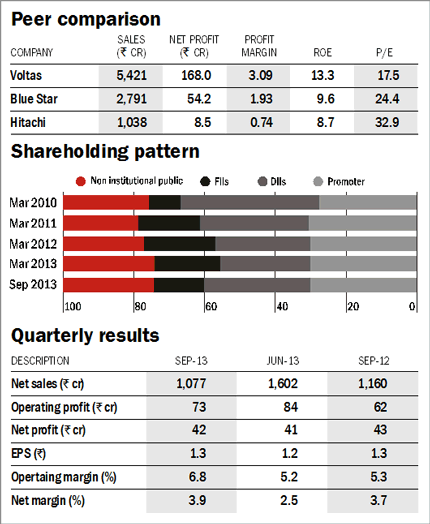
Even though things have started looking up, the second quarter of FY14 was a downer. Revenue fell seven per cent over the previous year owing to 14 per cent decline (y-o-y) in the EMP vertical which was in turn affected by slowdown in international projects. The company's unitary cooling products (UCP) segment remained flat as monsoons lingered longer. With fresh orders coming in from the Middle East, order book jumped from Rs 3,810 crore (Q1FY14) to 4,350 crore.
Outlook and valuation
With a healthy order book in its bag, higher profitability profile of fresh orders and consolidated position of its room AC market leadership, Voltas looks set for a turnaround. Just don't expect a turnaround in the next quarter or two. Revenue growth for the second half of the current financial and the following year is still expected to be flat (Ambit estimates) as the company winds down legacy orders. Margin improvement especially in the electro mechanical projects (EMP) vertical looks set to go up. Voltas has already been able to sustain margins upwards of 10 per cent in its UCP segment so that should hold it in good stead. Voltas is not a get-rich-quick turnaround story. The company is the market leader in its business and is now correcting the mistakes of its past. The stock trades at 17.5 times its earnings--slightly higher than its five-year median valuations of 16.4x. Any rise in the profitability going ahead, the groundwork which the company is laying out today, will make Voltas a prime candidate for a stock re-rating. Buy with a five-year horizon.
This article was originally published on January 01, 2014.
Ask Value Research 

 New episodes every Friday


 New Process Alert
 Seems like you've uploaded a wrong QR code. Please upload the QR code downloaded from MF Central platform.


