
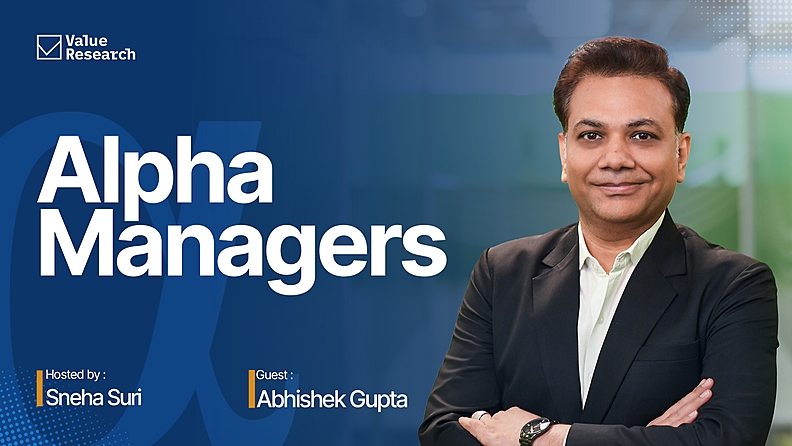
Alpha Managers | 25-Nov-2026 | Sneha Suri

A flexi cap that actually means it
Abhishek Gupta rebuilt HSBC Flexi Cap Fund within weeks of taking charge. He explains how he picks stocks, why the fund held firm in 2026, and what AI made him rethink.
Most flexi cap funds have a quiet habit. Give a fund manager the freedom to buy companies of any size, and the fund still ends up looking like a large-cap fund. Abhishek Gupta noticed this when he took charge of HSBC Flexi Cap Fund in March 2024, and decided his would be different.
It shows. By the end of October, the broader market had fallen about seven and a half per cent in 2026. His fund was flat. Gupta explains how he got there in our latest Alpha Managers conversation with Sneha Suri.
Half large, half small
"Flexi cap by definition gives you that leeway," he says. So he reworked the portfolio around a simple promise to investors: roughly half in large companies and half in mid and small ones. Today only about a third of what he inherited remains.
Does that make the record his? Gupta thinks so. Almost all of the fund's outperformance, he says, has come from picking the right stocks rather than from big bets on the market.
Four Cs and a contrarian streak
Every company goes through what he calls his 4C test: the strength of its moat, the quality of its corporate governance, its cash flows, and how its valuation compares. What survives is a list of businesses that offer both quality and growth.
He also has a patient, contrarian streak. A sector going through a rough patch, he believes, is not one to avoid. It is often the best place to find good businesses, so that you are already there when the tide turns.
All-weather, with rules
Nearly half the fund sits in financials and industrials. So how is that all-weather? Gupta keeps every sector close to its weight in the index, and does his real work inside each one. Take financials. He does not treat it as one block. Private banks, public sector banks, stock-market businesses and lenders are separate choices, and that is where he backs what he likes and skips what he does not.
He is refreshingly open about the trade-off: the fund swings more than it used to. He buys growing companies at sensible prices, and that style lags when markets turn fearful in a hurry, as they did in early 2025. His answer was to hold on to the businesses he believed in. The fund caught up in the second half of that year and into 2026.
A twin-engine aircraft
Gupta also runs HSBC India Export Opportunities Fund, which at the end of October was second in its category over one year. Investors expected a fund stuck in IT and pharma. Instead, more than 300 companies qualified on day one, and the list keeps growing. With about half its revenue earned abroad and half at home, he likens the portfolio to a twin-engine aircraft: it flies more steadily than one with a single engine.
His view on technology has a story of its own. He cut IT sharply this year, convinced that AI will be as big a change as the industrial revolution. Now he is buying again, because the benefits are real but will take time.
Outside in
The best moment comes at the end. For 15 years, Gupta pitched India to overseas investors, and every conversation began with "Why India?" Managing money for Indian savers changed the job. Global investing, he says, taught him capital allocation. Indian investors taught him what it means to carry a fiduciary duty.
How do you rebuild a 22-year-old fund and stay calm through a bad patch? Watch the full conversation to hear it from Abhishek Gupta himself.
Also watch: The method behind Bank of India Multi Cap's alpha
Other Videos


Rupesh Patel reads mid-caps like a lender
· 2,683 Views

The fund that missed 2025 and came back stronger
· 6,042 Views

Where Edelweiss Mid Cap's alpha really comes from
· 8,082 Views

The method behind Bank of India Multi Cap's alpha
· 7,812 Views

Up 8% when small caps were bleeding. How?
· 10,303 Views

Quant fell 16%, then rose 37%. Sandeep Tandon explains
· 18,626 Views
 New Process Alert
 Seems like you've uploaded a wrong QR code. Please upload the QR code downloaded from MF Central platform.


