
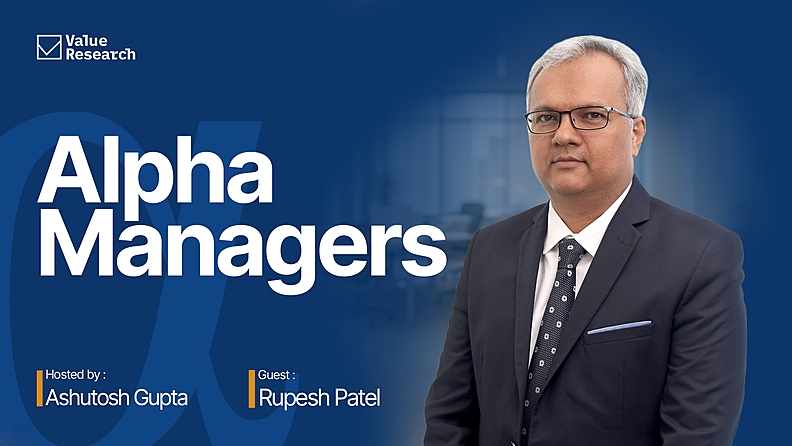
Alpha Managers | 28-Oct-2026 | Ashutosh Gupta

Rupesh Patel reads mid-caps like a lender
His fund has beaten its index mostly by falling less. Patel explains the credit habits behind that, and why Rs 50,000 crore does not worry him yet
Rupesh Patel spent the first six years of his career deciding whether companies could repay their loans. He now runs one of India's largest mid-cap funds, and he still starts where a lender starts. "Eventually cash flows are used to repay the debt," he told us.
That habit shows in his numbers. Since Patel took over Nippon India Growth Mid Cap Fund in January 2023, its direct plan has returned 20.9 per cent a year, against 17.9 per cent for the Nifty Midcap 150 TRI. Most of that lead came in the months when mid-caps fell. When they rose, the fund roughly kept pace.
Is that by design? Patel would not claim it. His explanation is simpler: pick the right stocks, then weight each one to match its risk. He said equity analysts can get absorbed by earnings growth and assume growth will fix everything. Covid taught him otherwise. Companies with sound balance sheets and steady cash flows survived the downturn and grew afterward.
The fund was launched as Reliance Growth in October 1995 and turned 31 this month. We spoke to Patel for Alpha Managers, a series that picks its guests by the numbers.
The mistakes that changed his mind
He said his costliest errors came from being too strict about price. Early in his career, he worked out a fair multiple for each stock and acted on it. More than once he sold a business early, or never bought it, because it looked expensive. The business kept growing, and so did the share price. Today he also weighs how long a business can last, how efficiently it runs and who runs it.
Price still restrains him at the extremes. Markets always drift toward gloom or excitement, he said, and a clear view of value keeps him from buying the popular story. About two and a half years ago, that kept the fund light on industrial companies, whose prices looked rich.
What he will not own
Patel calls it "selection by elimination". Some businesses, management and industries are struck off before the research begins. Weak governance is the firmest line. His warning signs: related-party deals that don't look fair, sales growth that comes with rising customer dues, and inventory that moves without explanation.
Mistakes still slip through, so the fund is built to contain them. It holds about 100 stocks, and the largest is around 4 per cent of the portfolio. Patel says that is deliberate. Nippon caps how much any one stock or sector can weigh. "When fund managers go wrong, the fund does not suffer big time," he said.
Why size does not worry him
In 2005, as Reliance Growth, this fund restricted fresh money at about Rs 1,300 crore. It now manages about Rs 50,000 crore, roughly four times what it held four or five years ago. Patel sees no problem yet.
By his estimate, companies in the Nifty Midcap 150 are worth about Rs 96 lakh crore, against roughly Rs 5 lakh crore in all mid-cap funds. A decade ago, a Rs 10,000 crore company counted as mid-sized. Today, he said, the smallest mid-cap is worth about Rs 34,000 crore. The list changes every six months, and he needs only 35 to 40 names.
Does he have a size at which he would ask Nippon to slow the inflows? He named none. "I think we'll see once we reach there."
What an investor should expect
Patel wants to be judged on rolling three-to-five-year returns against his benchmark, the way Value Research rates funds, and not on any single year. The pattern has exceptions. In March this year, the fund fell slightly more than its index. He promises the same approach whether markets rise or fall: bottom-up stock picking, an eye on price, and no reliance on a handful of stocks. He asks investors to invest regularly and stay for the long term.
That is a hard message for someone whose SIP, started six months ago, is underwater. Patel did not avoid it. The market has gone almost nowhere since its September 2024 peak, he said, but flat stretches like this have usually been followed by stronger ones. Valuations are lower than they were at that peak, and India's premium over the MSCI Emerging Markets index has shrunk. To him, this is a time to keep buying.
An investor deciding whether to stop that SIP can borrow Patel's own test: three to five years against the index, not the last six months.
Also read: AlphaGrep's SIF aims to beat arbitrage with low market risk
Other Videos


The fund that missed 2025 and came back stronger
· 6,014 Views

Up 8% when small caps were bleeding. How?
· 9,692 Views

Quant fell 16%, then rose 37%. Sandeep Tandon explains
· 18,110 Views
 New Process Alert
 Seems like you've uploaded a wrong QR code. Please upload the QR code downloaded from MF Central platform.


