




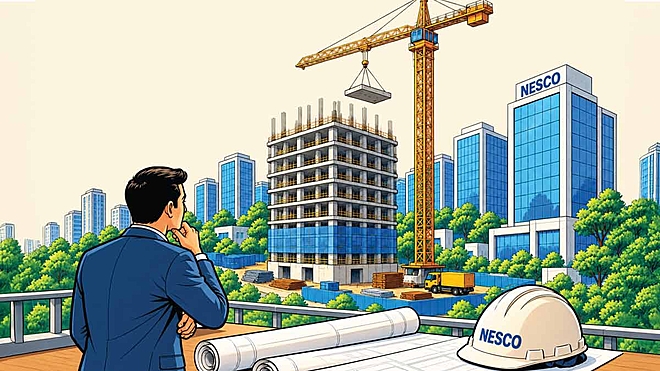
 Yogesh Sharma/AI-generated image
Summary: Nesco has prime land, near-full towers and almost no debt, so it looks like a classic value stock. We argue that its unused building rights are potential, not earnings, and that the long wait for each new tower makes it a redevelopment-cycle business, not a steady compounder. It then tests what today’s price already assumes and what has to happen for investors to earn a market-beating return.
Summary: Nesco has prime land, near-full towers and almost no debt, so it looks like a classic value stock. We argue that its unused building rights are potential, not earnings, and that the long wait for each new tower makes it a redevelopment-cycle business, not a steady compounder. It then tests what today’s price already assumes and what has to happen for investors to earn a market-beating return. Nesco looks like a stock value investors gravitate towards. At around Rs 1,100, it is down roughly a third from its 52-week high. It owns a prime campus in Goregaon, carries negligible debt and runs its towers at almost full occupancy. Its realty segment earned an 83 per cent margin in FY26, and its exhibition arm, the Bombay Exhibition Centre (BEC), earned margins above 50 per cent. Then there is the land. The realty segment’s development potential is now 9.72 lakh square metres, about 51 per cent more than the 6.46 lakh square metres available for its IT Park in 2019. Existing buildings use only 14 per cent of this and Tower 2 another 28 per cent, leaving 58 per cent for future growth. On paper, that looks like enormous embedded growth. But FSI, the floor space index that caps how much floor area can be built on a plot, is not earnings. Room to build, slow to build Changes in Mumbai’s development framework increased how much Nesco can build on its own land, so it does not need to keep buying expensive land to grow. A conventional developer routinely buys new land and recycles capital. Nesco&rsq


 New Process Alert
 Seems like you've uploaded a wrong QR code. Please upload the QR code downloaded from MF Central platform.


