




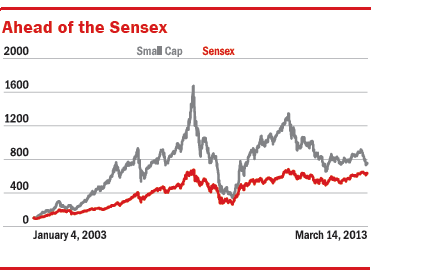
The Value Research database tracks 2,836 listed companies of which 2,595 fall in the small-cap segment. That is 90 per cent of the investment universe. Small-cap stocks tend to be low-priced, closely held, are highly volatile and risky. It is for this reason that small-cap stocks are more suitable for investors with a high risk appetite as they are hit harder when the market falls but make up for the losses in a rising market. The relative performance of small-cap stocks to large-caps is now far above long-term (See graph: Ahead of the Sensex) large-cap indices. The benchmark BSE Small Cap is more volatile than indices like Sensex or Nifty.

Invest with caution
Investments in these funds is not for the faint hearted and Value Research recommends addition of such funds to a portfolio only when it is well-diversified and one is well aware of the risks involved. The other problem faced by these funds is the inevitability of the stock in the fund drawing undue investor interest the moment it enters a fund's portfolio. Other investors discover its virtues and, as they enter, the price starts to shoot up; adding to the risks. As the price starts to rise, investors tend to pull out money, which is also something that leads to its fall. Investors exit these funds resulting in further fall in their returns. Take for instance HSBC Small Cap, which lost 35 per cent and Reliance Long Term Equity 24 per cent between March 2011 to September 2012 after the market downturn of 2011.
Currently, the RoE of small-cap companies is at the same level as it was in 2004 as the index level in March 2013 is similar to what it was in September 2005. Certainly, the case for funds in this category exists among investors as long as they are willing to take the involved risks, and benefit from potential gains.
Ask Value Research 
 New episodes every Friday

 New Process Alert
  Seems like you've uploaded a wrong QR code. Please upload the QR code downloaded from MF Central platform.


