 Widely read:


 Vinayak Pathak/AI-Generated Image
Summary: You may be holding multiple funds from the same AMC to achieve diversification. However, numbers show that several fund houses have multiple pairs of funds that share more than half their portfolios. The question is whether yours is one of them.
Say you own two mutual funds from the same AMC. Different names, different categories, possibly different fund managers. Your portfolio looks diversified. But is it?
What if both funds hold the same heavyweights: Reliance, HDFC Bank, Infosys, ICICI Bank, TCS? What if 60 per cent of one fund's holdings mirror those of the other? That's not diversification, that's diworsification. In simple terms, you haven't spread your risk; you've just bought the same stocks twice.
Here's why overlap within same-AMC funds is more common than most investors realise, and why your portfolio deserves a closer look.
How bad is the overlap problem?
In its March 2026 Master Circular for Mutual Funds, SEBI (Securities and Exchange Board of India) made it mandatory for fund pairs, particularly in sectoral and thematic categories, to keep portfolio overlap below 50 per cent with other schemes from the same AMC (excluding large-cap funds). Fund houses must now also disclose overlap levels every month.
AMCs that aren't compliant have up to three years to fix this, after which schemes with over 50 per cent overlap must be merged. The three-year window gives fund houses time to realign portfolios without forcing hurried stock sales.
How many equity fund pairs within each AMC share more than 50% of their portfolios
Nearly every fund house has equity funds with a high portfolio overlap
The table shows, for each AMC, how many fund combinations exceed 50 per cent portfolio overlap, alongside the total possible combinations and the ratio between the two.
Naturally, AMCs running more funds show higher overlap counts simply because more funds mean more possible pairings. But strip away the size factor and the picture shifts. Some smaller fund houses have a surprisingly high share of overlapping pairs. Others, despite managing large fund ranges, have kept the ratio low through genuine portfolio differentiation.
Suggested read: Diversification can be a dummy exercise. So, check this for best result.
At one end of the table, several AMCs have zero overlapping combinations, whether through truly distinct portfolios, a limited fund range, or deliberate management. Either way, investors holding two funds from those houses are genuinely getting two different things.
Why overlap matters more than you think
Sticking to one AMC isn't unusual. A familiar brand and strong track record offer comfort. But the whole point of owning multiple funds is broader market exposure, not owning the same stocks in different wrappers. When two funds from the same house hold the same 20 companies, you're not reducing risk; you're concentrating it, while diluting your returns.
Checking for overlap is straightforward. Most financial data platforms let you enter fund names and instantly show the percentage of common holdings by weight. If the overlap crosses 50 per cent, shifting your investment from the second fund into one with a genuinely different approach, same AMC or otherwise, will do far more for your portfolio than brand loyalty ever will.
The bottom line
Portfolio overlap rarely feels dangerous. But quietly, over time, it drags down returns while masking the true risk: that you're holding the same stocks over and over. Knowing exactly how much your funds overlap is one of the simplest, most revealing checks you can run on your portfolio.
Want to find out how much your funds overlap? Subscribe to Value Research Fund Advisor and analyse your portfolio to find whether your mutual funds have a significant portfolio overlap and find funds that actually diversify your money.
Disclaimer: This content is for information only and should not be considered investment advice or a recommendation.
For grievances: [email protected]
Ask Value Research 
 New episodes every Friday











 New Process Alert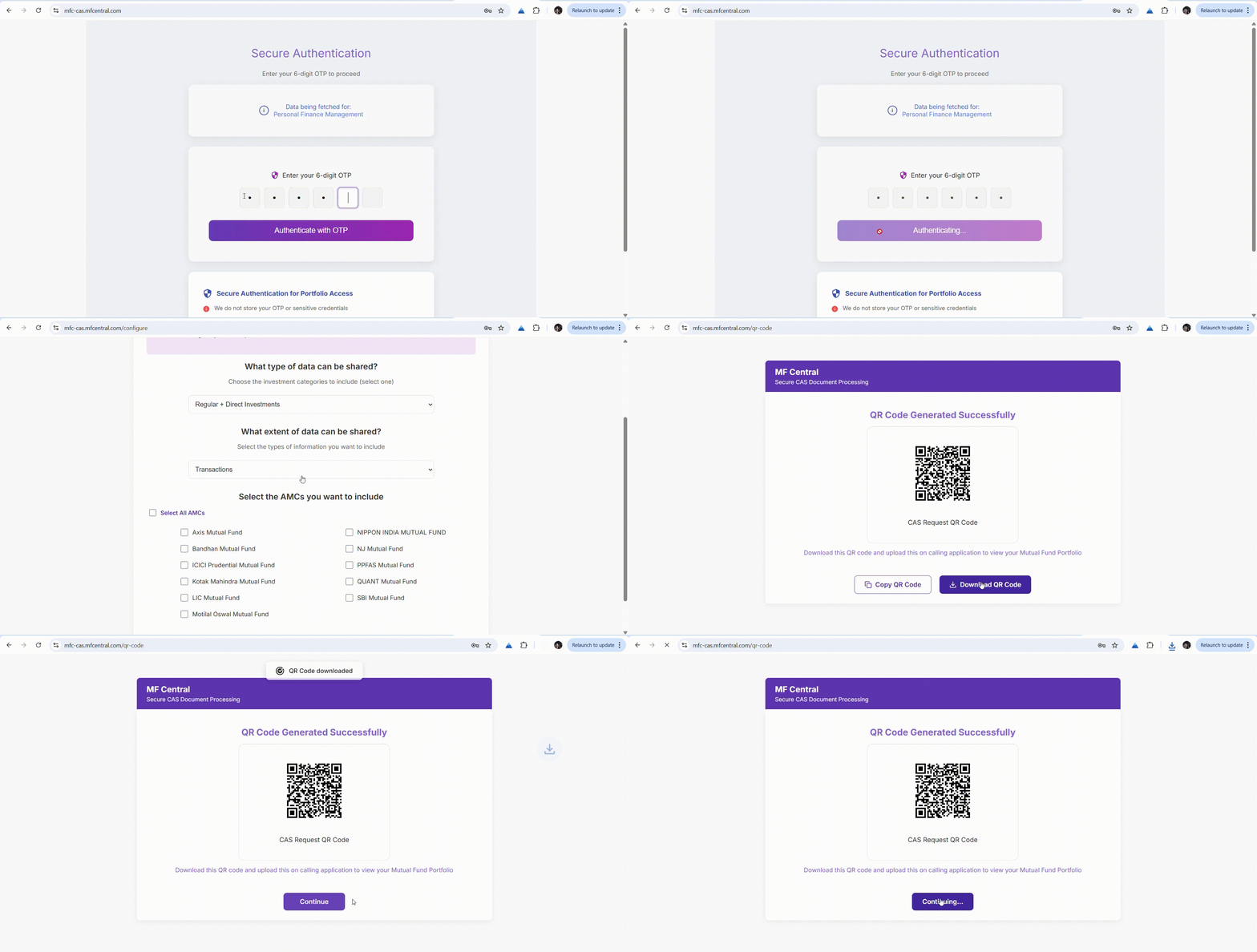
 Seems like you've uploaded a wrong QR code. Please upload the QR code downloaded from MF Central platform.


