 Widely read:



In Imphal, Manipur, there is a market called Ima Keithel. The Mothers’ Market. It has run for five hundred years.
Over five thousand women vendors. Three multi-storey buildings named after Meitei goddesses. Men were allowed only as customers, porters, and chai servers. Stalls passed mother to daughter. The market’s union runs its own credit system — an indigenous financial institution older than modern banking.
When the British tried to undermine this market, the women fought back. Twice. In 1904 and 1939, over five thousand market women organised boycotts and blockades. Forced the colonial administration to reverse its policies. These are called the Nupi Lan—the Women’s Wars.
In 2003, the government tried to replace the market with a shopping mall. The women organised 24-hour sit-ins for three months. They won.
I start here because Ima Keithel demolishes, in one example, the idea that finance is a “male domain.” The notion that women are newcomers to money management is not just wrong. It is historically illiterate.
The data says you’re already better at this
When women invest, something interesting happens. They outperform.
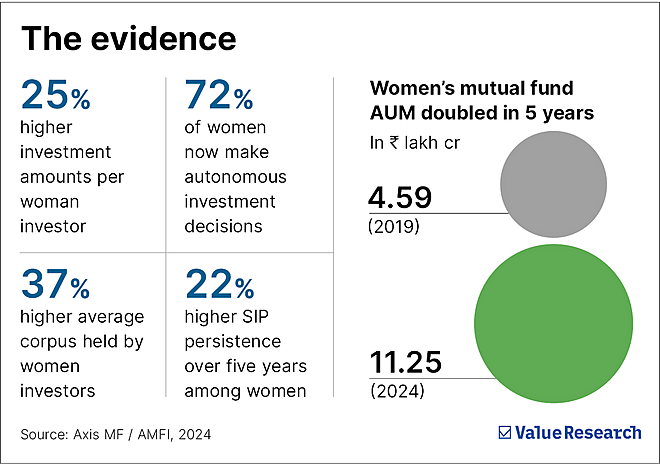
Read those numbers again. Women invest more. Hold longer. Persist through volatility better. The “confidence gap” isn’t in the data. What’s there is patience, discipline, and a refusal to panic-sell. Which are, not coincidentally, the three qualities every investment textbook says matter most.
Why the myth survives
Because the industry was built that way.
Walk into any bank branch. Look at the mutual fund posters. Look at investment app imagery. Look at who hosts financial webinars, writes market commentary, sits on panels. Men in suits talking to men in suits about markets, returns, and alpha.
The language reinforces it. Investing is talked about in combat terms: beating the market, aggressive growth, bull run, war chest, blockbuster IPO. This signals: this is a world for people who enjoy risk and aggression. If you prefer careful analysis and steady accumulation, the language tells you this space isn’t for you.
Except it is. The irony is devastating. The qualities the industry celebrates—aggression, timing, frequency—lead to worse outcomes. The qualities it codes as “feminine”—patience, consistency, risk awareness—build wealth.
Handling the dismissal
Let’s talk about something specific. The moment someone makes you feel like you don’t belong in this conversation.
The advisor who directs explanations to your husband. The father-in-law who’ll “take care of” investments. The colleague who talks stocks the way men talk cricket—assuming expertise, testing whether you can keep up.
R K Narayan nailed this in 1938. In The Dark Room, Savitri’s husband controls every rupee. The women of Malgudi, Narayan observed, “are not financially free. Unpaid work brings no money. Hence, they need to ask.” That was 1938. The language has changed. In many families, the dynamic has not.
Here’s how to handle it.

Seventy-two per cent of women now make autonomous investment decisions. You are not the exception. You are the emerging majority.
The women of Ima Keithel didn’t ask permission to run the economy. They just did.
Her Money, Her Future • A 5-part Women’s Day special by Value Research
Next: The family’s finances are your business too
Ruchira Sharma, Senior Editor, Narrative & Long-form | Value Research
She writes about money the way it actually lives in Indian families, tangled with culture, silence, gold, and love. At Value Research, she anchors Investors' Hangout and Fund Manager Interviews, narrates Dhirendra Kumar's First Page, and leads the audio-visual team. Her Money, Her Future brings together her two crafts: the journalist's instinct for the untold story and the financial editor's demand for evidence in every sentence. Previously, 14 years at India Today: scripting, production, and long-form storytelling.
This article was originally published on March 07, 2026.
Disclaimer: This content is for information only and should not be considered investment advice or a recommendation.
For grievances: [email protected]
Ask Value Research 
 New episodes every Friday

 New Process Alert
 Seems like you've uploaded a wrong QR code. Please upload the QR code downloaded from MF Central platform.


