 Widely read:


 Aditya Roy/AI-Generated Image
Summary: Few investors are putting their money in ELSS funds. In this story, we tell you why long-term investors can and should stay the course and trust in the long-term process of equity investing.
There was a time when investing in an equity-linked savings scheme (ELSS, also known as tax-saving mutual fund) was a no-brainer. It helped one save tax under Section 80C of the Income Tax Act and build wealth in the long run through large-, mid- and small-cap investing.
However, the new tax regime has rained on their parade, big time.
Since 80C tax deductions are no longer available under the new tax regime, and because over 72 per cent Indian taxpayers have opted for the new regime, ELSS funds are rapidly losing their sheen. On a side note, the number of Indian taxpayers under the new tax regime is likely to be higher this year, as the 72 per cent data is of the previous financial year.
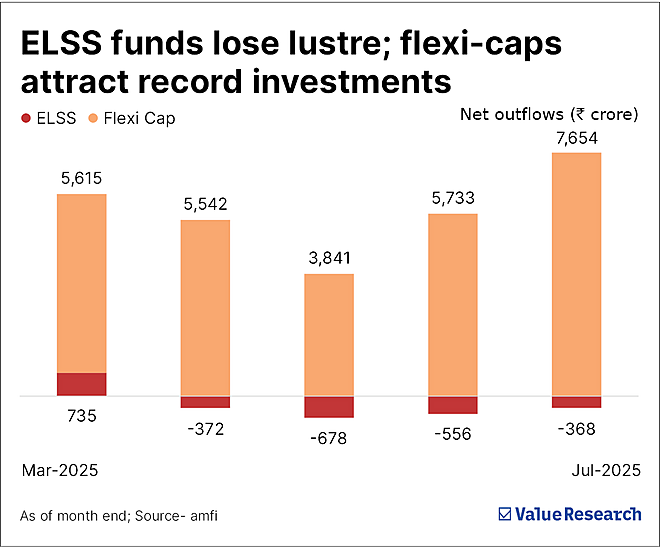
Returning to the current plight of ELSS funds, the current data are an eyesore. Although these tax-saving funds are similar to flexi-cap funds and invest across large-, mid- and small-cap stocks, investors are exiting them en masse. While flexi-cap funds have added significant fresh investment in recent months, ELSS funds have lost more than Rs 2,000 crore in net investment between April and July.
How have ELSS funds performed?
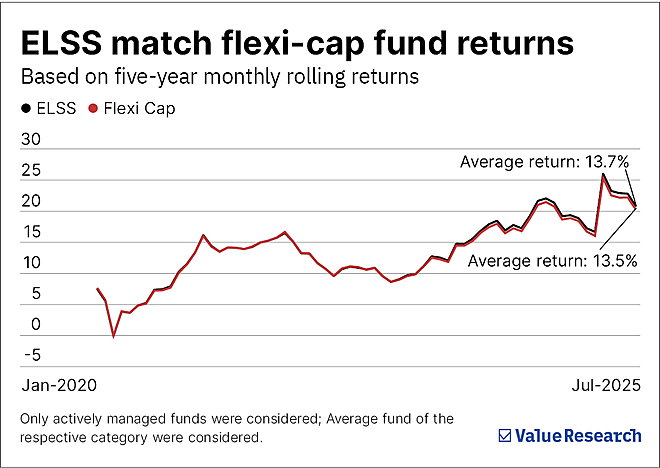
It’s not as if ELSS funds have delivered poor returns. This makes us safely conclude that the recent decline in their popularity has less to do with how they have performed and more with how tax rules are reshaping investor behaviour.
Because if you compare long-term returns, ELSS funds have performed nearly in line with flexi-cap funds and their common benchmark, the Nifty 500 TRI.
So, does that mean investors should merely join the ELSS exodus? Or do they still have a strong investment case?
Why ELSS funds can still matter
- Discipline through lock-in: ELSS funds come with a mandatory three-year lock-in period. While that may be perceived to be a negative, it can actually be a good thing for new investors or those who may not have the discipline to ride out a low phase in the market. Because of these funds’ lock-in feature, it prevents hasty exits and forces investors to ride out volatility.
- Flexibility compared to other tax-saving options: ELSS has the shortest lock-in among tax-saving instruments, much lower than other options like Public Provident Fund (15 years) or NPS (once you turn 60).
- Still relevant for old-regime taxpayers: For those sticking with the old tax regime, ELSS continues to offer both tax savings and the chance to create meaningful wealth in the long run through its equity exposure.
Also, avoid exiting your existing ELSS investments prematurely, as a three-year holding period in equity investing is too short a time. You can be exposed to medium-term fluctuations in the equity market.
The bottom line
The shrinking of the assets managed by ELSS funds is a headline-worthy story. But it’s not a verdict on the funds themselves. It reflects a tax-driven behavioural shift, not a deterioration in quality or performance.
For investors still in the old regime, ELSS remains among the most effective ways to combine tax-saving with wealth-building. For those in the new regime, ELSS may no longer be the first choice, but that doesn’t mean past investments are suddenly irrelevant.
Looking to get more such fund insights? We urge you to keep reading Value Research stories.
Also read: New tax regime is here. Time to stop your ELSS investments?
Disclaimer: This content is for information only and should not be considered investment advice or a recommendation.
For grievances: [email protected]
Ask Value Research 
 New episodes every Friday











 New Process Alert
 Seems like you've uploaded a wrong QR code. Please upload the QR code downloaded from MF Central platform.


