 Widely read:


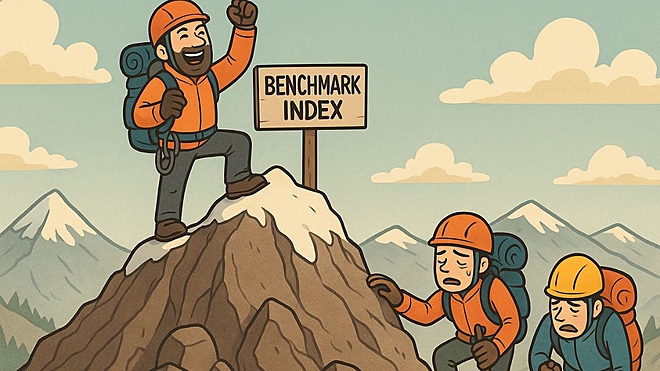 Aditya Roy/AI-Generated Image

Summary: Large-cap funds are meant to be the “safe bets” of equity investing, managing nearly Rs 4 lakh crore. But here’s the catch: when tested over a long term, only 9 of 26 funds consistently beat the BSE 100 TRI. The rest? They trailed despite charging higher fees. Want to know if your fund made the cut? Large-cap funds are often seen as the “comfort zone” of equity investing. They put your money in the country’s 100 biggest companies, like Reliance, Infosys, HDFC Bank and TCS. Basically, names that feel familiar and safe. For many investors, that familiarity translates into trust. And it shows. As of June 2025, large-cap funds manage a massive Rs 3.97 lakh crore of net assets, making them the third-largest pure equity fund category after flexi-cap and mid-cap funds. So far, this financial year, they have attracted fresh inflows of Rs 7,700 crore. But here’s the uncomfortable truth: despite all the faith and money flowing in, most active large-cap funds haven’t managed to beat the benchmark itself. Why beating the benchmark matters Large-cap funds with an active investing strategy are required to put at least 80 per cent of their investors’ money into India’s 100 largest listed companies. The idea is simple: instead of just copying an index like the Nifty 100, the fund manager tries to outsmart the market by picking the right stocks at the right time. If the fund manager succeeds, you as an investor should earn more than what you would get from a plain-vanilla index fund. If not, you’ve basically paid higher fees for no extra benefit. So, how do we

 New episodes every Friday











 New Process Alert
 Seems like you've uploaded a wrong QR code. Please upload the QR code downloaded from MF Central platform.


