 Widely read:


 AI-generated image
You’ve probably heard the term ‘mutual fund’ thrown around by friends, colleagues or financial influencers. Maybe you’ve even considered investing in one but weren’t quite sure what it is and how it really works.
If that sounds like you, you’re not alone.
The good news is: mutual funds aren’t as complicated as they sound. In fact, they’re built to make investing simple and accessible for people who want to grow their money without diving into stock charts or balance sheets every evening.
According to AMFI (Association of Mutual Funds in India), as of May 31, 2025, the total number of mutual fund accounts, or folios in industry terms, stood at 23.83 crore. That’s a big vote of confidence in something built for everyday investors like us.
Let’s break down what mutual funds are and how they work in plain English, so you can invest with confidence, too.
What is a mutual fund?
Think of it like this. Say you and a bunch of friends decide to go on a holiday together. Instead of each person booking their own transport, hotels and meals, you pool your money and let a travel planner take care of everything. One shared budget, one expert managing it and everyone benefits.
That’s pretty much how a mutual fund works.
You, and thousands of others, contribute money to a common pool. A professional then takes this money and invests it in things like shares of companies, bonds or a mix of both. You don’t own the shares directly, but you do own units of the mutual fund, which represent your share of the overall investments.
And the best part? You can get started with as little as Rs 100 in some funds.
Why mutual funds exist in the first place
Not everyone has the time or knowledge to track the stock market. And even if you do, it's not easy picking the right stocks, monitoring their performance and knowing when to buy or sell.
Mutual funds simplify all of that. They give you:
- Access to a wide range of investments
- A professional handling the decisions
- The ability to start with small amounts
Plus, they’re regulated, transparent and easy to buy or sell. That’s why they’ve become a go-to choice for long-term financial goals.
Just look at this: monthly SIP contributions crossed Rs 26,000 crore in May 2025, according to AMFI. That’s a sign of growing investor discipline and confidence.
So, how does a mutual fund actually work?
Let’s now walk through the life of your money once it enters a mutual fund step-by-step.
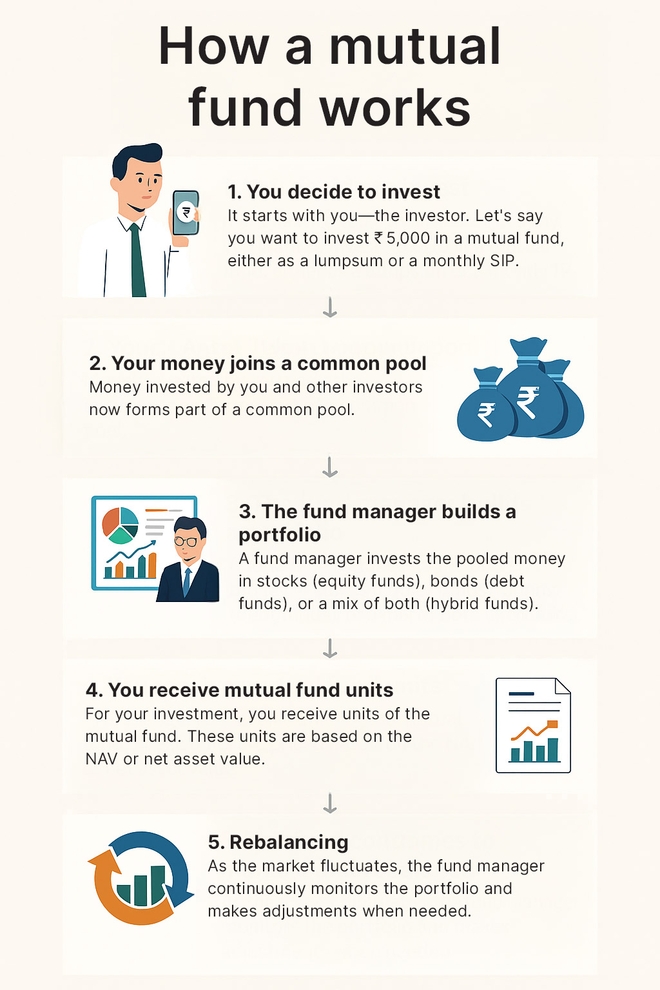
1. You decide to invest
It starts with you—the investor. Let’s say you want to invest Rs 5,000 in a mutual fund. You could do this as a one-time lumpsum or as part of a monthly SIP (systematic investment plan). Either way, your money gets added to a much larger pool of funds contributed by thousands of other investors.
2. Your money joins a common pool
This pooled money is now part of a fund, a structured investment vehicle managed by an asset management company (AMC). At this point, your Rs 5,000 isn’t sitting idle. It’s ready to be deployed by professionals, called fund managers, who do this for a living.
3. The fund manager builds a portfolio
Here’s where the expertise kicks in. A fund manager, supported by a team of analysts and researchers, takes this pooled money and invests it in a range of assets. Depending on the type of fund, these could include:
- Stocks of Indian or international companies (in equity funds)
- Bonds issued by the government or companies (in debt funds)
- A mix of both (in hybrid funds)
Fund managers don’t pick investments randomly. There’s a well-defined investment strategy based on the fund’s objective, whether it’s growth, income or stability.
Think of the fund manager as the captain of a ship. You decide where to board (the fund), but they steer the ship daily, adjusting course based on the weather (market conditions) and destination (investment goal).
4. You receive mutual fund units
In return for your investment, you’re allocated units of the mutual fund. These units are priced based on something called NAV or net asset value. NAV is the per-unit value of the entire fund’s assets after accounting for costs.
For example:
- If the NAV is Rs 50, your Rs 5,000 investment gets you 100 units (Rs 5,000 / Rs 50).
- If that NAV rises to Rs 55, your investment becomes Rs 5,500 (Rs 55 x 100 units).
- If the NAV falls to Rs 45, it’s worth Rs 4,500.
This NAV is updated at the end of the day, typically after the markets close.
5. The fund continues to manage and rebalance
Markets change, companies evolve and interest rates move. A good fund manager doesn’t just buy and forget; they monitor the portfolio and rebalance it when needed.
For instance, if one sector becomes too dominant in the portfolio or if a stock is no longer attractive, the manager may trim exposure or switch to better opportunities.
This is the day-to-day job of the AMC and the reason you pay a small annual fee (called the expense ratio) for their services.
6. Income and gains get reflected in your NAV
Your mutual fund earns money in two main ways:
- Capital appreciation: When the underlying investments grow in value.
- Income: Like dividends from stocks or interest from bonds.
Whatever the fund earns, it flows back into the fund’s NAV — and therefore into the value of your units. In a growth plan, these gains stay invested and grow further. In an income plan, they may be paid out to you.
7. You can exit when you want
Most mutual funds offer high liquidity. This means you can withdraw your investment money whenever you need it, either partially or fully.
The redemption value = Number of units held × NAV on the day you exit.
The amount usually gets credited to your bank account within 1–3 working days.
That said, be aware of:
- Exit loads (small fees if you withdraw too soon)
- Taxation rules (capital gains taxes apply depending on how long you hold investments and fund type)
- Lock-ins, like in ELSS funds (three-year mandatory holding)
All these are designed not to restrict you, but to encourage you to stay invested so that your money has the time it needs to grow.
8. You track your investment (occasionally!)
You don’t need to monitor your fund every day. That’s the job of the fund manager. But it's wise to check in once every few months using trusted tools like Value Research’s Portfolio Manager to make sure your investments are still aligned with your goals.
Who does what in a mutual fund?
Here’s a quick look at the key players:
- AMC (asset management company): This is the company running the fund. HDFC Mutual Fund, PPFAS Mutual Fund and others fall into this category.
- Fund manager: Makes investment decisions on your behalf.
- SEBI (the regulator): Keeps an eye on the entire ecosystem to protect your interests.
- Custodian and registrar: Handle all the backend operations and recordkeeping.
As an investor, you don’t need to deal with any of this. It’s all handled for you and tightly regulated.
Types of mutual funds: just to give you an idea
While we won’t get into too many categories, here are the broad flavours:
- Equity funds: Equity mutual funds invest in company shares. Higher risk, higher return potential. Best suited for long-term goals.
- Debt funds: Debt mutual funds invest in fixed-income securities like government bonds and treasury bills. They’re more stable and suitable for shorter timeframes.
- Hybrid funds: Hybrid funds are a mix of equity and debt, offering balance.
Choosing the right one depends on your time horizon and comfort with risk. But remember, there's no one-size-fits-all. It's about what works best for you.
FAQs on how mutual funds work
1. Is it safe to invest in mutual funds?
Yes. Mutual funds in India are regulated by SEBI (Securities and Exchange Board of India), which ensures transparency and investor protection. However, mutual funds are subject to market risks, so it’s important to match your investment with your time horizon and risk tolerance.
2. Do mutual funds guarantee returns?
No. Mutual funds do not offer guaranteed returns. Their performance depends on the market value of the underlying investments. While debt funds may offer relatively stable returns, equity funds can fluctuate more in the short term but offer growth potential over the long run.
4. Can I withdraw money from a mutual fund anytime?
Yes. In most cases, you can withdraw from your investment at any time. However, some funds may charge an exit load if you withdraw within a certain period. ELSS or tax-saving funds have a mandatory three-year lock-in.
5. What is the minimum amount needed to start?
You can start investing in mutual funds with as little as Rs 100 to Rs 500, depending on the fund. SIPs (systematic investment plans) allow you to invest small amounts regularly, making it easy to build wealth over time.
This article was originally published on June 19, 2025.
Disclaimer: This content is for information only and should not be considered investment advice or a recommendation.
For grievances: [email protected]
Ask Value Research 
 New episodes every Friday











 New Process Alert
 Seems like you've uploaded a wrong QR code. Please upload the QR code downloaded from MF Central platform.


