 Widely read:


 Anand Kumar
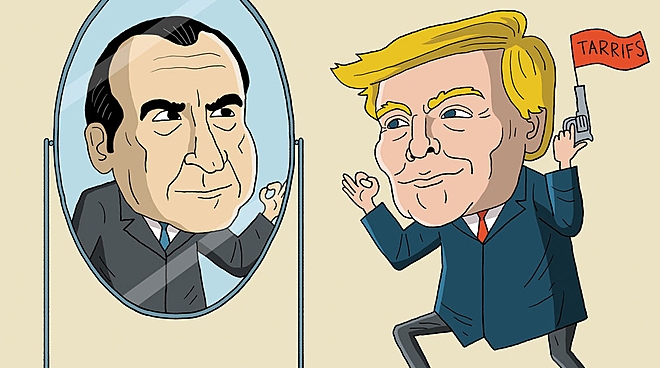
In August 1971, a secretive meeting at Camp David, led by President Richard Nixon, reshaped the global economy in ways that still echo today. Chronicled in Jeffrey E Garten’s ‘Three Days at Camp David: How a Secret Meeting in 1971 Transformed the Global Economy’, the decisions made over that weekend – known as the Nixon Shock – ended the Bretton Woods system, severed the US dollar’s link to gold and introduced floating exchange rates. Fast forward to 2025, and the US is once again stirring global markets with President Trump’s aggressive tariff policies and proposed tax reforms. Mark Twain once said, “History doesn’t repeat itself, but it often rhymes.” Let’s examine how closely it does. A historical turning point In his book, Garten, a former Yale School of Management dean and seasoned policymaker, recounts the economic and political pressures that drove Nixon’s bold moves in 1971. The US was grappling with a weakening dollar, soaring trade deficits and rising inflation, exacerbated by the Vietnam War and the economic resurgence of Japan and Western Europe. The Bretton Woods system, which pegged global currencies to the dollar (convertible to gold at $35 per ounce), was crumbling. US gold reserves had plummeted to $10 billion against $40 billion in liabilities, as foreign nations demanded gold for their dollar holdings. Nixon, facing re-election in 1972, sought a dramatic solution to avoid a recession and restore US economic dominance. At Camp David, Nixon and advisors like Treasury Secretary John Connally, Federal Reserve Chairman Arthur Burns and Paul Volcker debated fiercely. The outcome, announced on August 15, 1971, was the New Economic Policy: The US suspended dollar convertibility to gold, imposed a 10 per cent import tax a
This article was originally published on June 01, 2025.
 New episodes every Friday












 New Process Alert
 Seems like you've uploaded a wrong QR code. Please upload the QR code downloaded from MF Central platform.


