 Widely read:


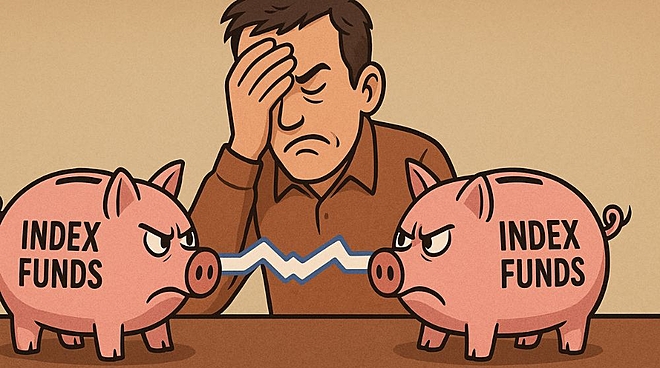 Aditya Roy/AI-Generated Image

It's a common beginner move. An investor, impressed by the simplicity and performance of index funds , decides to split their Rs 1 lakh corpus into several index funds, hoping to diversify better. After all, diversification is the golden rule of investing, right?
However, this investment tactic may not have sound logic. Here's why.
When variety becomes repetition
Most index funds follow a fixed list of stocks, and many track the same ones.
They're great for low cost, transparency and matching their benchmark returns. But if you invest in too many of them, you might end up owning the same stocks again and again, without real diversification.
For example, India's top indices - Nifty 50, Sensex and Nifty 100 - are 83 to 85 per cent similar. So, buying all three won't give you three different baskets. You'll mostly just get the same set of large-cap stocks.
| Index | Number of stocks | Key overlaps with Nifty 50 |
|---|---|---|
| Nifty 50 | 50 | -- |
| Nifty 100 | 100 | Around 83% weight in common |
| Sensex | 30 | Around 85% weight in common |
Real-world example
To test how this plays out in actual portfolios, we compared two hypothetical investors:
-
Rohit
invests Rs 1 lakh across three index funds that are quite different from each other: a Nifty 50 fund, a Nifty Midcap 150 fund and a Nifty Smallcap250 fund.
- Seema splits Rs 1 lakh across 10 index funds, primarily focused on large- and mid-cap Indian equity benchmarks. The portfolio includes funds tracking the Nifty 50, Nifty Next 50, Nifty 100, Nifty 200, Nifty 500, Nifty 500 LargeMidSmall, Nifty LargeMid Cap 250, Nifty Bank, BSE Sensex and BSE 100 indices.
Here's what their final exposure looks like.
| Stock | Rohit(Three funds) | Seema(10 funds) |
|---|---|---|
| HDFC Bank | 4.40% | 10.40% |
| ICICI Bank | 3.10% | 7.80% |
| Reliance | 2.90% | 4.90% |
| Infosys Ltd. | 1.60% | 3.00% |
| Bharti Airtel Ltd. | 1.50% | 2.60% |
| Top five total | 13.50% | 28.70% |
Despite holding more funds, Seema ends up with a highly concentrated portfolio, with over a quarter of the portfolio allocated to just five companies. This happens because of the heavy stock overlap between the underlying indices.
In contrast, Rohit's portfolio provides diversification across market caps, resulting in lower individual stock concentration and broader risk spread.
So, how many is too many?
It's not about the number, but the nature of the index funds. Multiple index funds can add value, but only when they are built on fundamentally different market segments.
For example, combining a large-cap fund (e.g., Nifty 50), a mid-cap fund (e.g., Nifty Midcap 150) and a small-cap fund (e.g., Nifty Smallcap250) or an international index fund (e.g., Nasdaq 100 or S&P 500) can result in genuine diversification. The key is low overlap and distinct risk-return characteristics .
But stacking several large-cap index funds, just because they have different names or benchmarks, offers little incremental value. Worse, it gives a false sense of diversification.
How to check before you invest
Before adding an index fund, consider this checklist:
-
Does it track a different part of the market? (e.g., mid caps, global equities, small caps)
-
Does it reduce overlap with my existing portfolio?
- Is the risk-return profile different enough to justify it?
You can verify this by comparing fund holdings using tools like Value Research Fund Compare. This reveals the degree of overlap, often surprisingly high, between seemingly different funds.
Final word
Index investing is powerful because of its simplicity. But that simplicity gets lost if you start collecting funds without checking what's inside them.
Adding more index funds doesn't automatically reduce your risk. In fact, when the underlying stocks are the same, you may just be overloading your portfolio with the same bets under the guise of diversification.
The smarter approach? Select a few index funds that genuinely complement each other. That will give you true diversification, better balance and a cleaner portfolio that's easier to manage over time.
An investor education and awareness initiative of Nippon India Mutual Fund.
Helpful Information for Mutual Fund Investors: All Mutual Fund investors have to go through a one-time KYC (know your Customer) process. Investors should deal only with registered mutual funds, to be verified on the SEBI website under 'Intermediaries/Market Infrastructure Institutions'. For redressal of your complaints, you may please visit www.scores.gov.in . For more info on KYC, change in various details and redressal of complaints, visit mf.nipponindiaim.com/InvestorEducation/what-to-know-when-investing
Mutual fund investments are subject to market risks, read all scheme-related documents carefully.
Also read: Why can funds tracking the same index have different NAVs?
This article was originally published on May 23, 2025.
Disclaimer: This content is for information only and should not be considered investment advice or a recommendation.
For grievances: [email protected]
Ask Value Research 










 New Process Alert
 Seems like you've uploaded a wrong QR code. Please upload the QR code downloaded from MF Central platform.


