 Widely read:


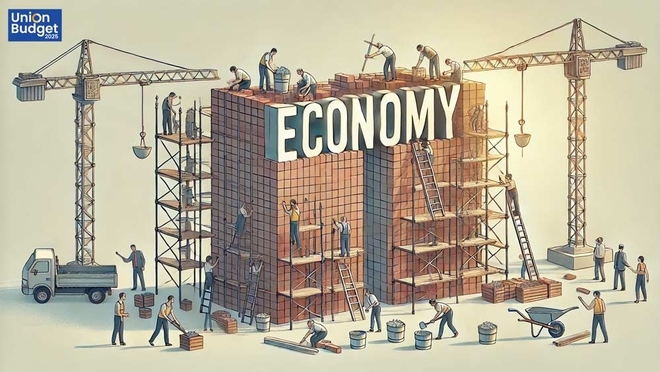
Ever wondered how a country navigates the turbulent waters of inflation, unemployment, and economic growth? It's like steering a ship with two powerful tools - monetary and fiscal policies. While one adjusts the sails (money supply), the other fuels the engine (government spending). Together, they ensure the ship, or in this case, the economy, stays on course.
Let's break down these two economic powerhouses and how they work in harmony to shape India's financial stability and development.
What is monetary policy?
Monetary policy is the Reserve Bank of India's (RBI) way of controlling the money tap. It manages how much money is circulating, what it costs to borrow (interest rates), and ultimately, how stable the economy is. Think of it as your home's thermostat, adjusting the temperature to keep things comfortable.
How does it work?
The RBI uses a mix of tools to fine-tune the economy:
1. Quantitative tools: These influence the overall money supply in the economy. Examples include:
a. Repo rate: Like your credit card interest - when the rate is high, borrowing cools down. When low, it heats up economic activity.
b. Reverse repo rate: Encourages banks to park excess money with the RBI, soaking up liquidity.
c. Open market operations (OMO): Buying and selling government securities to control the flow of cash.
2. Qualitative tools: These focus on specific sectors:
a. Credit rationing: Directing funds to priority sectors like agriculture or infrastructure.
b. Moral suasion: Persuading banks to adopt desirable lending practices.
For example, when inflation soars, the RBI raises interest rates to make borrowing costlier, reducing spending. During sluggish growth, it cuts rates to spur borrowing and investments.
What is fiscal policy?
Fiscal policy is the government's economic playbook, focusing on where to spend and how to earn. It's all about taxation and spending decisions to steer the economy toward growth while ensuring welfare.
The two pillars of fiscal policy are:
1. Taxation: Direct and indirect taxes are used to generate revenue and manage disposable income in the economy.
a. Direct taxes: Income tax, corporate tax.
b. Indirect taxes: GST, customs duties.
2. Public spending: This includes expenditures on infrastructure, healthcare, education, defence, and subsidies to stimulate demand and create jobs.
Think of fiscal policy as the engine of an economy. During tough times, the government revs it up with stimulus packages, as seen during the Covid-19 pandemic, to keep the economy running.
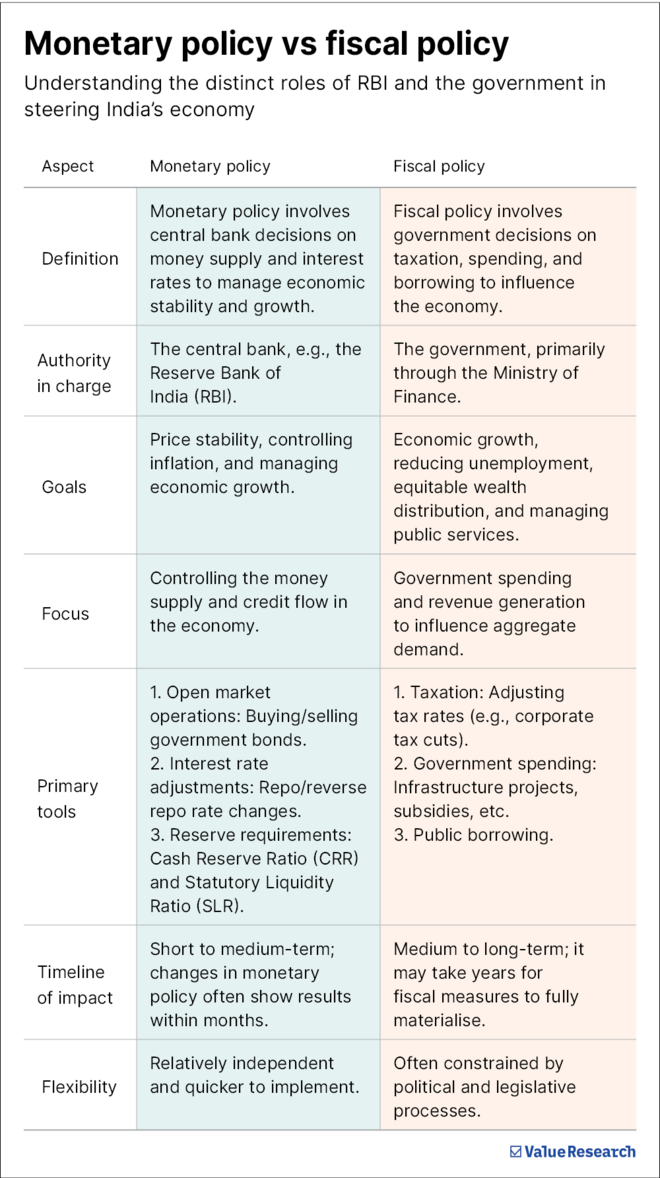
Monetary policy vs fiscal policy: What's the difference?
Monetary and fiscal policies differ in terms of their controllers, tools, and impacts:
How they work together
These two policies are like a dynamic duo, addressing different economic challenges.
- In inflationary times: The RBI tightens liquidity (raises interest rates), while the government may cut spending to cool demand.
- In recessions: The RBI lowers rates to encourage borrowing, while the government increases public spending to stimulate demand.
For instance, during the 2008 global financial crisis, central banks worldwide slashed rates while governments pumped in massive stimulus packages. The result? Economies stabilised faster.
Why should you care?
The interplay between monetary and fiscal policies impacts everything - from the prices of your groceries to the interest rates on your loans.
- A hike in repo rates could make your home loan EMIs more expensive.
- Increased government spending on infrastructure could mean more job opportunities and better roads.
Understanding these policies gives you a front-row seat to how the economy works and how it affects your finances.
Final thoughts: A balancing act for progress
Monetary and fiscal policies are the yin and yang of economic management. While one stabilises the flow of money, the other directs resources toward nation-building. Together, they create a delicate balance between growth and stability.
As India marches toward its goal of becoming a $5 trillion economy, the synchrony between these two pillars will determine the country's ability to navigate global challenges while meeting domestic aspirations. For a nation of over a billion dreams, these policies are not just strategies - they're the compass guiding us toward shared prosperity.
Wrapping up your "Budget Lingo" journey
You have reached the final term in our glossary of budget jargon.
Revisit the previous term: Disinvestment decoded: Selling public assets to fuel progress
Thank you for joining us in making sense of the language behind India's Union Budget.
Disclaimer: This content is for information only and should not be considered investment advice or a recommendation.
For grievances: [email protected]
Ask Value Research 
 New episodes every Friday









 New Process Alert
 Seems like you've uploaded a wrong QR code. Please upload the QR code downloaded from MF Central platform.


