 Widely read:



Think of direct taxes as the government's paycheck — funds it collects straight from you to build roads, schools, and hospitals. They're not hidden in the price of a product like GST but come straight out of your salary, profits, or investments. Fair? Well, that's the idea. Let's break down how direct taxes work and why they're the backbone of India's fiscal health.
What are direct taxes?
Imagine a family pooling money for a big event, like a wedding. The older siblings with higher incomes contribute more, while the younger ones chip in what they can. That's how direct taxes work — a progressive system where those who earn more pay more, ensuring fairness in funding shared goals.
In simple terms, direct taxes are levied directly on an individual's or company's income or wealth. They include:
- Income tax: What you pay on your salary or other earnings.
- Corporation tax: Charged on the profits of companies.
- Capital gains tax: A slice of the profit when you sell property, shares, or bonds.
- Securities Transaction Tax (STT): A small cut on stock market transactions.
- Minimum Alternate Tax (MAT): Ensures companies don't escape taxes entirely due to exemptions.
- Equalisation levy: Dubbed the "Google Tax," it targets payments to non-residents offering digital services.
- Gift tax: Taxes on gifts above a certain value, because generosity sometimes comes with a price.
Why do direct taxes matter?
Because they're the backbone of public spending and social equity. Here's how:
- Funding essentials: From highways to hospitals, direct taxes finance the infrastructure we rely on daily.
- Reducing inequality: Progressive tax rates ensure higher earners contribute more, redistributing wealth for the greater good.
- Economic health check: Robust tax collections often mirror strong economic growth and better compliance.
In Budget 2025, direct tax revenue for FY26 is projected at Rs 25.2 lakh crore — a steady rise from the Rs 22.37 lakh crore estimated for FY25.
Suggested read: Taxpayers to save Rs 35,000 - Rs 1.1 lakh after tax slab revision
Making sense of the numbers
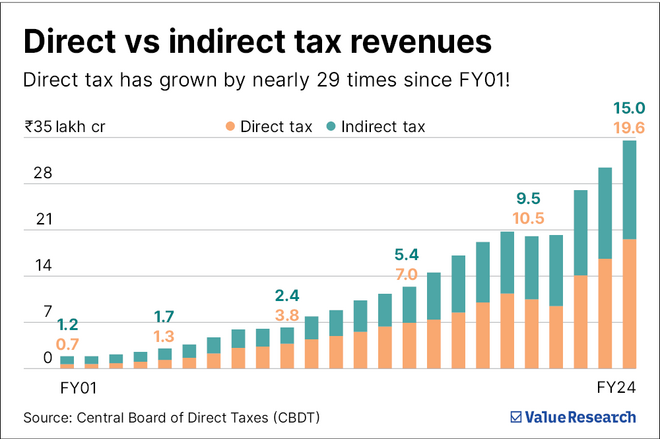
Direct taxes now account for 57 per cent of India's total tax revenue (based on actual figures in FY24), a significant jump from just 36 per cent in FY 2000-01. Key contributors:
- Corporation tax: Expected to rake in Rs 10.82 lakh crore in FY26.
- Personal income tax: Projected at Rs 14.38 lakh crore.
Despite this growth, there's untapped potential. Out of a population of over 140 crore, only 8.1 crore individuals filed tax returns in FY24. Imagine the possibilities if compliance were even broader!

A walk through history
Here's a fun fact: India's first income tax law was introduced in 1860 by James Wilson to cover the costs of the 1857 revolt. Though scrapped in 1865, it returned in 1886 and evolved into today's comprehensive system.
Fast forward to FY 2000-01, when direct tax collections were just Rs 68,305 crore. By FY 2023-24, they had surged to Rs 19.6 lakh crore — a nearly 29-fold increase! Milestones like the abolition of the wealth tax in 2015 and the introduction of faceless assessments show how far we have come in simplifying and streamlining the system.
Why should you care?
Because every rupee you pay in taxes builds something tangible. That metro line cutting your commute in half? Funded by taxes. The hospital in your city? Ditto. Direct taxes aren't just deductions on your payslip — they're your investment in a better, more equitable India.
Closing thought
Direct taxes may not be the most glamorous topic, but they're the heartbeat of a nation's revenue system. With initiatives like digital filing and faceless assessments, the system is becoming simpler and more transparent. So, the next time you file your taxes, know that your contribution is paving roads, powering schools, and building a brighter future for everyone.
Your taxes aren't just numbers — they're the fuel driving India's progress. Now, isn't that worth paying for?
Keep playing "Budget Lingo"
Revisit the previous term: Capital expenditure decoded: Building India's future
Learn the next term: Indirect taxes explained: The invisible hand in transactions
Stay with us as we continue to decode the terms that demystify India's Union Budget.
Disclaimer: This content is for information only and should not be considered investment advice or a recommendation.
For grievances: [email protected]
Ask Value Research 
 New episodes every Friday









 New Process Alert
 Seems like you've uploaded a wrong QR code. Please upload the QR code downloaded from MF Central platform.


