 Widely read:



Capital expenditure, or capex, is like the government's "dream big" fund. Think of it as saving for a house, investing in your education, or buying that high-tech laptop for your side hustle. These are not everyday expenses but investments that promise big payoffs in the future. Similarly, capex in the Union Budget is all about creating assets that drive India's growth story. Let's explore why capex matters and how it shapes the country's economic future.
What is capital expenditure?
Capital expenditure (or capex) is the government's spending on physical assets like roads, railways, schools, and digital infrastructure. Unlike revenue expenditure, which pays for day-to-day operations, capex focuses on building and upgrading things that last.
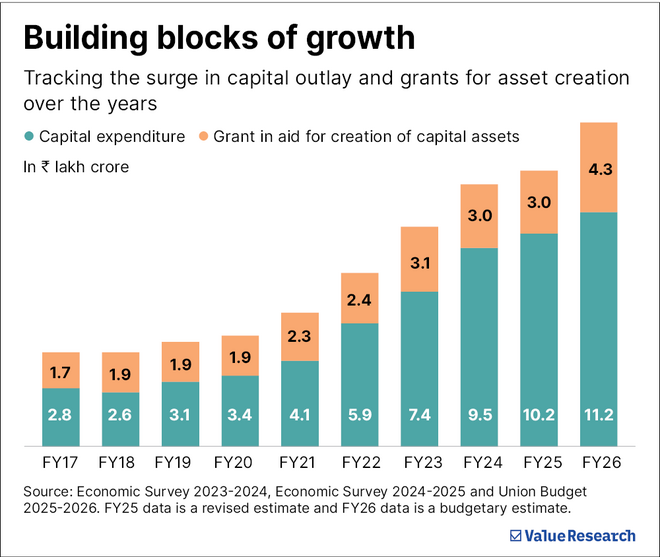
Take Budget 2025: India has allocated Rs 11.2 lakh crore for capex in FY26 — a 10 per cent increase from the previous year. It's like upping your savings to buy better tools for a more productive future.
Why does capex matter?
Because it's the engine of long-term growth. Here's why:
- Boosting productivity: A new highway doesn't just cut travel time; it improves business efficiency by enabling faster goods transport.
- Creating jobs: Infrastructure projects create immediate construction jobs and spur indirect employment across sectors.
- Multiplier effect: When the government builds a metro line, it not only hires engineers and labourers but also supports local vendors, reduces commute times, and boosts urban development.
For instance, the PM Gati Shakti plan aims to revolutionise logistics by integrating roads, railways, and ports. Better logistics mean lower costs for businesses, ultimately benefiting consumers like you.
Crunching the numbers
In the Budget 2025, capital expenditure accounts for 22 per cent of total spending, with over Rs 15 lakh crore earmarked for effective capex, including grants for asset creation. This 17.4 per cent increase over last year underscores the government's commitment to growth-oriented investments.

High vs low capex: What it tells us
- High capex: Signals robust investment in future growth. For example, increased spending on renewable energy projects aligns with global sustainability goals and reduces reliance on fossil fuels.
- Low capex: Often a red flag, suggesting fiscal constraints or an over-focus on short-term crisis management. Prolonged low capex hampers growth by delaying critical infrastructure projects.
A look back: Capex through the decades
Post-independence, capex was all about building basic utilities — dams, roads, and railways to connect the nation. The 1990s liberalisation era shifted focus to modernising ports and airports, making India more competitive globally. Today, initiatives like Smart Cities and Digital India are redefining capex to include urban planning, clean energy, and cutting-edge technology.
Why should you care about capex?
Because it impacts your life in more ways than you realise. That metro you take to work? The broadband powering your startup? The renewable energy lighting your home? All of it stems from capital expenditure. It's the invisible scaffolding of your daily life, shaping your commute, job prospects, and access to services.
Closing thoughts
Capital expenditure is how governments lay the foundation for a nation's aspirations, turning policy into tangible progress. When capex rises, it's a signal of future growth, innovation, and better opportunities for everyone.
So, the next time you hear "capital expenditure," think of it as the government's way of building a brighter, better India — one project, one investment at a time. And just like saving for your own future, it's worth every penny.
Keep playing "Budget Lingo"
Revisit the previous term: Capital receipts unplugged: How governments fund and build
Learn the next term: Direct taxes explained: How you help build India's future
Stay with us as we continue to decode the terms that demystify India's Union Budget.
Disclaimer: This content is for information only and should not be considered investment advice or a recommendation.
For grievances: [email protected]
Ask Value Research 
 New episodes every Friday









 New Process Alert
 Seems like you've uploaded a wrong QR code. Please upload the QR code downloaded from MF Central platform.


