 Widely read:



Think of a government's finances like your own. You've got your steady income (revenue receipts), but when you need a big chunk of money — like for a house down payment or an emergency — you might dip into savings, take a loan, or sell your old car. That's capital receipts for a nation: funds that come from borrowing or selling assets. They're critical to keeping things running but come with their own set of strings attached. Let's break it down.
What are capital receipts?
For the government, capital receipts include:
- Borrowings: Loans from domestic or foreign sources.
- Loan recoveries: Getting back money lent to others.
- Disinvestment proceeds: Selling stakes in public sector enterprises.
These funds are crucial for big-ticket needs but either increase debt or shrink assets.
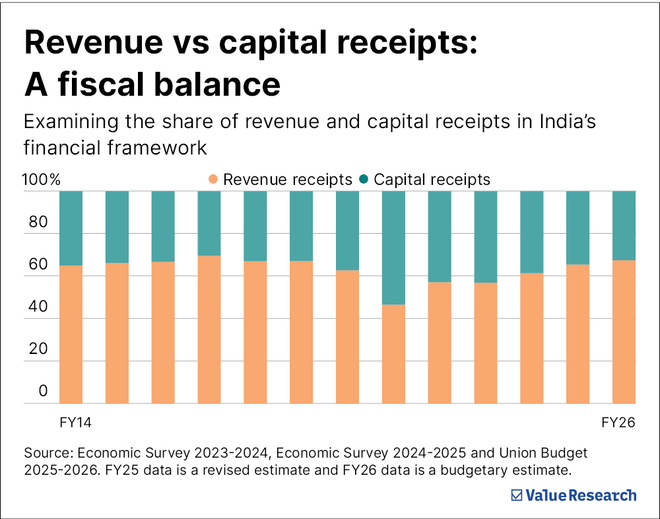
Take the Budget 2025: India's capital receipts are pegged at Rs 15.68 lakh crore, with more than 95 per cent coming from borrowings.
Why do capital budgets matter?
Because they fund the big stuff. Whether it's building highways, upgrading healthcare, or ensuring the nation doesn't default on debt, capital receipts are the government's go-to for financing long-term projects or managing shortfalls.
In Budget 2025, Rs 11.2 lakh crore has been earmarked for capital expenditure — a 10 per cent jump from last year. This spending powers economic growth by investing in areas like transport, education, and renewable energy.
The numbers speak
To decode capital receipts, it's all about the details:
- Borrowings: While borrowing can fund growth, over-reliance signals fiscal stress.
- Disinvestment: Selling assets like public sector companies can generate quick cash and reduce inefficiencies, but it's a one-time trick.
- Non-debt receipts: In Budget 2025, Rs 76,000 crore is expected from non-debt sources, showing efforts to diversify income streams.

A page from history
Remember 1991? India was in the middle of an economic crisis so severe that it pledged gold reserves to raise funds. It was a bold, albeit desperate, move to generate capital receipts. But that moment of vulnerability sparked economic reforms that redefined India's fiscal policies.
Fast forward to today, and the government's approach is more structured — disinvestment, asset monetisation, and strategic borrowing have replaced emergency measures. It's a testament to how capital receipts have evolved into a powerful tool for development.
Closing thoughts
Capital receipts may not have the glamour of GDP growth figures or the simplicity of taxes, but they're the backbone of a nation's financial strategy. They fund ambitious projects, keep the debt manageable, and push reforms forward.
Next time you hear about borrowing or disinvestment in the Budget, think of it as the government's way of juggling long-term goals with immediate needs. And remember, just like selling an old car to pay for college, it's all about using resources wisely to build a better future.
Keep playing "Budget Lingo"
Revisit the previous term: Revenue expenditure: The monthly bills that keep India running
Learn the next term: Capital expenditure decoded: Building India's future
Stay with us as we continue to decode the terms that demystify India's Union Budget.
Disclaimer: This content is for information only and should not be considered investment advice or a recommendation.
For grievances: [email protected]
Ask Value Research 
 New episodes every Friday









 New Process Alert
 Seems like you've uploaded a wrong QR code. Please upload the QR code downloaded from MF Central platform.


