 Widely read:



If you want to invest in a mutual fund offering tax-saving benefits and long-term growth, ELSS (equity-linked savings scheme) might have caught your attention. These funds provide tax-saving benefits under Section 80C of the Income Tax Act, allowing you to deduct up to Rs 1.5 lakh from your taxable income annually by investing the same amount.
However, these tax benefits are applicable only under the old tax regime. So, if you are in the new tax regime, do ELSS funds still hold relevance? Or should you consider diversified equity options like flexi-cap funds to build long-term wealth?
Let's compare the two and then determine which is better.
Overview
ELSS, commonly known as tax-saving funds, invest at least 80 per cent of their portfolio in equity and equity-related instruments. Flexi-cap funds, on the other hand, invest at least 65 per cent of their assets across equities. Despite this difference, both fund categories invest nearly all of their money in equity.
A key similarity between ELSS and flexi-cap funds is their flexibility in investment mandates. Both are free to invest across various market capitalisations, sectors and themes, offering broader diversification and strong long-term growth potential.
Liquidity
ELSS funds come with a mandatory three-year lock-in period, post which you can withdraw the entire investment.
Flexi-cap funds have no such restrictions, making it convenient to withdraw your investments at any time.
Performance comparison: Who wins?
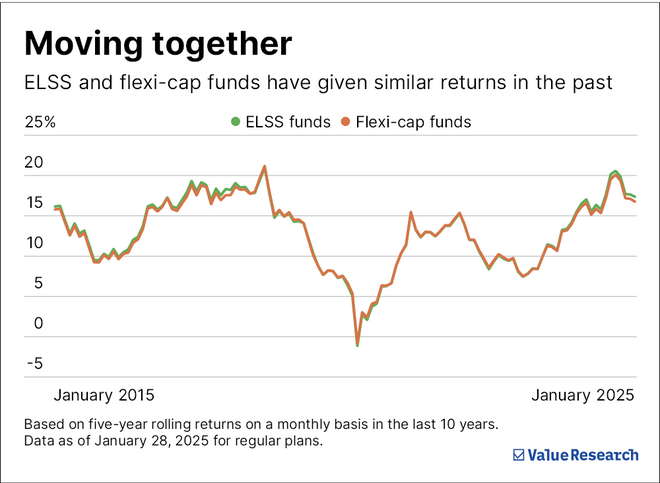
When it comes to returns, both ELSS and flexi-cap funds have delivered nearly identical performance, often moving in sync with each other.
How are ELSS and flexi-cap funds taxed?
From a taxation perspective, both ELSS and flexi-cap funds are classified as equity-oriented investments.
Thus, any long-term capital gains from these funds are taxed at 12.5 per cent and short-term capital gains at 20 per cent, with an exemption limit of Rs 1.25 lakh.
ELSS or flexi-cap funds: Where should your money go?
Both funds are great for long-term wealth creation, with similar investment styles and comparable returns.
If you are under the new regime, you can't use ELSS investments to save tax under Section 80C. However, if you are a novice investor, aim to foster disciplined investing and tax saving isn't a priority, ELSS may be a suitable investment option due to its three-year lock-in period.
On the other hand, if you prefer an investment with better liquidity and potential for somewhat similar returns, consider flexi-cap funds.
Want to invest in the best-performing ELSS or flexi-cap funds but don't know where to start? Subscribe to Value Research Fund Advisor and get access to a list of our recommended funds tailored to your needs.
Also read: New tax regime? These three 80C investments still make sense
This article was originally published on January 30, 2025.
Disclaimer: This content is for information only and should not be considered investment advice or a recommendation.
For grievances: [email protected]
Ask Value Research 
 New episodes every Friday











 New Process Alert
 Seems like you've uploaded a wrong QR code. Please upload the QR code downloaded from MF Central platform.


