




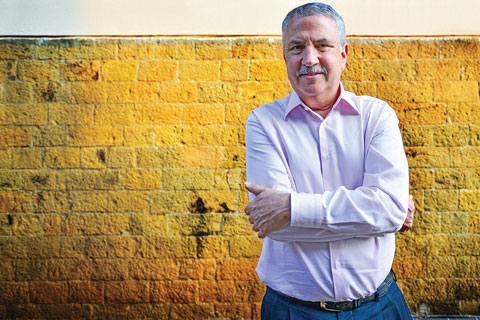
The West is pulling away from globalisation because of populist politics. How do you think that affects developing nations like India?
It’s both a challenge and an opportunity. If we (the West) don’t globalise, you’ll globalise without us. Look what’s happening with the TPP (Trans Pacific Partnership). (US President Donald) Trump came in and pulled out of the deal and now the other 11 nations are trying to pull it off alone. I don’t know if they can, but nobody’s going to wait for us. And, you see how the Chinese President Xi Jinping has now become the biggest defender of globalisation even though they’re not such big globalisers; they control their market very tightly. He can really gain a lot of soft power by being the defender of globalisation. So that’s the opportunity.
America built the institutions that are the backbone of globalisation – the World Bank, the IMF (International Monetary Fund), the global trading system. We were the greatest advocates of those. And now, if (we) don’t support free trade in a sensible way, it’ll affect everybody. So it’s not a good standpoint.
So what’s the way around it because you said it’s an opportunity as well?
It’s an opportunity for the developing world. What India’s doing right now is very interesting; it’s got a lot of advantage because you can leapfrog; you don’t have a lot of legacy systems. When you put together over a billion people on the unique ID platform (Aadhaar), where you can have a trusted identity and then that platform becomes an operating system that all kind of apps can be built out of, that’s a big deal.
If you were to say to me, what’s the biggest thing in the world? Is it the Brits deciding to pull out of the European Union or is it the fact that actually three million more Americans voted for Hillary Clinton than Donald Trump, but because of our electoral system, he’s President? Or is it the fact that over a billion people in India are on this uniquely built ID platform on which you can build apps for banking, educating, communicating? I think this is a much bigger trend in the world than what we’re doing.
The fact that (much of) China is a cashless economy now is a much bigger trend than what some people in the British countryside decided they want to do to punish the elite. If you ask me as a Westerner, I’ll tell you the biggest thing in the world is Trump and Brexit. But if I were a Martian who’s come down to Earth and is just looking at it, I would say that 2.5 billion people who are doing all of the globalising and digitising now are the bigger trend; there’s no question.
Are you still bullish on India as you were 12 years ago when you wrote The World Is Flat?
If India were a stock, I’d still buy it. Though the change is not linear – it’s curvilinear – so there will always be ups and downs. But I still believe India has enormous assets, considering the world we’re going into. It’s learning to manage diversity in a world that’s only getting more diverse; that’s a big deal. And the fact that 1.3 billion Indians speaking a 100 different languages, with different religions and ethnicities, in addition to conducting free and fair elections, that’s not a small thing. If India were living like Iraq and Syria today, the whole world would be different. That’s a huge asset. I think the transitions such as Aadhaar and the economy going cashless are wrenching transitions and will not be perfect. But India is going in the right direction.
The benefits of globalisation have not been distributed very evenly. A Credit Suisse wealth report said that 92 out of 100 Indians have wealth worth less than $10,000.
I think two things are happening here. The top is rising and the floor is rising as well. The top will rise faster because the more integrated and advanced the economy gets, the more knowledge workers benefit.
What would you rather have –India growing at the Hindu rate of growth where everybody was equally poor? I’d rather have a system that’s unequally rich; the government is there to equalise that. If it fails to do that, that’s a political issue; don’t blame the system.
Even in the US, there is talk of the 1 per cent. Because of this, we have seen the rise of strongmen as leaders. What do you have to say about that?
It’s fairly dangerous to extrapolate when you’re in the middle of a rapid transition like we are right now. This could be a short phase, or a long one. Nobody knows for sure.
An accelerated pace of change produces these men. In the US, when a person goes to the grocery store, the woman at the cash register is wearing something other than a baseball hat. They go to the men’s room and there’s a woman there. Then they go to the office and their boss rolls up a robot next to them and it seems to be studying their job. So, all the things that anchor us in the world – my identity, my community, my job – are in a flux. So then someone who comes along and says I can stop the wind by building a wall is appealing to some people. Is this one last gasp of the legacy? I don’t know and am not making any predictions at all.
But what’s going on is not illogical. I’m not unsympathetic. That’s what my new book is about – how do we manage the change? It’s called Thank You for Being Late. I’m praising everything old and slow. But I don’t mean globalisation; I mean values. The faster the world gets, the more everything old and slow matters more than ever. By old and slow, I mean all the things you can’t download – good teaching, good parenting, good religious leadership, good governance. All those values matter more because when the world moves fast, the small errors have huge consequences.
Apart from globalisation, what’s adding to worker insecurity is technology in developed and developing countries as well.
A study has even said that 47.3 per cent of all jobs that exist today will be gone by 2050. To this I say, who knows which jobs will be there? Did anybody know there would be a job today called search engine optimiser?
If there’s fear of jobs dying, why do we have the lowest unemployment rate in America right now? When was it that everything in the jobs sector was perfect? What I argue in my book is that for many centuries, we worked with our hands. Then we started work with our heads. In the future, we’ll work with our hearts.
In my book, I quote the surgeon general of the US, Vivek Murthy, saying that the most prevalent disease in America is isolation. What that tells me is that there’s going to be a huge industry of connecting hearts to hearts.
So when I wrote about it, I discovered that the fastest growing restaurant chain in America in 2015, according to Entrepreneur magazine, is Paint Nite. Artists come to local bars and create personalised paintings for customers. If you’re an artist, you make $200 a night. So this is huge.
If you go to the Airbnb website, you’ll see a new tab called ‘Experiences’, apart from ‘Homes’. It could be a night tour of Mumbai, three basketball games at Havana or piñata-making in eastern LA. The company will tell you it’s the fastest growing part of their business. This is people monetising their passions and interests. Airbnb will be the biggest jobs site in 10 years. So let the system go. We’re in the middle of a transition. Who predicted last year that the fastest growing part of Airbnb would not be its rooms but its experiences? Have a little optimism in the human race and our ability to
create things.
By Arushi Kotecha. In arrangement with HT Syndication | Mint
Ask Value Research 
 New episodes every Friday

 New Process Alert
  Seems like you've uploaded a wrong QR code. Please upload the QR code downloaded from MF Central platform.


