



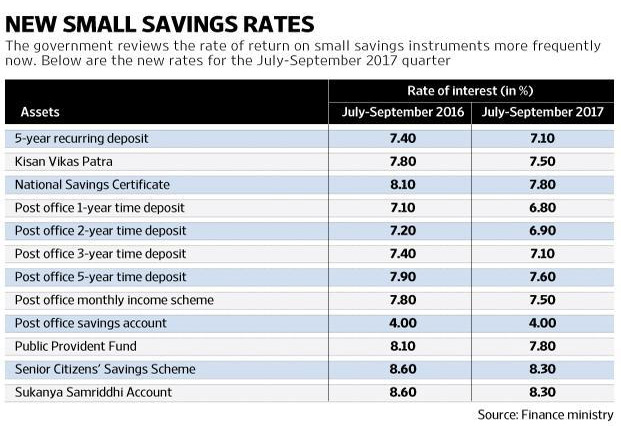
Interest rates on various small savings schemes like Public Provident Fund (PPF), Kisan Vikas Patra (KVP) and National Savings Certificate have been reduced by 10 basis points for the 1 July to 31 September quarter. One basis point is one-hundredth of a percentage point.
Since April 2016, interest rates of all small saving schemes have been linked to government bond yields and are now recalibrated on a quarterly basis. Over the last couple of years, interest rates of most small savings schemes has witnessed a decline of about 1 percentage point . For instance, the interest rate on Senior Citizen Savings Scheme has come down from 9.3% in FY2015-16 to 8.3% now.
Should this rate cut make you revisit your investment portfolio, especially if you invest substantially in small savings schemes?
Rate cut
Interest rates across all the small saving schemes have been reduced by 10 basis points for the next quarter except the post office savings account, which will remain unchanged at 4% per annum.
Investments in PPF schemes will now fetch an interest rate of 7.8% per annum, compared to 7.9% in quarter ending June 2017. Similarly, a 5-year National Savings Certificate will return 7.8% instead of 7.9% per annum.
New KVP investments would now double in roughly 10 years (they will mature in 115 months) as they will now give a return of 7.5% per annum.
The scheme for girl child savings, Sukanya Samriddhi Account Scheme, and 5-year Senior Citizens Savings Scheme will provide 8.3% returns. The 5-year Monthly Income Scheme will be 7.5%. Term deposits of 1-5 years will offer 6.8-7.6%. The 5-year recurring deposit will earn 7.1% interest.
What should you do?
During the last quarter, the interest rate on PPF deposits went below 8%-to 7.9%-for the first time ever. And now it has further declined to 7.8%.
"The decreases in rates during the last few years (not to miss out the gush of liquidity in the banking system after demonetization) has led to some of these rates currently being at multi-decade lows and most investors are not even aware of this reality," said Santosh Joseph, founder and managing partner, Germinate Wealth Solutions LLP. Even a 1 percentage point decrease in interest rates can make a huge difference over the long term. For instance, if 2 years back you had started investing Rs1.5 lakh in PPF every year for 15 years, when the rate of returns was 8.7% per annum, you would have calculated that your corpus would have been Rs46.76 lakh at the end of 15 years.
However, a 1% percentage point decrease in interest rate after couple of years would reduce your corpus by about Rs3.42 lakh, or 7.31% in total over 15 years period.
"Most investors have made certain calculations about their money's growth or size of their accumulated savings. However, they may be in for a harsh reality check. Key implications (of the rate cut) could be that they would fall short of their desired corpus," said Joseph.
However, some experts point to the differences in real rate of return and absolute returns. They believe that the decline in small savings interest rates may impact those who had taken only the absolute rate of return in these schemes into consideration while designing their portfolio, while those who were working with the real rate of return would not be impacted as much comparatively.
"Interest rates on fixed return products have varied over the years. Their returns are linked to some benchmarks such as current interest rates and inflation. What is relevant is the real interest rate over inflation, and not absolute rate. But as we get used to a quantum of interest, drops are not palatable. If one had used real interest rates, their plans are not impacted," said Lovaii Navlakhi, founder and chief executive officer, International Money Matters Pvt. Ltd.
However, those who have not taken into consideration the real rate of return, or those who depend primarily on the income from these fixed instruments, may need to revisit their portfolio.
"Expecting the savings to give a certain regular income will have to be reviewed. For investors who depend on the interest income as their primary income, this is like a salary cut," said Joseph. "Investors need to think and explore opportunities beyond the conventional sphere of small saving instruments, he added.
Where direct equities are not preferred or advisable for many people, especially those who have a low risk appetite or those who are nearing their different goals or retirement, mutual funds can certainly be an option to consider. "Savvy investors have already begun using debt funds and hybrid mutual funds to beat these blues," said Joseph.
Even retired individuals can opt for investing in debt mutual funds to maintain returns on their portfolio. "The solution lies in clearly defining the requirements of these funds and breaking them up for specific time periods or goals," said Joseph.
Before you make a decision on a product to invest in, compare it with the other avenues. Look at the returns that they generate but at the same time look at other parameters, too, such as taxation and liquidity. Some of the small saving schemes still fit in the portfolio of many individuals because the returns generated from them are tax-free.
In arrangement with HT Syndication | MINT
Ask Value Research 

 New episodes every Friday


 New Process Alert
 Seems like you've uploaded a wrong QR code. Please upload the QR code downloaded from MF Central platform.


