


We are living in very optimistic times, or so it seems if one looks at the financial markets. Equity funds have had a great year - the average large-cap fund is up more than 20% for the financial year 2017, and mid-caps are doing way better. On 3- and 5-year basis too, the average largecap fund is up 15-17% annually. Even debt funds have had a good run with income funds giving almost 10% returns for past 3 years and long-term gilt funds returning 12% compound annual growth rate (CAGR).
With such a good track record, money is pouring into both equity and debt funds. Investors are convinced that these are the best investments and advisers are only pleased to ride on. The common refrain is: "Market might correct a bit in near term, but equities will surely make 12-15% over 3-5 years" or "bank deposits rates are so low; debt funds give better returns, with the same low risk".
It was only 5 years back that you could not lose money in real estate, and now real estate is dead. The overwhelming consensus now is that equities or funds are the best asset class. I am not advocating going back to real estate but I do feel that as advisers, it is essential to question these narratives, and be aware of the possibilities.
Fast growth
India is poised to grow fast and equities will give 12-15% returns over 3-5 years. A simple analysis of Sensex rolling returns for past 37 years shows that this is true only half the time, i.e., you had a 50% chance of earning less than 12%. For 5 years, probability of less than 12% returns fell to 30%. Interestingly, as the chart shows, 3-year returns have tended to fluctuate around 10-11% for most of the time. It's only the short bursts on the upside that pushed up the 5-year and 10-year returns. And periods of sub-par (below 12%) can last for long.
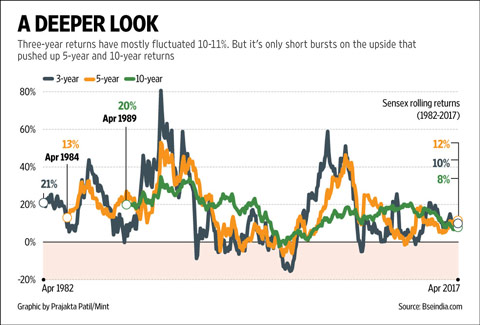 As for economic growth acceleration driving the markets, it is just one of the variables; not the only one.
Mutual funds' outperformance
Mutual funds have historically beaten the index. Largecap funds have outperformed by an average of 4% over the past 3 years and by a similar amount over 5 years. But here also, it is getting tougher to beat the market. Interestingly, almost 40% of large-cap funds underperformed BSE100 over 1-year period till March 2017-an unusually high number. Over a 3-year period, the performance is much better, with almost 80% beating the index.
Even in multi-cap funds, almost a third of the funds underperformed over 1-year period.
The dispersion among funds is also high, i.e., returns can vary between 10-40%. Recently, a well-respected fund manager (now retired) remarked that it is becoming increasingly difficult to beat the index as the number of market participants increases with better, wider research and stricter compliance standards.
Debt funds' stability
Bank deposits can be replaced by debt funds; they are as safe and give better returns. Sure, debt funds have given better returns in the past but they are not free from shocks, especially in a volatile business environment. In the past 2 years, there have been a few cases of debt funds losing almost 6 months of returns due to a single downgrade. Some of the funds have bounced back, but again the volatility has to be kept in mind, especially for credit or income funds. In the current environment of low interest rates and low spreads, credit standards can become lax, especially if funds are getting huge inflows and good quality instruments are few. Credit ratings are also not totally reliable as they can change overnight, giving little time for a fund to rebalance. For gilt funds also to give similar returns could be difficult-yields will have to fall almost 250 basis points over the next 3 years for longterm gilt funds to match the returns of previous 3 years. One basis point is one-hundredth of a percentage point.
To conclude, the disclaimer 'past performance is not indicative of future returns', which we hear rushed at the end of every mutual fund advertisement, needs to be taken more seriously.
In arrangement with HT Syndication | MINT
This article was originally published on May 05, 2017.
Ask Value Research 

 New episodes every Friday


 New Process Alert
 Seems like you've uploaded a wrong QR code. Please upload the QR code downloaded from MF Central platform.


