


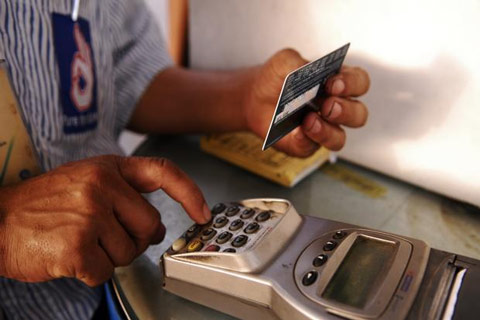
Have you faced a situation where a merchant, say, a grocer, has asked you to pay extra because you wanted to pay using a card? That is because for every card swipe at a point of sale (PoS) terminal, the grocer has to pay a fee that is calculated as a percentage of the transaction value. It is calculated using merchant discount rate (MDR). Here's more about it.
The MDR is divided up between the bankers involved in the transaction, the company that installed the PoS and the card network company. In short, the merchants and in turn the consumers, have to pay a fee to use the payment infrastructure developed by the financial institutions.
The Reserve Bank of India (RBI) has capped the MDR that can be charged from debit card users. It does not regulate MDR on credit cards: "Credit card usage is linked to the credit limit sanctioned by the issuer and carries with it an element of credit risk. Thus, given the different nature of the two products, there is no rationale for having a similar MDR for debit and credit cards," the central bank says.
If you pay a merchant using a credit card, the charge could be between nil and 2% of the transaction value, depending on the credit card you use.
In most cases, the merchant should not demand a separate charge to accept payment by cards. That is because, ideally, the merchant should account for all the costs of a product or service, and include them in price demanded.
Quantum of MDR
As per current guidelines for debit cards, MDR is capped at 0.25% for transactions up to Rs1,000 and at 0.5% for transactions above Rs1,000 and up to Rs2,000. For transactions above Rs2000, the MDR is capped at 1%. These guidelines were announced in December 2016, with the aim of facilitating wider acceptance of card payments after the demonetization of Rs500 and Rs1,000 currency notes. While they were expected to stay in force till 31 March, the RBI has extended them and they are still in force in the country.
Upcoming changes
On 16 February, the RBI issued a draft circular on rationalization of MDR for debit card transactions. The circular states that MDR will be restructured on the basis of merchant turnover, rather than the present slab rate based on transaction value. It also proposed differential MDR for government transactions. And the MDR could be different for merchants having physical PoS terminals and asset-light digital acceptance infrastructure models such as QR codes. The MDR for physical PoS terminals would be 10 basis points higher. One basis point is one-hundredth of a percentage point.
The draft also categorizes small merchants as those with turnover of less than Rs20 lakh per annum, and other merchants as those with turnover of over Rs20 lakh per annum.
The MDR structure for government transactions will not be based on percentage of value of transactions.
For government transactions, the proposal is for a flat fee of Rs5 for transaction value of Re1 to Rs1,000, Rs10 for transaction value of Rs1,001 to Rs2,000; and 0.50% for transaction value of above Rs2,001, with a cap of Rs250.
MDR for debit cards at fuel stations will be decided later after the industry consultation with the oil ministry, the draft circular said.
In arrangement with HT Syndication | MINT
Ask Value Research 

 New episodes every Friday


 New Process Alert
 Seems like you've uploaded a wrong QR code. Please upload the QR code downloaded from MF Central platform.


