


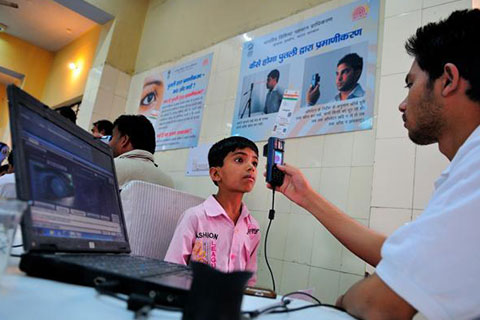
With an intention to use Aadhaar for all government schemes, the Centre last week notified all sections, but one, of the Aadhaar, (Targeted Delivery of Financial and Other Subsides, Benefits and Services) Act, 2016. This means that Aadhaar has received a legal backing to be used in social welfare schemes and to disburse subsidies as well.
The Supreme Court had last year ruled that use of this system will not be mandatory and can only be extended to services like transfer of cooking gas subsidy, Jan Dhan Yojana, and Mahatma Gandhi National Rural Employment Guarantee Act. The ambit has slowly increased as it is seen as a valid document in daily financial life as well.
If you don't have an Aadhaar number yet, should you apply for one, as it looks set to become a key validation and verification document? Here's a look at Aadhaar's usage in availing financial services.
Use in transactions
Taxation: You can e-verify income tax returns with the help of Aadhaar. You need to link your Aadhaar and Permanent Account Number (PAN) to the income tax department's website with the help of a one-time password (OTP). However, it is important that the details such as name of the person on PAN and Aadhaar are same. Any difference, even in the spelling, may make it impossible to link the number. "It is not a mandatory element, but the government is looking to make the system more convenient for a taxpayer.from e-KYC to verification, Aadhaar will be a strong requirement to do business with the government," said Archit Gupta, founder and chief executive officer, ClearTax.com, an online tax filing company.
According to the company, of the total number of e-verified income tax returns (ITRs) of 16.8 million this year with the tax department, around 7.77 million verifications were through the Aadhaar-PAN linked system.
Mutual funds: Aadhaar-based e-KYC has been facilitated by the Securities and Exchange Board of India for mutual funds. The procedure needs an OTP and Aadhaar. "There are some restrictions. If you do e-KYC through Aadhaar, you cannot make large-value investments due to limit of Rs 50,000 per year," said Vishal Dhawan, founder and chief financial planner, Plan Ahead Wealth Advisors.
Banking: It is mandatory for customers to provide certain details to comply with know-your-customer (KYC) norms. To make this process paperless, the Reserve Bank of India had introduced Aadhaar-based e-KYC, which substitutes the need to submit multiple documents . Instead of giving separate proofs for ID and address, among others, a single document can replace all these requirements. To open a Jan Dhan Yojana account, one can simply use only Aadhaar as well. "It (Aadhaar) also helps in keeping track of the various schemes and programmes the government runs along with the beneficiaries," said Adhil Shetty, chief executive officer and co-founder, Bankbazaar.com
Payments: Last week, there were reports that Aadhaar was going to be made mandatory to book railway e-tickets from December. A senior railway official, associated with the developments, clarified that it will not be in December. The Railways has been cracking down on fraudulent bookings with measures such as different timings for tatkal bookings, among others. Aadhaar-based booking may be a step in that direction.
What you should do
It would be prudent to apply and get an Aadhaar if you don't have it already. You can visit the nearest enrolment centre along with proof documents and get your biometrics registered as well.
While not mandatory, experts recommend getting this card to benefit from smoother transactions.
In arrangement with HT Syndication | MINT
Ask Value Research 

 New episodes every Friday


 New Process Alert
 Seems like you've uploaded a wrong QR code. Please upload the QR code downloaded from MF Central platform.


