


The June quarter GDP (gross domestic product) numbers are largely inconsequential, as everybody is focused on growth in the second half of the current fiscal year, when it is expected to accelerate, thanks to the good monsoon and a hike in central government salaries. Nevertheless, a few questions are in order
1. Is the growth trajectory holding firm?
It depends on whether your preferred yardstick is GDP or gross value added (GVA). Real GDP growth has slowed from 7.5% in the June quarter last year to 7.1%. On the other hand, real GVA growth has moved up slightly, from 7.2% in June quarter last year to 7.3%.
Why is GDP growth lower than GVA growth? GDP is GVA plus taxes less subsidies, so taxes may have been lower in the June quarter, perhaps on account of refunds. It's also possible that with the pressure on the government to spend more on the national rural employment guarantee scheme, subsidies may have risen. This effect will wear off as the year progresses.
Recall that the Reserve Bank of India (RBI) has said we could see a slowing down of real GDP growth as wholesale prices rise, because the Wholesale Price Index is used as a deflator in computing GDP at constant prices in some sectors.
2. Which sectors drove growth during the June 2016 quarter?
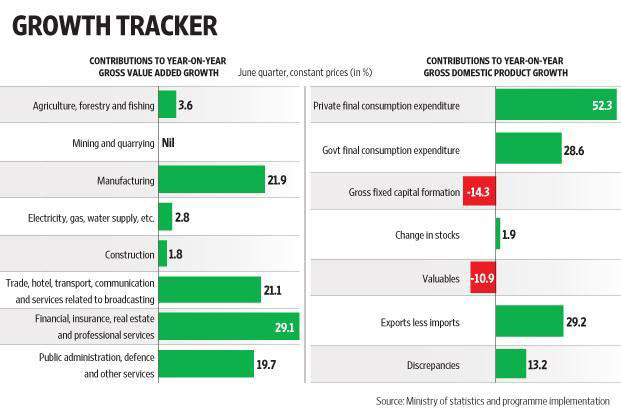
The chart has the details. Services were clearly the driver, accounting for 71.7% of the year-on-year growth (taking construction as part of services) of GVA at constant prices. The highlight here was the 19.7% contribution of "public administration, defence and other services", which means that government spending was very high. Manufacturing growth was strong, accounting for 21.9% of the GVA growth. Growth in construction was pathetic, which implies that job growth for the masses was dismal.
On the expenditure side, as the chart shows, consumption (both private and government) contributed four-fifths of the growth in GDP. Government consumption contributed a high 28.6% of GDP.
While capital formation fell from a year ago, the external sector (exports less imports) contributed as much as 29.2% of GDP growth at constant prices. Independent economist Gaurav Kapur says this indicates a current account surplus in the June quarter. That would imply domestic savings being higher than investment. The fall in investment shown in the GDP numbers would also imply that, while the rise in domestic savings indicates the RBI policy of keeping real rates positive is working.
3. Have discrepancies as a percentage of GDP come down?
Yes. In the June quarter, they were 0.9% of GDP at constant prices, compared to 4.8% in the March quarter. They accounted for 13.2% of the GDP growth in the June quarter.
Note, however, that discrepancies amounted to a negative 3.4% of GDP at current prices in the June quarter. So discrepancies were a negative 3.4% of GDP at current prices and a positive 0.9% of GDP at constant prices.
4. What is inflation according to the GDP deflator?
Inflation according to the GDP deflator is 3.2% in the June 2016 quarter, well above the 1.2% in the June 2015 quarter.
Inflation according to the GVA deflator is 2.5%, while it was slightly negative in the June 2015 quarter.
5. Will IndAS make a difference to value added?
Since the GDP data now takes into account value added in the corporate sector, the change in company accounting standards by the adoption of IndAS could lead to a change in the macro numbers as well. Says Dhananjay Sinha, head of research, economist and strategist at Emkay Global Financial Services Ltd, "Value addition will undergo a change based on how you are accounting for various items, such as provisions.
Also when you aggregate accounts across group companies, some changes appear. So it does appear that corporate numbers could undergo a change and from that standpoint, it does affect GDP numbers." Differences in the recognition of income could also affect the value added numbers. The June quarter results show that companies have had to restate their sales, and operating profit and net profit numbers as a result of the changes in accounting standards.
These changes may also impact GDP calculations. If they do, the question of comparability of data with earlier periods will also arise.
In arrangement with HT Syndication | MINT
Ask Value Research 

 New episodes every Friday


 New Process Alert
 Seems like you've uploaded a wrong QR code. Please upload the QR code downloaded from MF Central platform.


