


The reforms of July 1991 unleashed the creative spirits of Indian business and society. They also created a new world whose true inheritors came from a generation born in a rapidly developing India. Here are the stories of eight such young women and men, the children of liberalization.

Meghdut Roychowdhury
Date of birth: 19 October 1991
Profession: Entrepreneur
All of 24, Meghdut Roychowdhury has already visited 35 countries without financial support from his parents. He spent a summer at Stanford University learning about business management and is headed for Tel Aviv to finish his MBA as part of an exchange programme from HEC, Paris.
His story might have been very different had he not gauged the need for a production house for budding musicians in his home town, Kolkata, when he was only 19, which led to his founding BlooperHouse Studios.
"I am not a musician but I have a good ear and I know what will sell. Also, the bigger music production houses were too expensive for the city bands that had everything but money to make it to the charts," explains Roychowdhury.
Roychowdhury's family owns the Techno India Group which runs universities, engineering colleges and business schools. When asked why he chose to go abroad to finish his education, Roychowdhury said, "I wanted to understand how accelerators around the world operate so that I could build the same for tech students in Kolkata." He wants to build an accelerator platform based on a crowd-funding model to fund tech start-ups.
"I don't know which particular change in India's economic policy has helped me do the things I am doing right now, but I am sure without the 1991 reforms, I wouldn't have achieved this global perspective and made friends who I also see as future business contacts from 135 countries," says Roychowdhury before wrapping up the Skype session with us from a student hostel in Prague where he is working as a 'Happiness Manager', an opportunity he got from a backpacking forum on the Internet.
- Preetha Banerjee
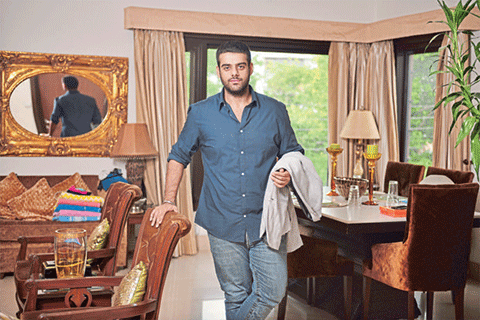
Hritik Sachdeva
Date of birth: 31 July 1991
Profession: Family business
It took an economics textbook in class XI for Delhi-based businessman Hritik Sachdeva to understand the magnitude of economic reforms. "I had not heard of liberalization until I chose to study commerce in school. I remember studying a chapter on LPG (liberalization, privatization and globalization) in India in the early 1990s and things fell into context," says Sachdeva.
Born into a family of businessmen, Sachdeva's early exposure to liberalization prompted him to look beyond his family business. With plans of settling abroad, he went to Singapore in 2010 where he studied International Business Management at Management Development Institute of Singapore which is affiliated to Southern Cross University, Australia.
Sachdeva was interested in hotel management but losses in the family business forced him to return after graduation.
"I loved cooking but my father made it clear that he would not give me a penny for anything but construction work. I needed the money, he needed my support. However, it was only after working with him that I realized how much things had changed over the years," says Sachdeva, who has been working in his father's company-Swift Infrastructure Pvt. Ltd-for three years.
After the 1991 reforms, not only did import duties come down but more and more foreign companies started setting up plants in India. "Working with foreign companies is much easier and gives you more exposure and scope for expansion," explains Sachdeva.
Have the plans of settling abroad and opening his own restaurant been put on hold?
"For the near future, yes," says Sachdeva.
- Meenal Thakur

Riku Sharma
Date of birth: 25 July 1991
Profession: Public relations professional
Riku Sharma's earliest memories of Shillong in the nineties are as hazy as the mist that swathes the tiny hill station. "I was too young then to remember much," he says on a call from Delhi, where he now lives and works, "But what I remember is the scenic beauty of the place".
It is still beautiful, of course, but things have changed considerably, says Sharma, who graduated from St Anthony's College in Shillong, "The most significant difference is the change in the land use pattern," he says. "We needed it. Development in Shillong has really boosted tourism," he adds.
His understanding of economic reforms is merely a textbook one., "We had a chapter on LPG (liberalization, privatization, and globalization) in high school but it never has really affected me directly," he says.
His father who grew up in Assam did not have the luxuries he has, admits Sharma. "He had to work in a cycle repair shop for a meagre amount of Rs.3 to pay for his school fees and books." Later, he struggled to establish a business too, adding that ultimately, his father opted to go for a government job and was posted to Meghalaya in 1984.
Sharma believes that the reforms have catalyzed growth and it will only get better. Of course, this development comes at a price. "I remember my father talking about the cheap fares in public transport. His first salary was only Rs.365 and he was still able to save," says Sharma, adding that though he earns around hundred times more, he finds it difficult to save.
- Preeti Zachariah

Suyasha SenGupta
Date of birth: 7 August 1991
Profession: Singer
Lead vocalist of the popular band, 'The Ganesh Talkies', SenGupta was born in Kolkata in 1991. "Our genre is alternative rock/pop/dance, but our aesthetics are heavily Bollywood since we've grown up watching a lot of Bollywood movies and have heard too many Bolly-movie original soundtracks on radio and television," says SenGupta. Born to parents who are stereotypically "inclined towards culture", she feels privileged to have had their support when she ventured to do something 'off-beat', and dropped out of a coveted master's programme in modern history from Jawaharlal Nehru University. "They don't necessarily understand my lifestyle and my career choices, but they do have my back," she adds.
"I am not sure about the exact reforms made in 1991, but I think we millennials have benefited greatly from this because we're a part of a global world and as artists, it sort of puts us all on the same platform," she adds.
She also feels the music scene has benefited greatly because there is now an industry and first-generation professionals working to make this a permanent development.
"Take for example, OML (Only Much Louder), the company that my band is currently managed by. Vijay (Nayar) started out managing bands when this so-called 'scene' was still at a nascent stage and today, these guys are responsible for bringing the concept of international festivals (NH7 Weekender) to India. The very fact that something like this can now happen in India is due to economic liberalization and the freedom of open markets," she says.
- Preetha Banerjee

Kedar Singh Deshmukh
Date of birth: 12 July 1991
Profession: Automotive design engineer
Kedar Singh Deshmukh, born in Mongri village of Chhattisgarh's Balod district, is the youngest son of a farmer who didn't want his three sons to take up agriculture as a profession. "My father is a farmer who produces rice just a bit more than what is needed for the survival of our five-member family". So, Kedar went on to do his diploma from Central Institute of Plastics Engineering and Technology (CIPET), Bhopal. He now works as an automotive design engineer for Noida-based Samvardhana Motherson Group, and is currently deputed in Germany. He also holds an AMIE (Associate Member of Institution of Engineers) certification in mechanical engineering from The Institution of Engineers (India), Kolkata.
The pre-liberalization era for Kedar is fused into the stories his grandmother told him which referred to anna in the context of money. He remembers travelling by train in his early years as a child. "Those days, the seats of the train were made of wood," he adds. "While I waited for the train at the station which is two kilometres from my village, the number of bell rings by the station master indicated the arrival of the train. Now, when I travel, the seats have changed; purified drinking water, automated announcements and printed tickets are all new. One thing that hasn't changed is I still see people begging inside the train."
"Liberalization has done good things to a section of people but one size doesn't fit all," emphasizes Deshmukh, who also admits that better opportunities have helped him shape his education and career.
- Dharani Thangavelu

Mohammed Iqbal
Date of birth: 8 April 1991
Profession: Model
Mohammed Iqbal Salim is a model working with big names such as Manish Malhotra and sharing the stage with the likes of Deepika Padukone and Fawad Khan. After establishing himself as a professional in Kolkata and having walked the ramp at all the big banner fashion shows, he is now trying to carve a niche for himself in Mumbai.
"My knowledge about the economic reforms of 1991 is limited but I think it has had a good impact on the Indian middle class and hence, on me," he said when asked about what liberalization means to him.
But he feels that one major boon of the reforms has been the ease of communication. "My mother often tells me the story of how, after getting engaged to my father, they used to communicate through letters because there were no mobile phones and the one landline that the house had would always be in use by some family member. Today, when I close major work deals with someone from another city sitting in Kolkata, I realise how privileged I am to be born after liberalization," he adds.
Another thing he believes reforms have helped achieve is taking Indian talent to global heights. "Be it music or any art form, liberalization has made it easier for artists to collaborate from different parts of the world. An example could be how Priyanka Chopra has become an international icon," says Iqbal, admitting that he wants to be the next Shah Rukh Khan!
- Preetha Banerjee

Raunaq Kalia
Date of birth: 13 September 1991
Profession: Content marketer
Content marketer Raunaq Kalia is the quintessential child of liberalization who slogged at school to get straight As so that his parents would take him out to McDonald's. Eating out was a luxury in the early 90s and Kalia recalls his parents working hard, saving even harder and generally being risk-averse. "Our generation, on the other hand, is the risk-loving start-up generation which parties every Friday, spends a lot more and is barely saving enough. Mindsets have changed and so have our priorities," says the former business analyst at Wipro Ltd.
Pre-liberalization, life was simple, people had strict routines and expectations were straightforward-get good grades, find a stable job (preferably a government one) and start a family. There was minimal exposure in terms of career choices, financing options for going abroad to study or even when it came to single parenting or live-in relationships, says Kalia. Today, things are different. Life is more complicated, and the conversations on TV and social media far more liberal, says Kalia, who loves to eat out and party.
"Reforms changed our generation's way of life. The standard of living, the exposure, media, entertainment, everything has changed drastically. McDonald's used to be the classic example when we were kids but now you see every existing brand across categories has a dedicated store or is selling products online. I think the most important aspect of this change is choice and access," he says.
Globalization has given Kalia's generation immense choice and access to opportunities that probably no other generation could even think of, irrespective of their financial standing or social stature. "My peers are working at the most successful multinationals, which wouldn't have been possible with a closed economy," he adds.
- Nandita Mathur

Nikhil Hegde
Date of birth: 25 July 1991
Profession: Medical student
Nikhil Hegde, a student of orthopaedics at Kasturba Medical College, Manipal, first heard of liberalization in the early 2000s when his parents, Thimappa Hegde, a neurosurgeon, and Chetana Hegde, a biology school teacher, were discussing the dramatic changes in lifestyles and wider access to pretty much everything in Bengaluru.
For Hegde, weekend outings had expanded beyond Brigade Road, Vidhana Soudha and Lal Bagh botanical gardens with the emergence of the mall culture and a vibrant nightlife in the city, a direct by-product of the economic reforms of 1991.
"I remember the city was less noisy when I was growing up, the traffic was less and so were the number of people. You could hear more Kannada-speaking people on the roads; now there's a diverse and multi-cultural mix of people," he says.
Hegde's family bought their first car, an international brand-a Skoda Octavia-in the early 2000s, which is when he got his first computer as well.
While Hegde always knew he wanted to become a doctor, when the time came to take the final call, he had many options to pick from. He considered becoming a pilot or a sports writer, among other unconventional career options.
Hegde is optimistic about his future prospects in the country.
"I would want to continue living here. There is good enough scope for growth," says the medical student who will graduate in 2019. But a few years abroad for further studies and experience wouldn't hurt either, he added.
- Vidhi Choudhary
In arrangement with HT Syndication | MINT
Ask Value Research 

 New episodes every Friday


 New Process Alert
 Seems like you've uploaded a wrong QR code. Please upload the QR code downloaded from MF Central platform.


