


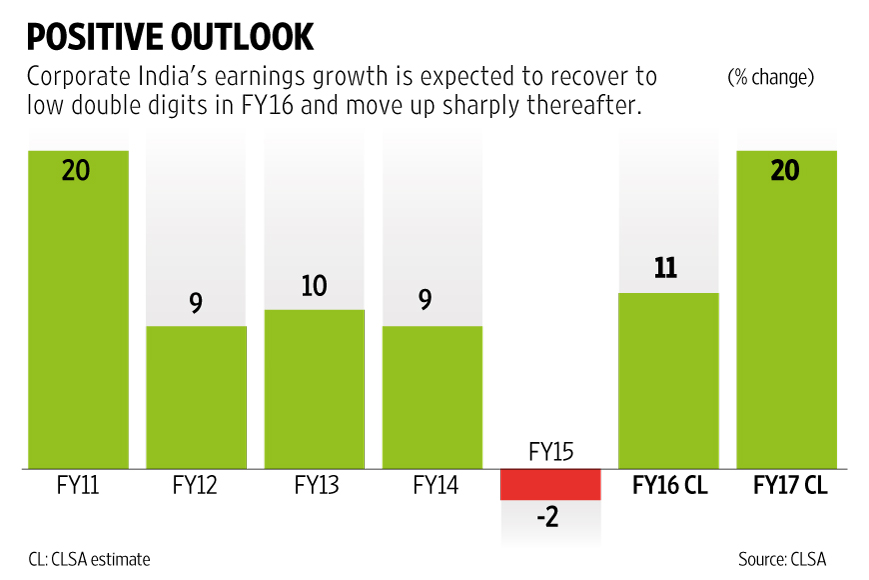
Corporate India's earnings growth is expected to recover to low double digits in FY16 and move up sharply thereafter, bringing an end to the earnings downgrades cycle which began from FY12, as you can see from the chart compiled by CLSA Research.
In each of the past six years including the first two quarters of this year, the actual earnings growth has been 6-15 percentage points lower than analysts' estimates in the beginning of the year. That could be because of several factors. The first is that sell-side analysts are an overly optimistic lot. Next, they overestimated the ability of the Modi government to turn around the ailing economy. Moreover, the slump in demand from commodity producing countries due to the oil rout and two consecutive years of weak monsoon hurt revenue growth in many Indian companies. The current fiscal year has been among the worst, with 15% earnings downgrade on the back of across-the-board downward revisions seen in the metals, capital goods and cement businesses and in public sector banks.
In a note dated 10 December, CLSA said it believed its FY17 earnings growth estimate of 20% has not more than five percentage point downgrade risk and hence growth would be far better than the 7% average earnings growth seen over the past five years.
Kotak Institutional Equities in a note dated 11 December said cuts in earnings estimates should largely be done by the March quarter of the current fiscal year and FY17 earnings growth should settle at around 15%.
What will drive earnings growth in 2016? Earnings will get a boost from the ongoing recovery in urban consumption, led by a steep 24% wage hike for government employees once the Seventh Pay Commission recommendations get implemented. As central government employees start spending more, it will trickle down to improvement in sales for consumer goods and auto companies. This will boost earnings, eventually increasing the capacity utilization rates of auto and industrial sectors, said Tushar Pradhan, chief investment officer of HSBC Global Asset Management India Pvt. Ltd. If the monsoon turns out normal next year, that would boost rural demand.
While the government has made some efforts to spur public spending through roads and railways, private sector investments remain lacklustre. Therefore, any visibility on government boosting investments during the budget will be important to watch out for. But much depends on the fiscal stance-whether the government will be willing to raise the fiscal deficit. If they stick to the 3.5% target for FY17, it would have a contractionary effect on the economy. Global growth is unlikely to be robust and companies depending on foreign revenues may not see much of a recovery.
With the prospect of US Federal Reserve hikes looming over the markets, with the continuing tail risk of a stumble in the Chinese economy and with fading hopes of structural reforms in the Indian economy, market performance will hinge on earnings growth rather than any increase in the price-to-earnings multiple.
In arrangement with HT Syndication | MINT
Ask Value Research 

 New episodes every Friday


 New Process Alert
 Seems like you've uploaded a wrong QR code. Please upload the QR code downloaded from MF Central platform.


