Recently Viewed
Clear All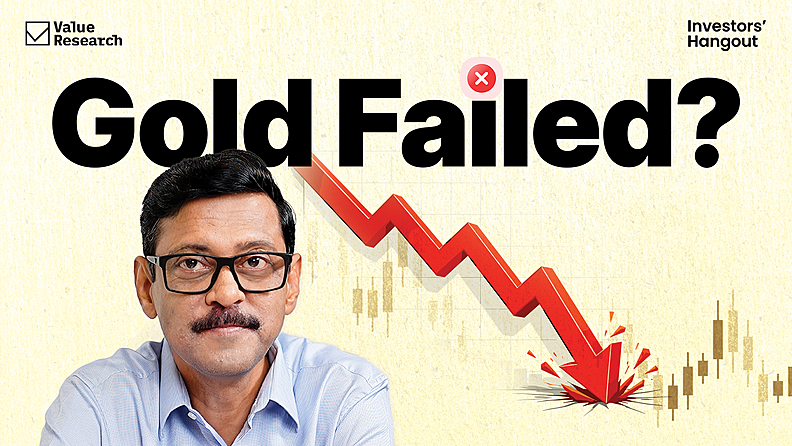

Powered by
Investors' Hangout | By Dhirendra Kumar | 03-Apr-2026

Why Gold Failed Its Biggest Test
Gold fell 20 per cent during the war due to central bank selling. Understand the real reason behind the fall and what it means for your SIP, portfolio allocation, and long-term strategy.
Gold peaked near $5,600 in January and has since dropped to around $4,400. That is a 20 per cent fall in four months, during an active war. If you bought gold thinking it would protect you in exactly this kind of situation, this video tells you what actually happened and what to do next. If you want the full picture on how much gold makes sense as portfolio insurance versus performance chasing, this piece by Dhirendra Kumar on the right gold allocation for your portfolio is a good place to start.
Gold surged because of central banks, not because investors were nervous. After the West froze Russian assets following the Ukraine war, countries including China, Poland, India, Turkey, and Kazakhstan collectively bought around 1,000 tonnes of gold over three straight years. The logic was straightforward: if your dollar reserves can be frozen, you diversify into something no one can freeze. That buying pushed gold up sharply. Now some of those same central banks are selling gold to raise liquidity for war spending. When sellers of that scale enter any market, prices fall just as decisively as they rose.
This matters for you because the fall has nothing to do with gold becoming a weaker asset. It has everything to do with who was driving it up and who is now driving it down. Most ordinary investors bought gold in recent months for the wrong reason. They were not buying insurance. They were chasing a rally that central banks created and that central banks have now partly reversed.
Oil is a different conversation entirely. When Middle East conflicts push oil above $100 a barrel, the instinct is to treat oil like gold and look for ways to profit. That instinct is wrong. Gold is a monetary asset. Oil is a commodity. Gold reflects trust in financial systems. Oil powers physical economies. When oil supply gets disrupted, prices spike, and those higher prices create inflation, which forces central banks to keep interest rates elevated, which hurts equities. An oil shock has real ripple effects across every industry. It is not a financial signal you hedge. It is an economic event you ride out with a diversified portfolio.
Trying to hedge oil through petroleum company stocks is harder than it looks. Most Indian oil companies operate across the full value chain, from exploration through refining. When crude prices rise, their refining margins do not always follow. For an investor running a Rs 5,000, Rs 20,000, or Rs 50,000 monthly SIP, taking a tactical position on oil is not a hedge. It is a bet. That is exactly what you pay a fund manager not to force you to make.
What a Crisis-Ready Portfolio Actually Looks Like
What is your asset allocation? Not what you intend it to be. What it actually is right now. In the last four to five years of rising markets, most investors have not tested their real risk tolerance. The honest test is simple. If looking at your portfolio value before sleeping means you cannot sleep, your equity allocation is too high for your actual comfort level. That is not a philosophical point. It is a practical instruction: reduce equity until the anxiety stops.
The second step is to look at what you own. If your portfolio holds thematic or sectoral funds you bought because they were trending, this downturn will hurt more than a diversified fund would. Fix that before the market recovers, not after. Move toward diversified equity funds managed by fund managers who track these positions daily, so you do not have to.
Gold belongs in this portfolio in a small, deliberate allocation. Think of it the way you think of a fire extinguisher in your kitchen. You buy it once. You put it away. You hope you never need it. You do not buy it because your neighbour's kitchen caught fire and gold went up 30 per cent. Gold as insurance means you own a small position that holds value when everything else in your portfolio is falling. It is not there to deliver returns. It is there to protect the floor.
For investors already one or two years into their SIP, this fall creates an opportunity. You are buying the same diversified equity funds at lower prices. Your monthly SIP is now buying more units for the same rupee amount. This is the exact mechanism that makes long-term SIP investors wealthier than one-time lump-sum investors. The discomfort you feel watching the market fall by 1 per cent or half a percent every other day is the price you pay for that compounding advantage. To understand how rebalancing at this point can work in your favour without triggering unnecessary tax costs, this explanation of how to shift equity allocation while rebalancing walks through the mechanics clearly.
Once you have watched the video, these tools will help you take action. Use the SIP Calculator to see exactly how your monthly amount compounds across different time horizons. The free investment reports give you independent analysis without any sales framing. For broader planning tools including goal-based and retirement calculators, the full calculators section covers most scenarios a salaried investor will face.
Investor’s Questions:
Why did gold fall 20 per cent when there is a war going on?
Gold fell because central banks, not war-related fear, drove both the rally and the reversal. Between 2022 and early 2025, central banks in China, Poland, India, Turkey, and Kazakhstan collectively bought around 1,000 tonnes of gold. The trigger was the freezing of Russian assets, which signalled to reserve managers worldwide that holding dollar reserves carries political risk. When those same central banks began selling gold to fund war-related spending, prices fell sharply. A war cannot offset selling pressure at that institutional scale. The war precipitated the selling but did not cause the original rally.
Should I sell my gold now that prices are falling?
If you bought gold as deliberate portfolio insurance, hold it. Selling now converts a paper loss into a real one for no structural reason. If you bought gold because it was rising and you were afraid of missing out, that was performance chasing, not insurance. In either case, the answer is not to sell in panic. Decide clearly what role gold plays in your portfolio. Size that allocation deliberately. Then leave it alone. The right gold position is small enough that its short-term price moves do not threaten your financial plan.
Is oil a good crisis hedge for retail investors in India?
No. Oil is a commodity, not a monetary asset, and behaves very differently from gold. When oil prices rise because of a supply disruption, the cost increase flows through every industry. It raises inflation, which forces central banks to keep rates high, which hurts equities and slows growth. Most Indian oil companies span exploration and refining, so their profitability during a crude spike is not straightforward to predict. For a salaried investor doing SIPs, trying to hedge oil through petroleum stocks is a tactical bet with unpredictable outcomes. A diversified equity fund managed by a professional is the better vehicle.
What should I do with my SIP if markets keep falling?
Continue your SIP without pause. Every time the market falls, your monthly investment buys more units for the same amount. This is rupee-cost averaging working exactly as it should. The investors who build the most wealth from equity SIPs are those who stayed invested during downturns, not those who paused and waited to feel comfortable again. If the volatility is genuinely affecting your sleep, that signals your equity allocation is too high. Adjust the allocation. Do not stop the SIP.
What is the right amount of gold to hold in my portfolio?
Gold should be a small, insurance-style allocation in a diversified portfolio, not a primary investment. Its job is to hold or gain value when equity and fixed income are both under stress simultaneously. A large gold allocation means you are betting on its price performance rather than using it as a buffer. For most salaried investors, a modest position rounds off the portfolio without distorting its long-term return potential. The key framing: buy it once with intention, size it for protection, and do not add more because prices are moving.
How do I know if my portfolio is ready for sustained volatility?
The real test is whether checking your portfolio value causes you to lose sleep. That is not a metaphor. If your investment values are affecting your daily decisions or your rest, your equity allocation is higher than your actual risk tolerance, regardless of what your intended allocation is. A crisis-ready portfolio is built on four things: a deliberate asset allocation between equity and fixed income, diversified rather than thematic equity funds, a small gold position for extreme scenarios, and the discipline to rebalance toward equity when prices fall rather than away from it.
What is the difference between buying gold as insurance and chasing gold as a trade?
Gold as insurance means you own a fixed, small position you rarely touch. You buy it once, at a considered allocation, and it sits in your portfolio doing its quiet job. Gold as a trade means you bought it because it was rising and you expected it to keep rising. By the time a rally is obvious enough to feel safe, you are often buying near the peak. Most retail buying in early 2025 was a trade framed as insurance. The 20 per cent fall that followed is the cost of that confusion. The correction changes nothing for investors who held gold the right way. It changes everything for those who held it for the wrong reason.
Disclaimer: This page is based on a video by Dhirendra Kumar, founder of Value Research, who has tracked Indian markets since 1992. Value Research is an independent, SEBI-registered investment research platform. This content reflects the video's analysis and is not a personalised investment recommendation.
Other Videos


3 Things to Do Before April 1
27-Mar-2026 · 50,870 Views

SEBI's New Rules: What They Mean For You
20-Mar-2026 · 45,563 Views

War, Wealth & What To Do
13-Mar-2026 · 29,998 Views

Women & Wealth: Why Earning Isn't Enough
06-Mar-2026 · 10,217 Views

Multi-Asset or Aggressive Hybrid: Which One Fits You?
27-Feb-2026 · 17,528 Views

SWP & Bucket Strategy for Retirement
20-Feb-2026 · 36,228 Views

NPS Changes 2026: Annuity Escape & Tax Benefits
13-Feb-2026 · 20,921 Views

CAGR vs XIRR vs Rolling Returns: Which Matters?
06-Feb-2026 · 21,749 Views

Union Budget 2026: Investor Checklist
01-Feb-2026 · 15,295 Views

Is ₹5 crore enough for your retirement?
23-Jan-2026 · 29,398 Views

Your first ₹1 Crore Plan
16-Jan-2026 · 62,437 Views

How to Gift Mutual Funds Today
09-Jan-2026 · 21,355 Views

The Only Mutual Fund Advice That Matters in 2026
02-Jan-2026 · 69,950 Views

Outliers, Laggards & the Cost of Chasing Past Performance
26-Dec-2025 · 28,123 Views

Best Mutual Funds for Senior Citizens (3-5 Year Goals)
19-Dec-2025 · 58,807 Views

Your Fund Isn't Performing. Should You Switch?
12-Dec-2025 · 33,645 Views
 New Process Alert
 Seems like you've uploaded a wrong QR code. Please upload the QR code downloaded from MF Central platform.


