





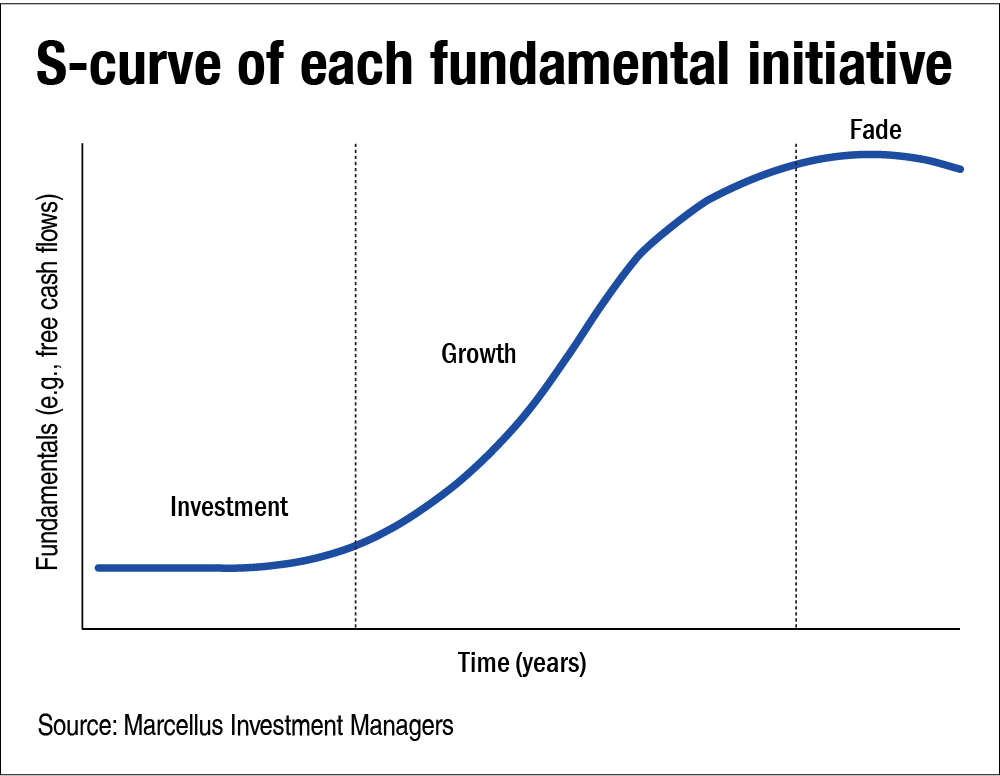
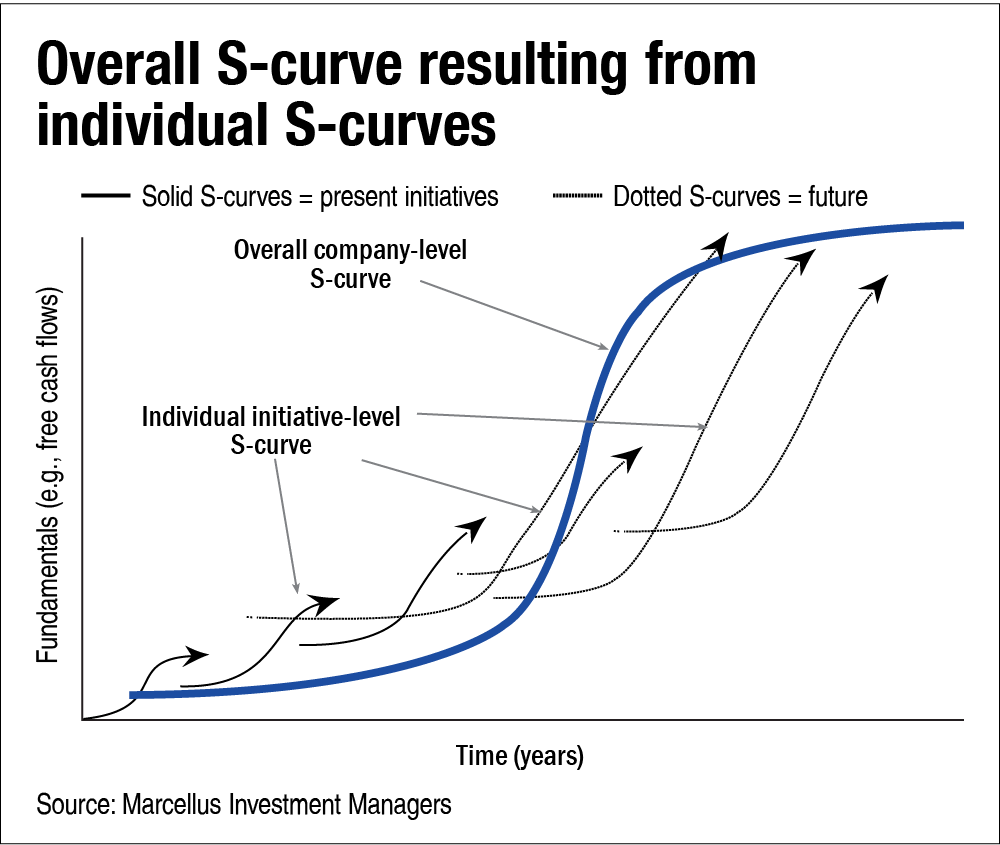
Every successful fundamental initiative that a company undertakes broadly consists of three stages - 'initial investment', 'growth', and 'fade', as depicted in chart 'S-curve of each fundamental initiative'. The longevity and pace of growth of an initiative is defined by the slope, height and shape of the fade of its overall S-curve. The fundamentals of the overall business can be treated as an overall S-curve, which is nothing but the consolidation of all individual S-curves pertaining to each initiative the business undertakes (see chart 'Overall S-curve resulting from individual S-curves').
Challenges organisations face as they grow bigger
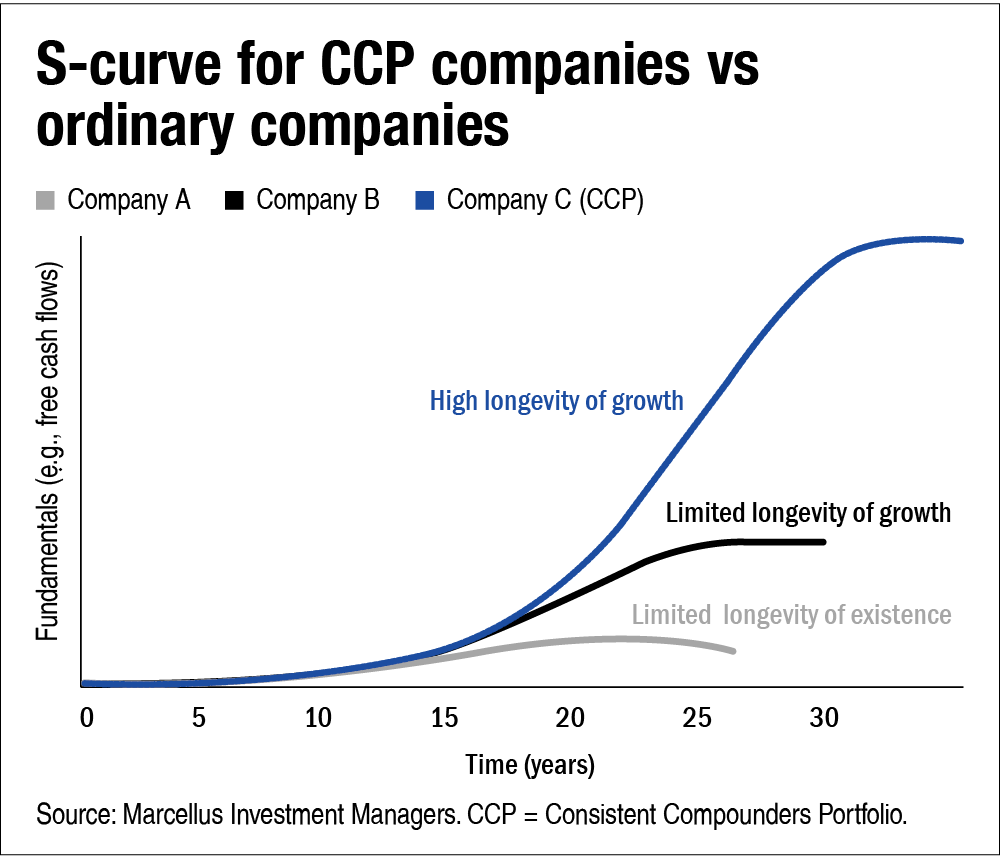
A 2012 study by Richard Foster at the Yale School of Management suggested that the average lifespan of an S&P 500 company in the US has fallen from 67 years in the 1920s to just 15 years. This is a global phenomenon. Of the 100 companies in the FTSE 100 in 1984, only 24 were still operating in 2012. However, there are also a few companies in every country that continue to survive and grow their fundamentals at a healthy rate consistently over several decades. Effectively, as shown in chart 'S-curve for CCP companies vs ordinary companies', these companies (curve 'C') deliver greater longevity of growth. ('CCP' stands for Consistent Compounders Portfolio'.)
There are several factors that limit the longevity of growth for a company. For example:
- Limited size of the addressable market: Growth drivers for companies in several industries include penetration of consumption, frequency of consumption and increase in market share. There are limits to all three of these factors. For instance, three decades ago, India's toothpaste industry was underpenetrated (a large part of the population was not a consumer of toothpastes), with low frequency of consumption (several consumers of toothpastes used the product only once a day), and fragmented market shares. This offered a massive growth opportunity for a company like Colgate in India. However, with 90 per cent penetration of oral care, 60 per cent market share of Colgate and rising frequency of consumption, the saturation of the addressable market now offers limited growth potential in the toothpaste industry.
- Diseconomies of scale and scope: As organisations grow, they suffer from diseconomies of scale because the business becomes too complex to manage and grow further. Authors Marco Iansiti and Karim Lakhani summarised this in their book 'Competing in the Age of AI' (2020): "When organisations expand, they become increasingly complex and difficult to manage, so they build bureaucracies and inefficiencies, and they embed norms, incentives, and rewards-and each of these fosters inertia. With too much scale, too much scope (variety), or too much demand for learning and innovation, any managerial process will eventually stop working well, leading to inefficiency and even failure. Plants reach an optimal size and then become unwieldy to organise and manage. Restaurants reach a maximum size and scope, as their customers and menus begin to overwhelm the staff's capabilities and systems. Even R&D organisations and product development teams can grow too big, and their productivity and innovativeness are known to suffer as a result. These considerations shape the maximum efficient scale of an organisation and impose overall limits to its growth."
- Competitive intensity: The more successful a company becomes, the more competitors it attracts who attempt to eat into the profit pool created by the successful incumbent. As a result, companies with weak pricing power either undergo deterioration in their profitability or loss of market share in the wake of rising competitive intensity. For instance, a firm like Colgate has frequently faced price wars from new entrants like Patanjali (2015) and incumbents like Hindustan Unilever (Pepsodent and Closeup) and Dabur (Red and Meswak).
- Disruptive and evolutionary changes: Innovative technologies, digitisation, automation, machine learning, artificial intelligence - all these themes have been a significant source of disruption over the last decade. Evolution in the economic landscape has consistently brought changes to the way companies have added value to customers in an industry. For instance, in the global automotive industry, Ford established its dominance by introducing mass production with the first moving chassis assembly line in 1913 that transformed manufacturing by increasing scale. However, through the 1950s and 1960s, General Motors won market share from Ford by increasing the scope of offerings through product-specific assembly lines. This was followed by market-share gains by Japanese carmakers like Toyota. The next phase of evolution is underway as electric vehicles, autonomous vehicles and ride-sharing apps see increased adoption.
There is more to the story:
S-curves: Investment implications
This article was originally published on January 18, 2022.
Ask Value Research 

 New episodes every Friday








 New Process Alert
  Seems like you've uploaded a wrong QR code. Please upload the QR code downloaded from MF Central platform.


