 Widely read:


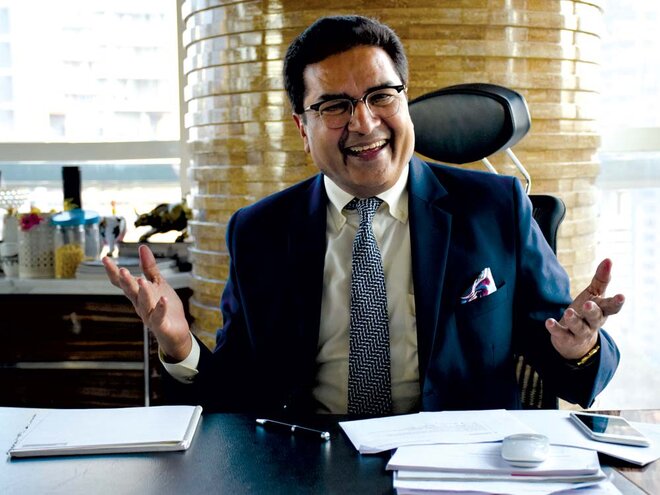
Blessed with an affable and practical approach, stock-market veteran Raamdeo Agrawal can stump you with his one-liners. Having seen the Indian markets evolve over the last 30 years, Agrawal, 60, has had the privilege of seeing both the primitive and the prime. In an interview with Kumar Shankar Roy, Raamdeo Agrawal or RA - as he is fondly addressed by colleagues - talks about the drastic shift in his investment thinking after he came across Warren Buffett, the reasons he bought multi-baggers like HDFC Bank, Eicher Motors and IndiGo, and why he always tries to understand the number of years a company will take to earn its current market capitalisation. How do you assess the magic of entrepreneurship when it comes to investing in a company? Assessing entrepreneurship is like assessing the company's potential. It's about understanding the person behind the company. I want to find out who the entrepreneur is, what he has done and what has been his upbringing. Upbringing is important because we must know whether the entrepreneur comes from a lower or upper middle class. Most successful entrepreneurs in India have come from a very modest background. Their educational background is also extremely important. How the entrepreneur advanced in terms of education shows the desire to progress. Next, I look at how the entrepreneur started the business. Typically, a first-generation entrepreneur has some skill, knowledge or some circumstantial opportunity because of which he ended up starting the business. Sometimes one has a big dream and this acts as the prime driver for starting a business. So, all entrepreneurial stories are in essence a piece of art. Human perseverance, ambition, passion and competence are required to build an enterprise. The word 'passion' carries a lot of weight. It's a key differentiator. Is the entrepreneur looking for retirement cheque or does he wan to make a company go from x to 10x. Typically, I have seen companies become what they want to become. But if the desire to make it is not there, you cannot make it. It's a tough world out there, and people with big dreams convey a message. Is the entrepreneur looking for moonshots? Is it feasible? These things make a big difference in how our investment will play out. What the entrepreneur has done in the last 30 years and what his plans are for the next 20-25 years, i.e. our investment period - all this should be clearly understood. You have a track record of spotting winners early, like HDFC Bank, IndiGo and D-Mart. What made you sure about their success? Excellence in a business is something that always tells you about success. In the case of IndiGo, as a consumer, I could see how they were different. It represented excellence. IndiGo had 35-40 per cent market share and was growing at 25 per cent. One common thing between HDFC Bank and IndiGo was a large opportunity. IndiGo showed excellence not only in its business but also in its numbers. To my mind, the excellence in profits should always be there. In the case of D-Mart, I had some advantage. I knew how good the man

 New episodes every Friday

 New Process Alert
 Seems like you've uploaded a wrong QR code. Please upload the QR code downloaded from MF Central platform.


